This culture/civilization is always held up as an example of one of the most peaceful people ever that was taken advantage of by imperialism/expansion, and my understanding is that that part of the world has much more limited history, at that time and before, than say Europe or mainland Asia.
Are there any records showing any legitimate battles, wars, or squabblings among this group of people before the West came over? And if there are not enough records, then perhaps we shouldn't hold them up as such a hallmark example of an ideal/utopian society?
I'm just curious because a civilization that doesn't eventually evolve, branch out, divide, and form differences, whether in language, caste systems, economics, etc., seems totally sociologically illogical to me. Could this culture really have been as morally utopian as my highschool teachers have led me to believe?
EDIT
After reading many responses I just want to clarify that I'm not necessarily the one who believes in the fallacies of the "Noble Savage" or the concept of the "other" (though I may to some degree like everyone else), but rather I feel like those concepts have been hidden within the teachings of Native American History in school (though of course that's biased because my schooling was America/Liberal NY). Why and how have they been hidden, well I'm not entirely sure and I'd be interested in how others have been taught this general subject matter as well. But a moral-utopian vibe was present when talking about Thanksgiving, how Americans expanded into those territories unfairly, and just even in the media when people talk of past peaceful cultures. This concept of "white guilt" is definitely rampant in the media in America if you ask me and perhaps Native American peoples are a big example of that. Anyways, love the responses as it was my first time posting in AskHistorians
While the Noble Savage fallacy has been particularly popular in the last few decades (with its roots going way back), it's just as erroneous and demeaning as its evil twin, the Savage Indian stereotype. As for "how peaceful" the various indigenous nations were before the time of European contact, I can't answer. For one, how would it be qualified or quantified? For another, there are simply too many cultures to consider across too much time. But to suffice it to say, yes, there were wars and battles before Europeans showed up.
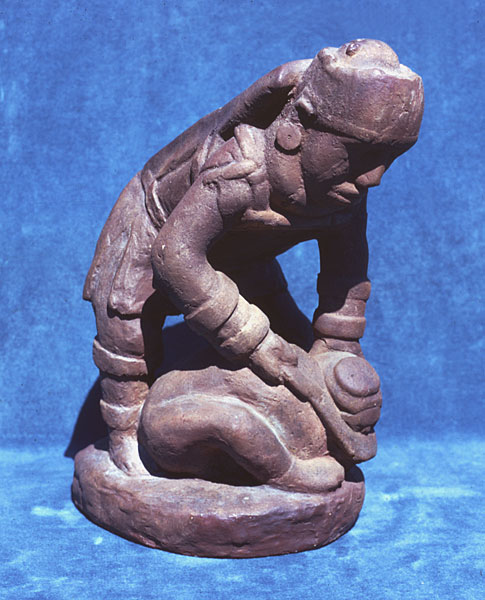
We can see it in Pre-Columbian iconography (such as this artifact from Spiro, depicting a Mississippian warrior decapitating a prisoner). We find it in the archaeological record (a famous example, the Crow Creek Massacre, occurred ~1325 CE, when almost 500 individuals of were buried in a mass grave that had been a trench for the wall the people of the town were building before they were attacked). We hear of it in oral traditions (the foundation of the Haudenosaunee, the Iroquois Confederacy, was precipitated by a long period of warfare between the Five Nations). We read about in the accounts of the early European explorers and colonists, who arrived in the Americas to find local wars already underway or well-trained armies and navies ready to resist them (Quigualtam, the final foe in a long line of enemies encountered by de Soto's expedition, chased the Spanish out of Mississippi Valley with a fleet of 100-200 war canoes, some large enough to carry 70 men, and performed well practiced maneuvers to rescue captives held by the Spanish). And this is, of course, just focusing on the area that's now the US (and largely the eastern portion of it). If we expand our view outward, we can begin to talk about the long and detailed history of warfare in Mesoamerican and the Andes as well, but I'll leave that for our specialists in those areas.
Now just as there has always been conflict and, at times, war, there have also been great advocates for peace. The wars that preceded the foundation of the Haudenosaunee, for example, finally came to an end thanks to a movement begun by man who has long been revered with the epithet The Great Peacemaker (his real name, Dekanawida, is to be used sparingly). Long before the Great Peacemaker brought the Five Nations together, there was the Pax Hopewelliana, an era from about 100 BCE to 400 CE, during which the Hopewell Tradition spread over much of interior river valleys and any evidence for large-scale (and even small-scale) violence is virtually absent and trade goods could spread from the Rockies to the Atlantic (though largely they were funneled into what's now Ohio). As the Hopewell tradition wanes after 400 CE, evidence for violence picks up again and people begin living in much more defensible villages. Its also around this time that the bow and arrow become widespread in the Hopewell region (This time period may correspond to the phase in Iroquois and Lenape oral tradition during which they allied against the Talligewi, to whom they attribute the Hopewell and Adena earthworks and after whom the Allegheny Mountains and River are named).
I'm just curious because a civilization that doesn't eventually evolve, branch out, divide, and form differences, whether in language, caste systems, economics, etc., seems totally sociologically illogical to me.
You're right, it wouldn't make sense. But the Americas had a diverse number of languages and social systems before (and after) Europeans arrived. If you have more specific questions, you'll hopefully get more specific answers. With a question this big, I felt I had to paint with a broader brush than I generally like to.
There was no "Native American" culture or civilization, and it's pretty much impossible to generalize about all of the different cultures and groups that made up the population of the Americas (or even just North America) prior to 1492. There were hundreds of different groups, who spoke different languages, lived dramatically different lifestyles, and had dramatically different cultures, and it's no more valid to talk about them in general terms than it is to suggest that "Europe" was a single culture or civilization, when obviously there were huge differences between life in Scotland and life in Southern Italy (to take a random example) during this period.
Generally speaking, though, you are correct to question narratives that suggest that the indigenous people that European colonists encountered were totally peaceful - the Iroquois and Huron were at war with each other before European contact, for example, and European explorers/settlers (like Samuel de Champlain) often formed alliances with these groups by agreeing to help them fight their enemies. Champlain, for example, intervened in Iroquois-Huron conflict in the Iroquois War (1609) in order to cement his alliance with the Huron and related groups. Different indigenous cultures often warred and fought with each other - I'm not sure why anyone would be teaching you otherwise.