I am reading a newspaper from 1914 and it writes how the soldiers made themselves at home in the trenches (couches, pianos and such). What I found interesting and somehow incredible is how they halted assaults when soldiers "had to answer their calls of nature" (which is odd, since they had toilets in the trenches). The newspaper goes (translated from Slovene):
Between noon and 2 o'clock (or other hours, depended on agreement) both sides halted their assaults to allow soldiers to deal with different human needs. If someone wanted to disappear from the trenches, he lifted rifle's butt and the fighting stopped. German soldiers noticed that there are women in French trenches and one day, when one of those pauses started, one of the French soldiers played a lively song on a piano, while said women came out of the trench and danced.
How accurate is this description and how often did those pauses and such mischief happen during the trench fighting? It seems as if war was more of a deadly sport, an arrangement that could be stopped at any moment and resumed when everyone was ready.
Briefly,
(which is odd, since they had toilets in the trenches)
Not quite. They had latrines which is a totally different thing. They did not have plumbing or a sewage system of any significant fashion. They did their business in a hole or a bucket and it was someone's duty to dump it and rinse it. Many times these would be little more than a hole dug into the ground a few feet.
Anyways, no this is a load of malarkey as a whole. It's journalistic license. While there were unspoken agreements at times between trenches in to 'live and let live' in more quiet sectors there was nothing, at least as I have come across, this explicit. Certainly nothing actually and literally negotiated like a time of day or something official. Even more spectacularly though is this idea that an entire assault would be halted because a few guys had to go number 2 or something; that's just fantasy. No, WWI did not have bathroom breaks!
You must remember this was a war and it was a war which both sides desperately wanted to win. The French were defending their homeland. The Belgians were defending their homeland and fighting for revenge for their destroyed country. The Germans were in too deep and knew this was a win or die situation. You're completely right that this was a deadly affair and both sides didn't treat it like a game taking bathroom breaks. With that said though it is based, like most myths, on a hint of truth -- the French and British were keen on treating whoever was opposing them differently. Prussians were treated ruthlessly as they were expected (and usually lived up to) a ruthless reputation. More "kindhearted peoples" like the Saxons would be left alone more often and be more prone to forming 'live and let live' situations.
As for the specific anecdote I can't speak to that unless the paper provides a unit name, a location, a specific date or anything for that matter. If it's not and just vague terms like "French soldiers" and "German soldiers" and "one day..." then you can almost assuredly assume it's a fantastical fiction based on probably a slight hint of truth (French soldiers somehow got a piano in a trench or something). The myth that both sides just chose not to fight whenever they could and general myths of camaraderie between the Entente and Central Powers has been from the beginning used as some criticism of "the brass"; generally including some narrative where they forced kindhearted innocent boys who just wanted to drink tea with the Germans into machine guns and cackling maniacally all the way. You must take all of these accounts of friendship between the two sides with a heavy grain of salt for that reason as it's a pervasive narrative pushed, usually by journalists for that matter.
If you want a fantastic book on trench life that is riddled with firsthand accounts (something I don't necessarily rely on but still works as a fantastic reference piece) is "Hot Blood and Cold Steel: Life in the Trenches in the First World War" by Andy Simpson.
I can't comment on the life in the trenches, but can comment on the realities of putting a piano in such conditions: the piano is about the worst possible instrument to have there.
First, pianos are heavy and quite difficult to move. And upright pianos from that time were quite tall and heavy (spinet pianos weren't sold until around the 1930s). The weight distribution is weird, if you put an upright piano on its back it's going to be difficult to get it vertical again. If they tilt, they will go down rather easily.
Putting a grand piano in a trench is even more problematic, because they are heavier and occupy a bigger area. The legs of grand pianos are removed when you transport them, cranes are some times used if you want to move a piano to a top floor.
Of course, give the nature of war they had people used to move heavy machinery under bad conditions, but pianos are not as sturdy as artillery pieces.
Pianos are indoor beasts. They don't sound right outside and they suffer with changes in climate. Humidity will just leave it quite unusable (and I understand humidity was frequently a problem in the trenches)...
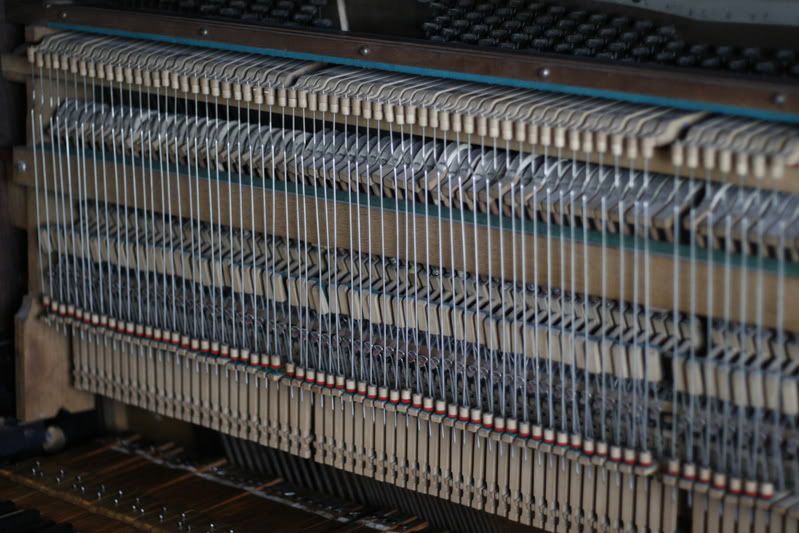
Why is humidity bad? Well, changes in humidity make wood swell. A piano is a machine made mostly of wood, (mostly unpainted) metal and felt (wool), those aren't the most durable materials. It is a machine with A LOT of moving parts, lots of wooden pieces with metal pins in the middle. If the wood swells, those pieces will not be able to move. Keys won't work very well.
The Brits made a lot of upright pianos with birdcage actions. Those are not fun to regulate (adjust), I think they would not do particularly well under harsh conditions.
Tuning is affected by humidity changes. The soundboard is also made of wood, and it swells and contracts seasonally. Big swings in humidity mess with tuning. It's not as easy to tune a piano as it is to tune a guitar, pianists can't usually tune their instruments (by that time piano tuners had existed for quite a while and pianists weren't expected to work on their instruments). You need special tools to tune a piano, and it takes time. Even if you weren't after a top notch tuning, it takes time to get so many strings to acceptable notes (a piano has 88 keys, around 200 strings to tune in total).
I guess a piano in bad shape can still be considered a nice thing under the conditions experienced by many soldiers during the war, but it won't be very useful if you can't play it. I would expect keys to stop working under humid outdoor conditions (they would go down, but wouldn't go back up on their own; the keyboard would feel quite hard to play).
TL;DR
Is it possible to have a piano in the trenches? I guess it is, with quite some work. I think it is going to be problematic to keep it playable, and the health of the piano will get worse and worse under the kind of conditions I understand people faced in the trenches. Would not recommend...
I can't link in because I'm on mobile but look up the Christmas Truce, May not fully answer why but it's an amazing event.