During the last Ice Age, which ended around 15,000 years ago, much of Europe was covered in ice. Therefore, you wouldn't be able to inhabit these lands. Does this imply that humans were living in these Icey areas during that time - or up until 15,000 YA? I know that humans lived in Europe 40,000 years ago, and it's possible that if there were no Ice Age, that these humans could have lived in Northern Europe, but of course, they'd have to disappear during the Ice Age. Is this the case?
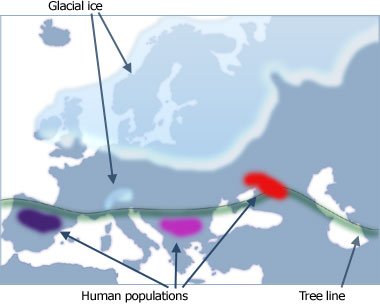
Europe wasn't entirely depopulated, but it had taken a hit in population. The major clumps of people were in Spain, Greece and north of the Black Sea, were the major forests remained.
See this for a visual explanation Also http://en.wikipedia.org/wiki/Last_Glacial_Maximum_refugia for where we sheltered.
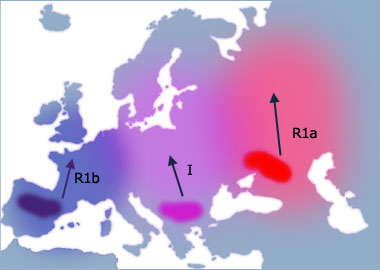
After the ice age began to end, and the wildlife from the south spread back north, they followed it and the population returned to pre-Ice Age levels.
See [this for the migration] (http://history.earthsci.carleton.ca/harvey/genealogy/images/genetics/europe_haplogroups_2.jpg)
However- this does not mean that that Europe was completely devoid of humans during this time. Remember, even though it was the Ice Age, the seasons were still in effect. In summer, the ice retreated and the tundra came to life.
See this for a better look of how Europe looked in the Ice Age. Notice how much of Europe is tundra- even today, primitive people still survive in the tundra.
There is evidence of cultures existing very close to the ice caps, like the [Hamburg Culture] (http://en.wikipedia.org/wiki/Hamburg_culture). There's no reason people couldn't exist near the ice caps (just not in great numbers or very well), it was only due to the lowered sea levels that we managed to walk into the Americas (though we had to wait for some major glacier/ice cap to melt before we could get out of Alaska I think).
A more extensive page can be found here: http://history.earthsci.carleton.ca/harvey/genealogy/dnartpatterson.htm