The open stack system is a relatively modern and still not widespread (globally) system. What would it have been like to visit the library of Alexandria?
I read /u/kieslowskifan 's post here but noted this question deserved its own thread.
We only have one physical description, and that's of the "daughter" library in the Serapeion (which probably means the main repository, after the royal archive was destroyed by fire in 47 BCE), and at a very late date in the history of the Mouseion. It comes from Aphthonios, who visited Alexandria at some point in the 300s CE. In his Progymnasmata 12 he describes the acropolis of Alexandria:
As one enters the acropolis itself a single space is marked out by four sides; the plan of the arrangement is that of a hollow rectangle. There is a court in the centre, surrounded by a colonnade. Other colonnades succeed the court, colonnades divided by equal columns, and their length could not be exceeded. Each colonnade ends in another at right angles, and a double column divides each colonnade, ending the one and starting the other. Chambers are built within the colonnades. Some are repositories for the books, open to those who are diligent in philosophy and stirring up the whole city to mastery of wisdom. Others are established in honour of the ancient gods. The colonnades are roofed, and the roof is made of gold, and the capitals of the columns are made of bronze overlaid with gold. The decoration of the court is not single. For different parts are differently decorated, and one has the exploits of Perseus. In the middle there rises a column of great height, making the place conspicuous (someone on his way does not know where he is going, unless he uses the pillar as a sign of the direction) and makes the acropolis stand out by land and sea. The beginnings of the universe stand round the capital of the column.
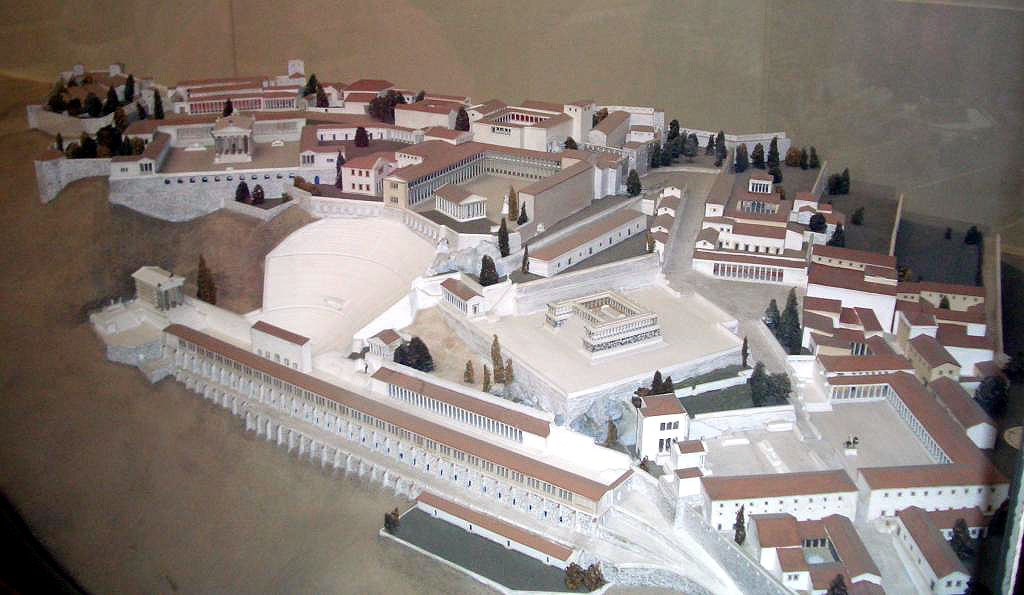
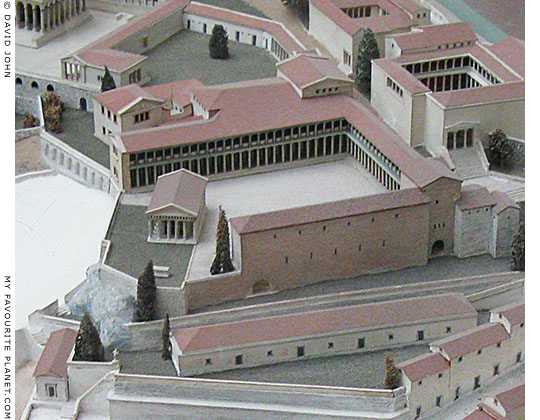
You'll notice that the books don't even make up a substantial part of his description. By that time the "library" was probably already pretty minimal -- a great place to go if you're an impoverished student with nothing else to read, but major scholars would have had their own private libraries. We have much more precise archaeological information about the layout of the library at Pergamon, and that should help convey what Aphthonios is describing when he talks about bookrooms coming off the colonnades: here's the layout of the acropolis of Pergamon, and you can see a close-up here: there's a stoa running ENE from the theatre, open to the air on the south side, and with a set of rooms containing the books on the north side.
Exactly what were the protocols for who could go there and look at the books? -- we don't have much evidence on this point. I've written a post here that tries to deal with that side of things, but you'll see there's very little direct evidence to go on. That post should probably be understood as referring to things in the Ptolemaic period, when the Mouseion was in its heyday. But the fact that the daughter library is more often called the "outer" (ἐκτός) library suggests it may even have been open to anyone who wanted. Look at Pergamon: what's to stop people visiting the theatre from popping in for a quick browse? Presumably there were guards to prevent vandalism, but the layout doesn't exactly cut the books off from public view.
Edit. I didn't look at the layout closely enough. The Pergamene library was separated from the theatre, and at a higher level. You had to go in the entrance at the east side. You can see in this photo of the Berlin model that the sanctuary of Athena is set above the back wall of the theatre: the temple itself is the detached building in the middle of the open space. Here's another view where you can see the library building behind the sanctuary's northern stoa. So access was more limited than I supposed. Oopsie.