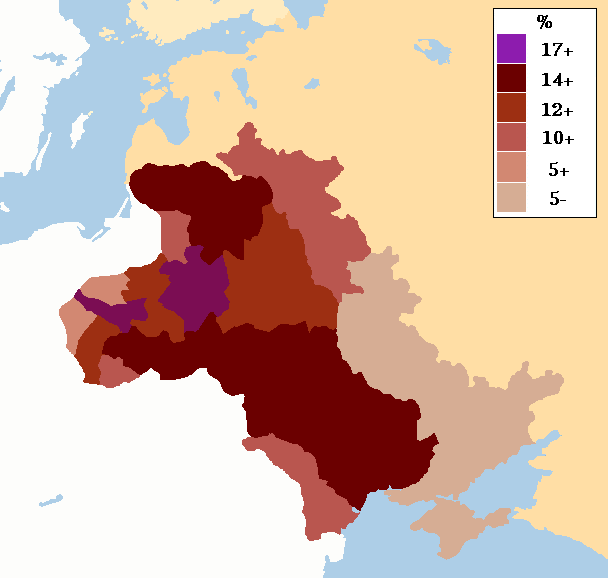
I wouldn't say that Jews in the US are mostly Russian. However, it's true that a lot of Jews in the US do have ancestors from Eastern Europe. Since Poland and Ukraine used to be part of Russia, many say "Russia" when they may be referring to places that are currently other countries.
There are 3 main reasons for the large number of Eastern European Jews in the US. 1) Pre World War II, that area had a large Jewish population, largely due to a welcoming attitude they had had several centuries ago, when many other countries had kicked Jews out or harassed them. 11% of people in Poland were Jewish pre-World War II. 2) While there had been Jews in the US since colonial times, their numbers were small and they mainly came from England, former Spanish areas, and Western Europe. Plus a wave of Jews from Germany in 1848 after some political turmoil there at that time. But during the late 19th and early 20th centuries, there was a large wave of antisemitism in Eastern Europe, largely in Russia, the area that is now Poland, and nearby areas like Belarus. There were a lot of pogroms, in which nearby Christians would attack Jewish villages and rape, kill, torture, and pillage. This resulted in a lot of Jews in the area trying to flee, wherever they could. The US had a pretty free immigration policy at that time, so this became a major destination, though Jews also fled to England, Germany and France. Most Jews in the US trace their origins to this 1870s-WWI wave. 3) There were several reasons why Jews did not emigrate in large numbers after this point: a wave of anti-semitism arose in the US in the early 20th century, and quotas were passed, limiting the number of Jews who could get visas, so Jews from other areas of Europe were unable to emigrate and emigration turned to a trickle. And then most European Jews were killed in the Holocaust, so the numbers existing to emigrate were smaller. The bulk of Europe's Jews were now, post WWII, in the Soviet Union, and the Soviet Union made it extremely difficult for any Jews to leave so there was negligible Jewish immigration to the US post WWII, except for a large wave of refugees just after the war. But it was a lot smaller than previous waves because there were simply not large numbers able to come. As soon as the fall of the Soviet Union, though, a lot of Jews in the former Soviet Union,who had been itching to leave during the Soviet era but unable to get a visa, started to get out. So there was another wave of Russian Jews coming to the US.
First off, although a sizable number of American Jews hailed from the Russian Empire/Soviet Union, very few of these Jewish immigrants would have self-identified as Russian. Jewish identity was something of an anomaly in both states; the Soviets hemmed and hawed over whether or not Judaism was an ethic/national identity or a religious affiliation and the tsarist state considered Jews inorodtsy (subject peoples) and seldom could become legally Russian even if they converted to Orthodoxy.
The genesis of the first wave of Jewish immigration to the US was the assassination of Tsar Alexander II in 1881, which prompted a wave of antisemetic violence called pogroms. These pogroms became periodic in the Russian empire during times of stress and economic dislocation. During this time (1881-1917), the tsarist state restricted most Jews to the Pale of Settlement. The Pale initially had was just one of the means the tsarist state employed to control its heterogeneous population. However, the imperial state's silent acquiescence or inaction during the pogroms soured many Jews about the Romanovs. This led to the creation of Jewish self-defense leagues and also organizational networks with other Jewish groups as they realized that the state was not going to aid them.
There was also little love for the Jews within tsarist officialdom. The tsarist state also increasingly encouraged Jews to emigrate, which was a stark contrast to other non-Russian ethnic groups within the empire which the autocracy sought to clamp down and regulate. The US was one area in the globe with relatively open borders, thus many of the empire's Jews ended up there.
The height of Jewish emigration peaked during the early decades of the twentieth century, but there was a curious Cold War epilogue. In the 1970s, the USSR reversed its previously stringent restrictions on Jewish immigration. The advent of the state of Israel made Jewish immigration a hot button issue as the Soviet's repression of Jews opened the USSR to charges that it was an antisemetic government. The Soviets allowed for immigration out of the USSR provided the applicant could prove they were Jewish. The US allowed these Soviet Jews in as refugees and the Israelis allowed them in unconditionally. Jewish lobbies and relief agencies helped settle these immigrants into the US.
Sources
Aronson, Irwin Michael. Troubled Waters: The Origins of the 1881 Anti-Jewish Pogroms in Russia. Pittsburgh, Pa: University of Pittsburgh Press, 1990.
Gitelman, Zvi Y. A Century of Ambivalence: The Jews of Russia and the Soviet Union, 1881 to the Present. Bloomington: Indiana University Press, 2001.