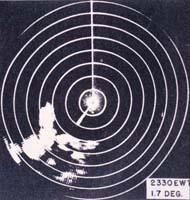
This is in response to a previous question I asked some months ago, wherein I was told that Japanese air and surface search radars didn't have a spinning PPI scope. How would such primitive radars be able to detect incoming airplanes and ships on the surface?
Before the advent of the PPI, most radar displays used technology based off of oscilloscopes. A dial or readout would show which direction in azimuth the radar was trained, while a bump from the return echo on the oscilloscope-like display would indicate the range in that direction.
It wasn't only Japanese radars that lacked the PPI scope; the PPI was a development later in the war, and before its onset even the Americans and British used the above method. It turns out it's a bit difficult to find pictures online, but here is one I found. Page 16 shows the information available to the operator of a ground-based, fixed, Wurzburg search radar. Page 22 shows what returns would look like in the Lichtensen search radar in a German night fighter aircraft. If that's still confusing, here's a better example taken from a video game, that is more or less the right idea.
A PPI works in essentially the same way, except the "bump" on the osciloscope is replaced by a dot in the correct direction at the correct range.