Most of what I remember learning during the handful of history courses I took revolved around European cities. Were there any events that happened on or near US territory?
Yes!
The Aleutian islands campaign is often referred to as 'The American theater'; and the Japanese used it as a diversionary effort and to facilitate the movement of carrier groups.
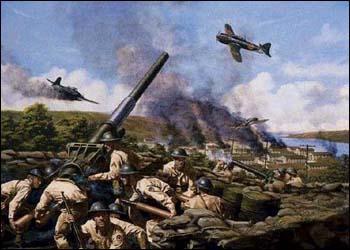
The US Army National Guard still celebrates the actions of the Arkansas-based coastal artillery units that formed part of the defense of the Alaskan coast; there is at least one documented case of Japanese air raids in and around Dutch Harbor that the National Guard commemorates. However, considering the US National Guard site goes out of its way to point out the poor and antiquated equipment of the force; we can surmise that even the US realized that the threat of the Japanese would remain at arm's length and to more 'strategic' arms such as the IJN.
I must stress that the bulk of Japanese actions in or near US Territories on the mainland were usually just air raids; like Pearl Harbor. The Aleutian Islands campaign concluded in 1943 and the Japanese threat, as transitory as it was, soon died out.
However, if you want to get technical; the fall of Guam, Wake Island, and the Philippines can all justly be declared as direct assaults on US territories; as they were all US mandates, de-facto or in actuality.
I lack further details unfortunately; I only know what I know from brief reading online in leisure time; so hopefully someone else will weigh in.
EDIT: See below for clarification on US territories.
The Aleutian Islands Campaign opened up with the Japanese attack on Dutch Harbor, where the US maintained naval facilities in the Aleutian Islands Chain of Alaska (then a territory, not a state). A few days following the bombing of Dutch Harbor, the Japanese landed troops in the, capturing Attu and Kiska. Kiska was unopposed, although two members of a military weather station were killed with the other eight captured. The small settlement present on Attu had about 40 Aleut natives, along with a school-teacher and her husband. The latter was killed by the Japanese during their invasion (possibly deliberate), while the rest were eventually evacuated to internment camps in Japan, where more than half of them would die.
The Japanese occupied the islands for almost a year, until an operation was finally put into motion in May, 1943 to retake Attu. The main landing site were at Massacre (the main force) and Holtz Bays (secondary force), as well as the Provisional Scout Battalion landed as a diversion. The Japanese didn't oppose the initial landings. This was a serious oversight, since at Massacre Bay, the heavy fog seriously slowed things down, while at Holtz Bay, only two landing craft at a time could fit in to the landing zone. Once the landings were discovered however, the Japanese put up a fierce resistence. At Holtz Bay, the Americans had to capture (the later renamed) 'Bloody Point', while the main force at Massacre Bay fought their way up Jarmin and Clevesy passes towards Chicagof Harbor after encountering Japanese defenses the second day.
The two week operation was a costly one for the US, with over 1,600 casualties, including 549 killed, as well as more than 2,000 men stricken by the cold. For the Japanese however, a mere 29 members of the 2,900 man garrison would survive to be captured, with most of the remaining defenders dying in a banzai charge on May 29th ordered by Col. Yamazaki with the remnants of his command.
Following the recapture of Attu in May of 1943, Allied planners prepared to retake what they believed to the more heavily defended island of Kiska. Prior to the joint American-Canadian landings on August 15th, the Japanese abandoned the island, evacuating the entire garrison in secret. Despite landing on the empty island, casualties for the operation were high, with a number of friendly fire incidents, as well as accidents and triggering of mines left behind by the Japanese. Aside from the landing itself, 71 sailors died on the USS Abner Read when it struck a sea-mine off shore.
Mostly sourced from 'War in the Outposts' from Time-Life Books.
The Japanese made a major effort to attack North America with hydrogen filled paper balloons that carried 12 or 18 kilogram bomb payloads. These were either anti-personal fragmentation grenades or incendiary bombs. They wanted to start forest fires and burn down the forests of British Columbia, Washington state and Oregon. The Japanese made a major effort with this campaign and launched approximately 9,300 of these balloons. They could cross the North Pacific in about eighty hours. There is documented evidence that at least 342 made it to North America. On May 5th 1945 one of these balloons were found by a minister's wife, four of her Sunday school students and her younger sister on Gearhart Mountain, near Klamath Falls, Oregon. They were studying this strange object when it exploded and killed them all. They were the only US citizens killed by enemy action on the mainland of the USA during World War II.
The US Government was very worried about these balloons. They already knew a little bit about the Japanese Army's biological weapons used in China in late 1944. The did not realize that this balloon offensive was an Imperial Japanese Navy program, that did not include a biological weapon component. The Federal Government was very worried that these balloons would cause widespread panic and they censored the media from reporting any of these balloon attacks.
Sources: For a full length book treatment read. "Japan's World War II Balloon Attacks on North America" by Robert Mikesh. Here is a trailer for the documentary movie "On a Wind and a Prayer" https://www.youtube.com/watch?v=_NlyJ4Zbld8
Let's not forget the submarine attack on an oil field in Ellwood, CA in February of 1942. Japanese submarine I-17 popped up on Feb 23, lobbed 17 rounds from her deck gun at the field, damaging a well, a pier, coming close to a ranch scaring some cattle, and passed over a place called "Wheeler's Inn."
While completely ineffective, it did trigger something of an invasion panic in California. It was apparently used as justification for the internment of Japanese-Americans as well.