I checked the sidebar and FAQ's but didn't find what I was looking for. Primary/diplomatic documentation on the subject would be amazing but I know that's asking a lot, so if anyone could just provide a historiographical summary with sources that would be so, so helpful.
Thanks!
This is an interesting question, though a restriction to primary/diplomatic documentation makes it more difficult to answer. Then again, not restricting it to that is equally hard to answer, since different opinions are formed from the same documents/plans.
Even so, we can conclude from the diplomatic and primary documentation that the British did attempt to create a Jewish state before WWII.
I tried to discuss things using only primary documents, and without including anything from historian interpretations of them. I left out details that I don't believe are necessary to this particular question, though there are some things one should know about for a fuller understanding of the history, such as the White Paper of 1939, the Anglo-American Commission (I only briefly mention this), and more.
First and foremost, an examination shows that the British goals appear to have shifted over time. In 1915, the McMahon-Hussein Correspondences (not the best source) are said to have promised Palestine to Arabs for their own state, but there are those who argue the British kept the boundaries vague intentionally to renege on that agreement later, as they presumably did if the critical interpretation is correct.
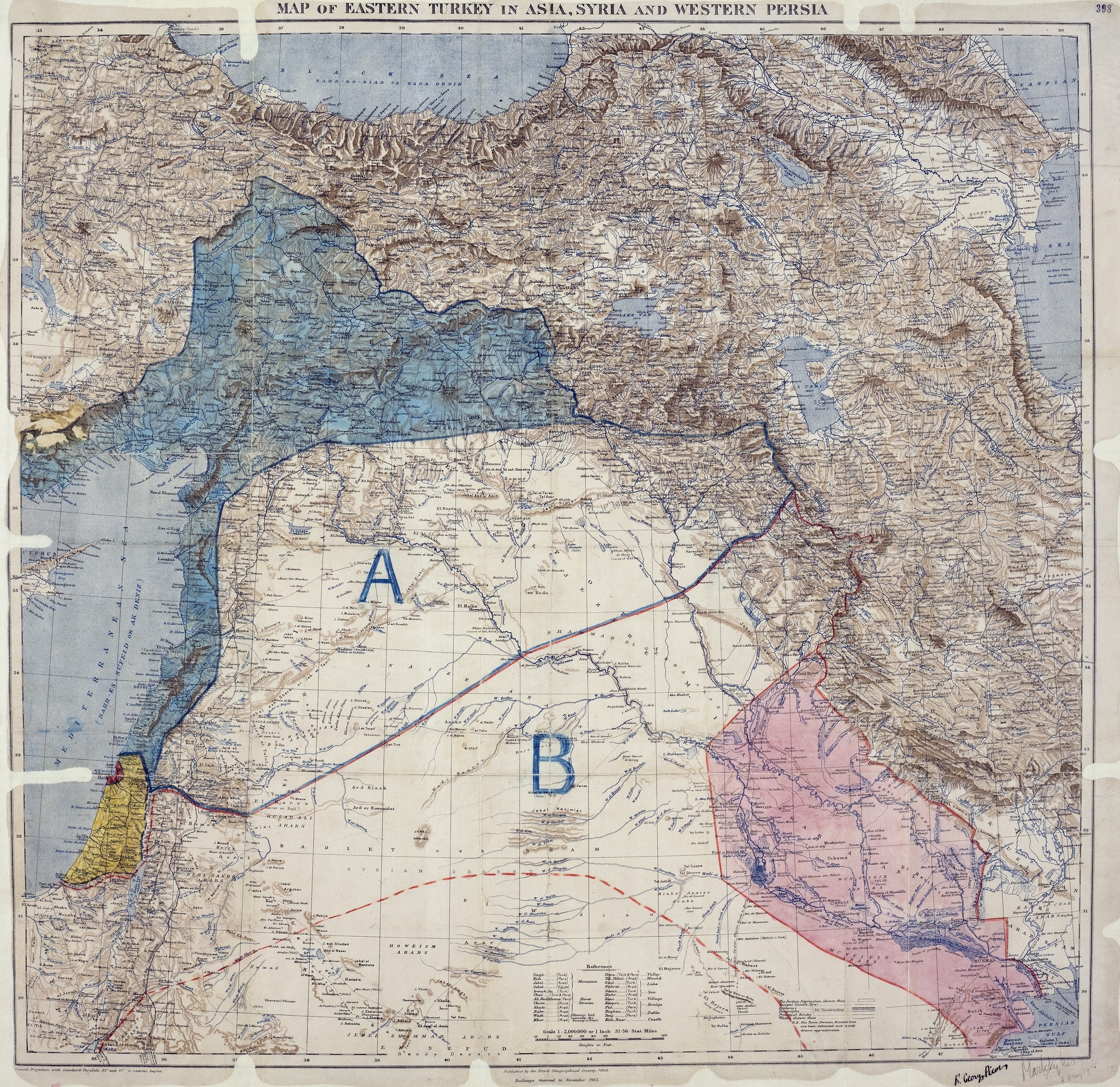
In the Sykes-Picot Agreement, a map was attached showing a proposed split of control/influence between the British and French. One can view that map here. The map shows that the southern half of Palestine would be an area in which the British could have influence via advising and acting as protectors over an Arab chief's suzerainty, but the northern half would be an international zone.
Then in 1917, the British government issued the Balfour Declaration, which called for the establishment of a "Jewish national home in Palestine".
By 1922, the British followed up on 1917 with the Churchill White Paper, which said that a national home would be established "in Palestine", not "throughout Palestine" to alleviate Arab concerns that all of Palestine would be a Jewish state, and it seems to imply that a national home may not mean a state, as it says:
That special position [of the Zionist Organization, the Palestine Zionist Executive] relates to the measures to be taken in Palestine affecting the Jewish population, and contemplates that the organization may assist in the general development of the country, but does not entitle it to share in any degree in its government.
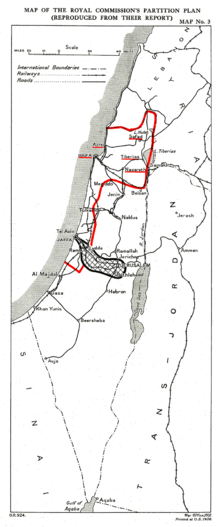
However, this doesn't mean the British were committed to that. 15 years later, the British established a commission, which was convinced that the best way to solve the problems they were having in Palestine (including dealing with riots in 1920, 1921, and 1929, as well as the Arab revolt that began in 1936) was partitioning the region into Arab and Jewish states. This commission's gigantic report put out a plan for partition borders. At any rate, without going to deeply into it, the British tried partition and the creation of a Jewish state before WWII and genocide.
In 1938, after seeing the Peel recommendations accepted in principle by the Jews and rejected by the Arabs, the Woodhead Commission was established. It also published a long report, with three possible partition plans. However, unlike the Peel Commission, it didn't recommend partition. In fact, despite the proposals, it said (according to the Anglo-American Committee) that partition could not be reached in a form that would succeed.
All of this, of course, happened before genocide or WWII.
After WWII more proposals came. They were mostly similar to previous border proposals the British gave, when the British were the ones giving them. For example, the 1937 Peel Commission Plan map and the 1938 Woodhead Commission Plan A map aren't all that different from the map plan put forward by the Morrison-Grady Plan of 1946, which was produced by U.S. Ambassador Henry F. Grady (he would be confirmed as U.S. Ambassador to India about a year after presenting the plan, on an unrelated-seeming note) and British Deputy Prime Minister Herbert Morrison. The two led a committee that came after the Anglo-American Commission of 1946. It's important to note their proposal wasn't for partition, but for a unitary federal system that would be provincial. Even so, the fact that the plan was proposed after WWII and the genocide shows that the British (and some others) hadn't necessarily changed their mind about how to apportion land just yet.
When the issue came up with the proposed UN Partition Plan, we have to keep in mind who the plan was drafted by. The people who did not vote for the majority report in the UN Special Committee On Palestine (UNSCOP) were India, Iran, and Yugoslavia. Those who voted for the majority report and were on the committee were Australia, Canada, Czechoslovakia, Guatemala, Netherlands, Peru, Sweden, and Uruguay. They evidently saw things differently from the British when drafting that partition plan's boundaries.
We can't say whether or not it was inevitable, however, because that would be drafting an alternate history. A good historian can't do that. What we can do is say that there were plans and attempts before then. Whether or not that would have persisted had there been no WWII or Holocaust is unclear.
I don't want to give short shrift to the influence of the Holocaust. The partition plan proposed by UNSCOP was supported by Russia, in part, because of the suffering of displaced Jews as a result of WWII and as a result of their suffering during the Holocaust. When the Soviet Union announced its policy of sticking to a one-state option but accepting that partition might be better if UNSCOP agreed that it was (as UNSCOP did), Andrei Gromyko was the one making the speech., ctrl+f "Gromyko" to find his name. And the UN partition plan presented by UNSCOP, as I linked above, includes a section titled "International responsibility for Jewish displaced persons" and numerous references to such. The Holocaust undoubtedly made the creation of Israel more likely, but Israel's creation was not a reaction to the Holocaust alone. It had been contemplated and debated before.
It likely would have gone differently had there been no Holocaust, but it's impossible to say that for sure, and to speculate would amount to nothing. It also is important to recall that it may have gone just the same, with violence mounting and forcing a UN resolution that was not accepted by one side or both and a war that the Jews could have won just the same. So as to that, who knows. But we do know it was talked about, at least.
To address just one part of the question, the creation of Israel was not the result of the Holocaust. This is one of those historical myths that assume Israel was created by outsiders "drawing lines in the sand." While there was considerable debate and diplomacy around the creation of a Jewish state in Palestine both before and after World War II, what ultimately made it a reality was facts on the ground. The State of Israel was the result of war. Israel was created by Israelis.