Previous weeks' Tuesday Trivias and the complete upcoming schedule.
Very simple theme today: please tell us about someone or something who was the first of their/its kind, or flip it and tell us about the last example of something. OR do both if you’re an overachiever.
Next week on Tuesday Trivia: Never Done: we’ll be talking about women’s work in history, any time, any place, any work done by women.
EDIT: and I'm quite low on ideas for Trivia, so if you have any good prompts for history's less relevant information please put them in my inbox!
Who was the first person recorded to have crossed the full breadth of North America? I'm setting aside the various Mesoamerican and Spanish travelers who certainly crossed the narrower southern portions of North America regularly.
Most people would say Lewis and Clark expedition in 1803. Or the less well known but earlier Arthur Mackenzie expedition to the Pacific across western Canada in 1793.
But someone beat both of them, and you've almost certainly never heard of him.
Moncacht-Apé, also known as the Interpreter due to his extensive knowledge of various indigenous languages, was an elderly Yazoo (a subdivision of the Tunica) when he met with the French historian du Pratz sometime in the 1720s. At the time, du Pratz was investigating the peopling of the Americas and while searching for local informants who might be able to relay some traditional knowledge of their origins, he was put in contact with Moncacht-Apé who had conducted his own exploration into the topic.
Many years earlier, Moncacht-Apé had lost his wife and children due to an unspecified tragedy. After this, he set out on his grand expedition. First, he traveled north to the Chickasaw and questioned their elders on the topic of their origins. Not finding a satisfactory answer among them, he continued up the Ohio through the lands of the Shawnee and the Iroquois and arrived in northern New England as winter set in. He spent the winter with in an Abenaki village, from where his hosts guided him to the Atlantic Ocean in the spring. He remained with the Abenaki for another year, finally setting out for home the following spring. As he took his leave, his hosts recommended that the return by a different route - the St. Lawrence - so that he might see Niagara Falls as well.
After viewing the Falls, he turned south and find the Ohio River again and follow back to his homeland in the lower Mississippi. While his relatives celebrated his return, Moncacht-Apé's wanderlust had only been encouraged by his eastward expedition. Some of his elders informed him that he might have better luck exploring to the northwest if he still sought the origins of his people, so he set out to find the source of the Missouri.
He stayed a short while in Tamaroas, part of the Illinois Confederacy, and from there crossed the Mississippi to the mouth of the Missouri River. From there, he reached the Missouria, with whom he spent the winter and learned their language. In the spring, he continued on, first encountering the Kansa - the last nation in his iternary that can be solidly identified.
After leaving the Kansa, he continued up the Missouri for another month until he encountered a small group of people he referred to as "the nation of Otters." They were surprised to find him wandering through their lands alone but appear to have welcomed him. One of the women in the group was late in her pregnancy and she and her husband set off for their village somewhere in the Columbian Plateau. It took some 15 days to reach it from where area where they were hunting when they first met Moncacht-Apé. It was beyond the Continental Divide, on "the Fine River" - which is either the Columbia River or one of its tributaries.
He remained in the Otter village for a few days, and praised their hospitality. An group of Otters were heading downriver to renew a peace they had established with another nation. Moncacht-Apé accompanied them and took up his winter residence among this people. He learned their language, which he says was common among the people of the region. This means he was probably among the Chinook, whose language forms a large portion of the Chinook Jargon trade language that was used as a trade language in the Pacific Northwest.
From there he continued down the Fine River, visiting various peoples but never staying anywhere more than a day, until he was only another day's journey from the Pacific Ocean. There he discovered a people who were under threat from"bearded men" who traveled in "floating villages" (though there were never more than 30 such men) and were armed with weapons that made "a great fire and great noise." These strangers came to the land in search of a certain wood that produced a yellow dye, but also attacked coastal villages to capture and enslave the people. Being more familiar with people from the Old World, Moncacht-Apé offered his assistance and remained with this people until the summer, when the bearded strangers returned. They set up an ambush at the place where these strangers normally landed, and waited for 17 days for them to finally arrive. Two ships came ashore and were quickly attacked. Eleven of the strangers were killed while the rest fled back to sea. Only two of those slain had powder and ammunition for their weapons, which Moncacht-Apé tried out and claimed were heavier and a shorter range than those the French sold in the lower Mississippi.
After fulfilling his promise to aid against strangers, Moncacht-Apé felt compelled to continue his journey. He continued to travel north until the land started to bend westward. He noted that the days were becoming unusually long and the nights notable short. Questioning some locals about what lay ahead, they told him that the land continues to the northwest for a considerable distance, then turns due west. After this it cut by "the Great Water" north and south.
Hearing that, Moncacht-Apé concluded that further explorations in that direction would be fruitless and impractical. He began his journey home - on that he expected to complete in three years but took him five due to unspecified delays.
Du Pratz published Moncacht-Apé's account of his expedition in his History of Louisiana in 1753. The Lewis and Clark expedition carried a copy with them, using Moncacht-Apé's as a guide for their own. There was a notable omission in the account that caught Lewis and Clark a bit off guard: Moncacht-Apé seems to have made no mention of the Rockies (or du Pratz neglected include such information in his history) and the later expedition was surprised to discover such a prominent mountain range - expecting nothing more substantial than the Appalachians they were familiar with.
Who was the first American killed in the Vietnam War?
For some reason, many popular history websites and newspaper like to mention Albert Peter Dewey as being the first man to die in Vietnam.
This is rather far-fetched since Lt. Col Dewey was not an American adviser following the ARVN in the early days of the insurgency or a US Marine being killed in 1965. In fact, he was a member of the OSS (Office of Strategic Services, the precursor of the CIA) who had arrived in Vietnam (then officially French Indochina) on September 4, 1945. Lt. Col Dewey was killed on September 26 by soldiers of the Viet Minh in a case of mistaken identity. There are many things that would disqualify this of being the first American casualty in the Vietnam War, but the most simplest is the fact that the American participation in what would become the Vietnam War didn't properly begin until 1955.
If not Dewey, then who was the first individual killed in the Vietnam War?
That is not an easy question to answer since the word 'killed' can have a very broad definition depending on what caused it.
The first American killed during the advisory period of the Vietnam War (1955-1965) was not killed by the enemy or by an accident. He was murdered. USAF Technical Sergeant Richard Bernard Fitzgibbon Jr. who was killed on June 8, 1956 after an argument with a fellow member of the USAF, who after getting drunk shot and killed him. Tragically, Richard Fitzgibbon's son, who shared the same name, would die in action in 1965.
The first injured Americans of the war occurred in 1957 when 13 members of the MAAG (Military Assistance Advisory Group) and the US Information Service were injured after a series of bombs targeting their installations were set off by insurgents.
That same year, interestingly enough the day before the previously mentioned attack, the first death caused by an accident occurred when Special Forces Cpt. Harry G. Gramer Jr. was killed during a training exercise. Cpt. Cramer was in command of a MTT (Mobile Training Team) who was responsible for training the newly formed ARVN special forces and died observing an exercise when a block of TNT prematurely detonated in the hands of a student, killing him, Cramer and several other individuals nearby.
So far, we've dealt with murders, accidents and wounded soldiers - so who was the first individual killed by an insurgent in Vietnam?
In fact, it was two men who were the first individuals to die in Vietnam.
Master Sgt. Chester Melvin Ovnand and Maj. Dale Richard Buis died in a VC attack on their compound at Bien Hoa on June 8, 1959. While it was erroneously reported that they had died after a bomb attack, they were actually killed by small arms fire while watching the movie The Tattered Dress. Both men were part of the MAAG and were responsible for overseeing the training of the ARVN in Bien Hoa.
Both men were killed exactly four years after the first American had been killed during the advisory period of the Vietnam War. Plenty of more men would die over the following six years leading up to the escalation of the Vietnam War: 489 more men would die before the first Marines took their first steps on the beach on Da Nang in April 1965.
Those who have an interest in Greek epic and the Trojan War myth often lament the loss of the "Epic Cycle", a group of six lost epics plus the two more famous Homeric epics that got stitched together into a single coherent narrative of the war. So when exactly was the Cycle lost? Who were the last people to read it?
The evidence tends to suggest that the epics must have been grouped together in the Hellenistic period, but most references to them in surviving sources are more piecemeal. So they clearly were published independently as well. And it turns out that evidence of when people still knew these epics varies depending on which epic you're talking about.
The Kypria, which related the prelude to war and at least the first nine years of the war (and possibly the whole thing, in its original form), was personally known to Pausanias (2nd cent. CE); at 10.31.2 he explicitly states that he had read the poem. Quotations do continue to appear in Clement of Alexandria's Protreptic and Stromateis, and in Athenaios' Deipnosophistai (both late 2nd/early 3rd cent.), and it's fairly likely that Athenaios knew the poem; but quotations are no guarantee of the poem's survival. Herodian's On unusual words (3rd cent.) also quotes from the Kypria, but in ancient scholastic sources that kind of quotation tends to be a result of copying an earlier scholastic note, rather than original research. That's almost certainly the explanation for Clement's quotations too. So for the Kypria I'm going to say that the last clear evidence of anyone reading it is in the late 2nd century.
Arktinos' Aithiopis, on the Amazons, the Aithiopes, and the deaths of Antilochos and Achilleus, didn't survive so well. Again we get a reference in Clement of Alexandria, and in Diomedes the grammarian (4th cent.), but both of them tell us explicitly that they're citing earlier scholars. So our latest evidence is actually the Tabula Iliaca Capitolina, which dates to the reign of Augustus. We have no evidence of the Aithiopis' continued existence after 14 CE.
Lesches' Little Iliad, about the fulfilment of various prophecies leading up to the sack of Troy, also appears in the Tabula Iliaca Capitolina, but Pausanias 10.26.1 implies that he knew this poem as well as the Kypria. Once again, quotations in Athenaios, Clement, Pausanias the lexicographer (2nd cent.?), and Hesychios of Miletos (6th cent.), carry no weight. There's one reference in Porphyry's Paraleipomena fr. 4 ed. Schrader (late 3rd cent.; =Eustathios Ad Iliadem 2.557=285.34 ed. Rom.=i.231.26 Stallbaum) which seems to indicate knowledge of the poem, but it's not incontrovertible. So here we have to say: 2nd century, possibly 3rd.
Arktinos' Iliou persis, on the sack of Troy, was certainly known to Dionysios of Halikarnassos (late 1st cent. BCE/early 1st cent. CE), who at 1.69.3 gives a detailed account of the poem's account of the Palladion; and we also find a reference on one of the other Tabulae Iliacae, catalogued as 6 B Sadurska, which survives only in a modern sketch, and is of unknown date. However, we can push the date forward a bit thanks to two 9th and 11th century collections of scholia on Vergil's Aeneid which refer to the poem. They're certainly based on much older scholastic material, but we can be pretty confident that the ultimate source can be no earlier than the Aeneid! So the Iliou persis was still being read at the time of Vergil's death, 19 BCE.
Agias' Nostoi, on the returns of the Greek heroes, is again pinned to the time of Pausanias. Again we have references to it in Clement and Athenaios, but Athenaios doesn't know the author's name and he gives the wrong title; Clement usually relies on earlier scholars. But Pausanias 10.29.6 and 10.30.5 report on details in the Nostoi's catalogue of women, implying that he had read it. So the poem survived at least to the 2nd century.
And finally Eugammon's Telegony, which gives aetiological explanations for Odysseus' double hero cult in NW Greece and in central Italy. This one is hard to pin down. Pausanias 8.12.5 refers to it, but uses the title Thesprotis (which may possibly have been a separate poem attributed to Mousaios). Up until last week we had two lines quoted from the poem in Athenaios and in Synesios' Letter 148; not that that means either of them had read the poem themselves, of course. However, now an article has come out casting grave doubt even on those lines. I haven't quite made up my own mind about the article yet, but it's certainly something to think about. That being the case, I don't think we can reasonably push evidence for the poem's survival any later than the Hellenistic scholarship that fed into the Odyssey scholia and Proklos' Chrestomatheia. The poem may possibly have survived later than the 1st century BCE, but there's no actual evidence to support its survival.
Edit. And a last note, on an ancient source reporting on the non-survival of the Cycle: the poet Peisandros of Laranda (ca. 210s-20s CE) is on record as saying that the Cycle was no longer anywhere to be found in his time, and that was why he wrote his Heroic marriages of the gods (reported in John Philoponos, Commentaria in Aristotelem Graeca vol. 13.iii: 157 lines 14-17).
Edit 2. My first edit was in far-too-dense academese. Slightly streamlined now.
I've previously talked about the introduction of helmets for ice hockey goalies, but this time I'll go for the skaters' use of helmets.
In the first decades that hockey was played, no one wore helmets, not even the goalies (as can be seen from this 1938 NHL match). There were a couple reasons for this: it went against the Victorian ideals of gentlemanly athletes, and though the players were no less violent to each other, they weren't as physical (if that makes any sense). So players went about bareheaded, or with a hat of some sort (Aurele Joliat, a famed NHL player in the 1920s and 30s was noted for wearing a small black cap, as evidenced in this photo.)
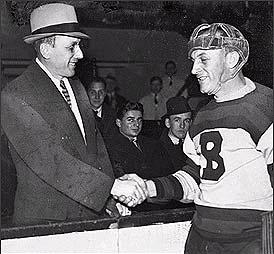
This did not mean that the occasional player didn't wear a helmet; one of the most famous early examples would be Eddie Shore a tough defenceman for the Boston Bruins in the 1930s. After he nearly killed Ace Bailey with a hit that saw Bailey's head hit the ice, Shore took to wearing a helmet (here he is shaking Bailey's hand shortly after the incident in question). Likewise Stan Mikita, a tough but skilled player throughout the 1960s and 70s, donned a helmet after a couple head-related injuries; this made him an outlier at the time though, and just added to his notoriety (along with being a top scorer and, initially, a tough violent player).
It was not until 1968 that helmets really came into play in the NHL. That year, tragically, saw the death of Bill Masterton, who was checked and hit his head on the ice in a game. Masterton died as a result of the injury, the first (and only) death to result directly from action in an NHL game. Several players donned helmets as a result of Masterton's death, and calls began to make it mandatory.
However it was not until 1979, that the NHL finally got around to doing so. That year they made it a rule that any player signing a contract with a team had to wear a helmet; players who had signed prior to that were grandfathered in. Due to the nature of sports, within 10 years the number of helmetless players had dropped to about 10, out of some 450 NHL players.
The last helmetless player in the NHL was Craig MacTavish, who had signed his first contract right before the rule was put in place, and retired in 1997, having never worn a helmet.
Now lots of people know about the last castrato, who is of course Alessandro Moreschi with his oh-so-famous recordings, but what about the opposite, the first castrato? Now who that might have been, pretty muddy! For the purpose of today, I’m defining “castrato” as a man castrated as a child, in the modern era, for the purpose of singing professionally in European music. There were also Byzantine “castrati” who sang in religious choirs too (but no connection to the castrati of the modern era), so to be clear we’re talking about the start of the Italian castrato phenomenon that ended with Moreschi.
We know that the first castrati used in Italy were Spanish and on the Vatican choir, and they intermingled pretty interchangeably with falsettists, both Italian and Spanish falsettists were around and working in the 16th century. Some of the Spanish falsettists that start showing up on the Vatican rosters in the 1500s are likely actually castrati and just not listed as such for reasons of embarrassment or whatever. So we’ll almost certainly never know who the first castrato was for certain, but here’s the front runners:
The first castrato listed on the rolls of the papal choir specifically as a eunuch is Didacus [Diego, Jacomo] Vasquez in 1588. Traditionally the first castrato to work professionally as a signer on the papal choir is given as Francesco Soto de Langa, entering the Vatican choir in 1562 and retiring in 1611, but not officially listed as a eunuch. HOWEVER, the best available research indicates the real first is probably Ferdinandus (Hernando) Bustamante, who started working in 1558, with a brother joining later who was probably also a castrato. (This is from the work of Richard Sherr) So there’s your 3 “first castrati,” take your pick! :)
For a bit more nuance on the idea of last castrato, because that’s much more well-trodden in the historical literature, it’s important to note that Moreschi only gets this title because he was the last one to DIE. I think it is easy to get this false impression of Moreschi being this last lonely dinosaur from another era, which is totally not true. When Moreschi joined the Sistine chapel choir in 1883 he was one of 7 total castrati on the choir. And actually, this is going to blow your mind maybe, Moreschi wasn’t the only castrato on the choir at the time of making his famous recordings, and thus he wasn’t technically the only castrato ever recorded, if you listen closely in the choral pieces (and have sharp ears) you can pick out the voices of the other two other castrati in the choir at the time. The second-to-last castrato died in 1919, with Moreschi dying in 1922, so Moreschi was really only “the last castrato” for a teensy three years.
The first computer animated film is actually from 40 years ago. As described in this article:
Subsequently Foldes moved to Paris and worked with the Office de Radiodiffusion Télévision Française (ORTF) having become fascinated with the possibilities of early computer assisted animation, for which his linear style seemed ideally suited. In 1971, at the invitation of the National Film Board of Canada, Foldes began work on Metadata.
In the late 1960’s, Nestor Burtnyk and Marceli Wein, working for the National Research Council of Canada, were beginning to develop a revolutionary key-framing technique which they presented at the SMPTE conference in 1970. Metadata, released in 1971, was the first film commissioned to showcase this technique and was also the first to use a graphics tablet (as developed by the NRCC) for input.
Although Metadata was well received Foldes was dissatisfied with the results and quickly began work on Hunger. The film was to take one and a half years to produce and was completed in 1973 although optical work would continue at NFB until its release in 1974 with Foldes commuting from Paris every three weeks while the technicians worked on software enhancements between his visits. This laborious process was achieved in “an air-conditioned room with what appeared to be about eight whirring refrigerators in it. It turned out to be an SEL 840A computer with a phenomenal 8 kilowords (24k) of core memory!”
You can watch Foldes' more famous film Hunger at the National Film Board website. The research that allowed Foldes' film to be made was pioneered in Canada, through the efforts of the National Research Council! So, the government of Canada played a key role in developing computer animation.
Despite what is commonly thought, international regulations on whaling did not begin with the 1982 Moratorium, nor with the establishment of the International Convention for the Regulation of Whaling in 1946. Typically, we consider the 1931 Geneva Convention on whaling to be the first real period of establishing a formal international treaty establishing the principles and practical framework for regulating whaling in the interest of whale stocks, based on increasing scientific knowledge of whale maturity, population sizes, and the concept of sustainable hunting. I'll provide a brief summary of those efforts.
Norway and Great Britain had established themselves as the premier whaling nations in what's referred to as the "modern whaling era" (the period of modernization in whaling vessels and weaponry so as to catch new species of whale on a greater industrial scale, beginning in the 1860s/70s), and as such, were typically the nations with the most weight in competition and commercial interests. In the early 1900s, we also see the entrance of other nations, Russia, Germany, Japan, etc., who had previously not been major players in the whaling industry. Whaling had begun to become more and more unsustainable, and more and more competitive. Scientific cooperation between Norway and Britain had started to bear the roots of international regulation in the 1910s, however, the First World War had caused those efforts to stall.
In the 1920s, international experts were invited by the League of Nations to draft proposals and principles for a future agreement on whaling regulation. The experts hailed from the principle Western and whaling powers of the time - France, Britain, Germany, Japan, Norway, Portugal, and the United States. Norway had passed its own Whaling Act in 1929, setting a precedent that was adopted by the international committee for the eventual Geneva Convention of 1931. What made the Geneva Convention unique was its scope: it applied to every body of water, regardless of the status of high seas or territorial boundary. The Geneva Convention established an important groundwork that has been followed by whaling treaties and debates since:
The Convention also required the ratification of Norway and Britain to be in force, eighteen countries, including Norway and the United States, ratified the treaty by 1932, Britain, in disputed negotiation with Norway, stalled until 1934.
In practice, the ratified Convention did little to really stop unsustainable whaling, especially in newly threatened grounds in the Antarctic. Germany and Japan did little to adhere to the regulations, the latter specifically arguing that their relatively new entrance to the whaling industry could not be protected by the new restrictions. However, the Convention was important in establishing a precedent for international cooperation, and many of the concepts and regulations introduced in 1931 would be continues and expanded on as the years progressed. Pre-World War Two negotiation and realization of the unsustainable whaling practices being used by whaling nations would be paramount, as well as the rise of environmentalism and ecological protection in the 60s and 70s, in setting up what would become the International Whaling Commission and the eventual moratorium that they set in 1982.
Edit, sources:
The History of Modern Whaling by Johan Nicolay Tønnessen and Arne Odd Johnsen
International Management of Whales and Whaling by Ray Campbell