The idea that Native American populations lived in tune with the land and overall maintained a "green" lifestyle with no waste is constantly brought up, but I was wondering if there are any examples of Native Americans destroying food chains, or over-farming etc. So this question isn't about the buffalo quote necessarily but whether the idea of Native Americans living in perfect harmony with their environment is true. Thanks for any insight!
The short answer is "no." Humans everywhere alter their environments, and whether intentionally or accidentally, some of those alterations will be negative from an ecological view. Before I give you some specific examples, I should include the usual disclaimer that "Native American" covers the entire indigenous population of North and South America, which includes a staggering amount of diversity. Not everything I'm going to say applies to all people who fall under that modern label, and the situation can potentially be wildly different depending which specific culture we chose to examine.
In ancient times, the Old Copper Complex unwittingly contaminated the western Great Lakes with lead (source. The levels of lead pollution was significantly lower the modern industrial pollution, and the people of the Old Copper Complex likely didn't notice weren't adversely affected to any considerable degree, but the pollution was significant enough to be detectable thousands of years later. Deforestation has been proposed, along with associated erosion, as a factor in the collapse of Cahokia - though that this has also been contested based on the fact that the city seemed to have no trouble reconstructing its palisade at regular intervals, even as it was waning. More recently, during the colonial era, to fuel the fur trade with Europe, beaver populations (among other species) were extirpated across large portions of North America by both Native American and European hunters.
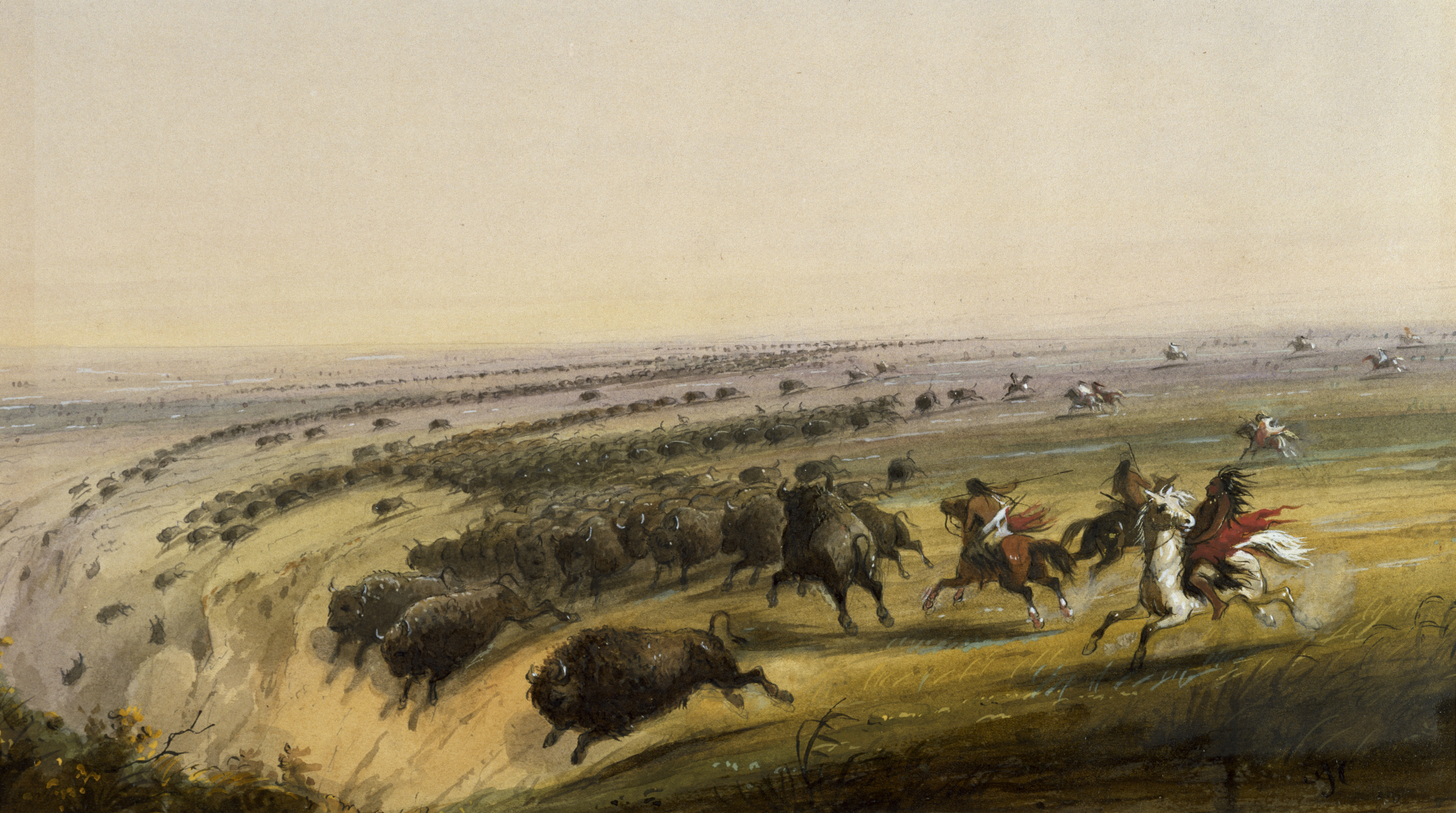
Regarding buffalo specifically, on the Plains, buffalo jumps could be considered a simultaneously efficient and wasteful method of hunting bison; the entire herd was driven over a cliff (as illustrated in this 19th Century painting. Of course, buffalo jumps have a long history of use. Head-Smashed-In first saw use at least as early 5500 years ago, and the Lewis and Clark expedition witnessed and old fashioned buffalo jump - one that didn't involve horses and required a hunter to guide the buffalo over the cliff on foot (don't worry, he'd get to safety at the last moment). The sheer number of buffalo killed during one of these jumps could potentially overwhelm the community's ability to process them. Still, when the meat is dried and converted into pemmican, it could be stored for long periods of time, so not all of it had to be consumed soon after the jump. As for using all the parts, the list of uses for the various parts of a buffalo is rather exhaustive (maybe not literally all parts, but enough to count colloquially at least). However, not every part was used every time, so some parts could well go unused if there was no need for its purpose when the buffalo was killed.
All that said, it's important to combat potential second-opinion-bias that might create the impression that Native Americans were, on the average, as rough on their environment as Europeans. While the traditional ecological philosophy of European is based on premises that amount to "be fruitful and multiply" and having "dominion over the earth" (to quote from a famous influence upon European thought), on this side of the Atlantic there are numerous tales and legends that warn against the dangers of overpopulation and over-exploitation of resources. There's a Zuni equivalent to the myth of Orpheus; after the grieving lover fails to retrieve his departed from the underworld, the story concludes that this was a blessing in disguise, for if the dead could return, we'd all be starving. On a similar note, in the Cheyenne creation myth, after some debate, the two creators ultimately decide that people should die permanently rather than be resurrected after four days, for similar reasons.
Also, here in the east at least, the pre-Christian view on humanity's place in the natural order emphasized that we were not significantly higher ranked than other organisms. Animals, to a certain extent, were regarded as people too, with souls of their own, albeit with different capabilities. While hunting them was a necessary part of life, it was not something that should be done wantonly (ideally at least, some of the hunting practices adopted during the fur trade obviously deviated from this expectation).
Finally, many Native communities before and after Europeans arrived lived in "harmony with their environment" in the same way you might say a gardener lives in harmony with his garden. 'Harmony' and 'balance' are not the base the states of nature, but things that must be actively worked toward (see Jean Chaudhuri's A Sacred Path for the Muscogee take on this philosophy). The productive forests that the Europeans marveled at when they arrived were not untamed wilderness, but heavily managed land that was being continually altered to ensure it provided an essential diversity of plants, both for human uses and for habitat required by beneficial animals. The Native farmer's field was only one phase in this system. The subsequent phases of forest succession were all managed to emphasize the growth desirable plants like berry-producing shrubs that would spring up soon after the field was 'abandoned.' Even when the land was not used for farming and guided succession, it was still being engineered, mainly through the use of fire to suppress unwanted undergrowth and later phases of succession. Left unchecked by fire, many oak forests in the Eastern Woodlands will become beech-maple forests. And while beech and maple have their uses (beech provides nuts, and maple provides sugar and syrup), allowing them to dominate the forest would diminish the availability of other useful plants that thrive in oak forests.
Very briefly, another example of extensive alterations to the land for the better is the invention of terra preta by the pre-Columbian peoples of the Amazon. In general, rainforest soil is incredibly poor. They tend to be ancient and the bulk of their nutrient content has been consumed by uncountable generations of plants for millions of years and what little gets returned by decay is quickly leeched out by heavy rains. This is why when modern agriculture cuts down rainforest for farmland, the fields can only support such agriculture for a short time before the soil becomes completely exhausted and more land must be continually opened up for new fields. The pre-Columbian Amazonians avoided this problem by inventing an artificial soil called terra preta today. Here you can see the dark, nutrient rich terra preta compared to the typical rainforest soil. Unfortunately, the technique for creating terra preta has been lost, but if it could be recreated it'd be a huge boon for people through the world's tropics.
So ultimately, the answer to your question is that all humans can and do make ecological mistakes from time to time, and some ecological damage is worse than others. While many Native peoples before, during, and since European contact have held views on ecology that are quite distinct from traditional European ones and these might seem more eco-friendly, they're usually not the passive live-and-let-live harmony that people today might stereotypically imagine. Instead, it is an active process of harnessing natural processes and guiding them to human ends.