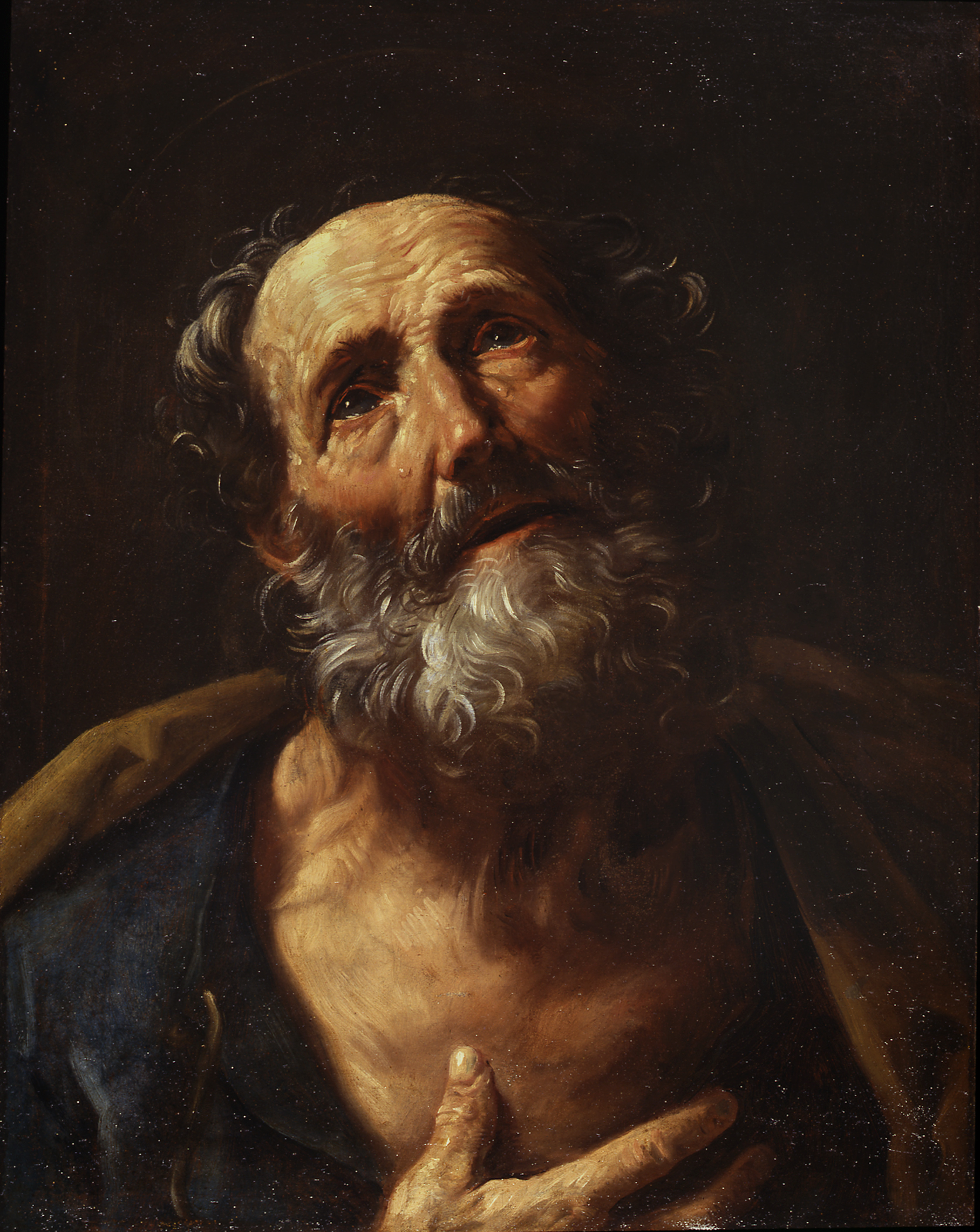
I have worded that question in the most basic and plain way I could manage. What I really mean is, why did we go from representations of people like this with unnatural positions and weird shaped bodies and faces to this with its lifelike expression and emotive face?
If it is purely down to materials available to the artist, then how is it possible that today a person can produce a highly lifelike portrait using only charcoal and rough paper?
Were the awkward and 2d figures of medieval european art a stylistic choice, or were the people of the time just not very good at drawing?
Not to be too brutal to my forefathers, but a lot of early to mid medieval representations of people are not too far beyond what you may expect from a child of 12-14 years old in the modern day. Even the paintings of battles towards the end of the period, in the wars of the roses, feature rather odd looking bodies and flat landscapes.
What were the people back then missing? What was stopping a gifted artist from working out how to draw depth of field, or how to capture the essence of a human face?
If it is purely down to materials available to the artist, then how is it possible that today a person can produce a highly lifelike portrait using only charcoal and rough paper?
definitely definitely not anything to do with materials. Well, at least not in the way you are phrasing it. The first image you linked looks like it's from a book - I'd imagine on vellum. Look how thick that book is. That is how many unique works must be produced. The second painting you linked is a standalone work (or perhaps part of a diptych or triptych, but, not 100's and 100's of works). Comparing the two is hardly fair - think of how much time it would take to make THAT many paintings all of the quality of the second image you linked. At the time, there was also a demand for these religious books from wealthy people (religion has supported the arts hugely throughout the years, but, thats a bit of a digression).
Were the awkward and 2d figures of medieval european art a stylistic choice,
absolutely. Even when people were capable of rendering things realistically, they still chose to warp perspective/reality in order to show their idea better. Here we can see the table being shown unrealistically in order to give us a better idea of what is on the table, and show off religious text.
What were the people back then missing?
perspective! The reason little kids are able to do all of this stuff is because we teach them things humans have learned in the past. I don't know about everyone's schooling, but, as a kid, they had us do several drawings like what is shown to teach us about vanishing points and perspective. We are able to create this illusion from an early age because of what we've learned from others throughout history.
What was stopping a gifted artist from working out how to draw depth of field, or how to capture the essence of a human face?
they were at the time drawing more symbolically, and everyone would draw these things differently for different stylistic choices. Different countries/regions had their own sense of style and wished to represent this. I believe in russian history Patriarch Nikon destroyed religious art that was from other regions (either because they depicted the lord and broke the commandments by creating 'false idols' to worship, or because he thought they were grotesque. I forget which). People can get passionate about art, and very territorial/nationalistic.
People were also often drawing animals based off of a book of drawings (of the animals - not photos of animals). I wish I could remember the name, but there was one piece of work where jesus was surrounded by the animals of the earth - and there were fish in the sky and other impossible things because the artist was working off of a book of animals rather than see the animals from life.
They didn't have photos to go off of. There was also a contraption that helped artists learn perspective, that I'm not really sure how to findfound it!. Imagine a window with a grid on it, and a person on the other side for you to draw (from life). You grid your paper, and then draw the person based off of the grid. Foreshortening, perspective, etc. were all huge improvements in terms of realism. A lot of people made things flat, as you say, because they were painting on something flat. The idea of creating such a strong illusion hadn't been worked out just yet. Foreshortening is pretty fancy stuff, and even nowadays if you walk into a lifedrawing class many trained artists will still struggle with foreshortening.
I'm not super 100% certain on where everything started, but, considering you are wondering why art before the 1300's is 'bad' and unrealistic, if you take a look at the timeline, the biggest movement in art history started during the 13th century. The renaissance was HUGE and people gave a lot more study to art.
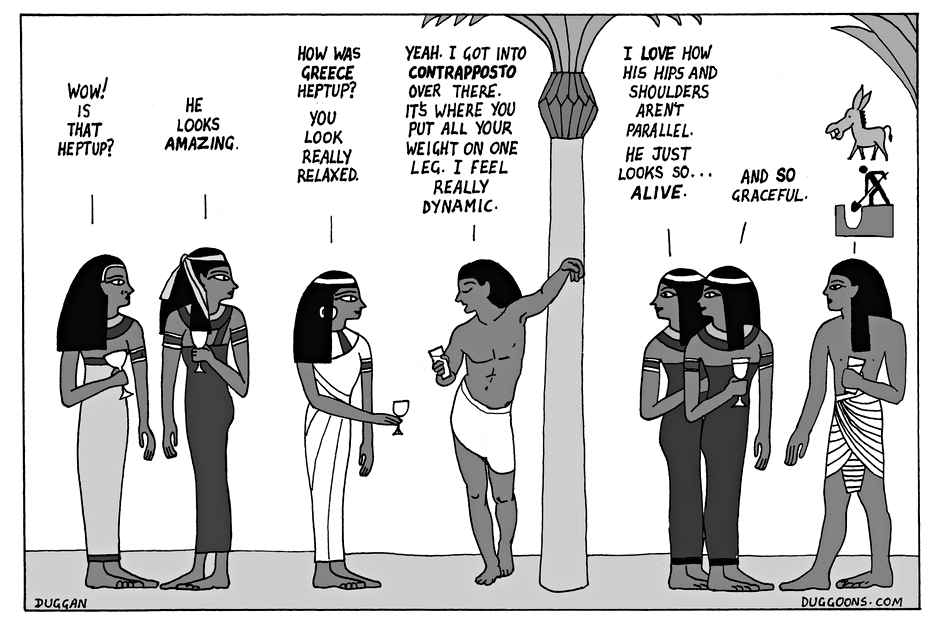
and, for a bit of humor, a comparison of cultures. We've come a long way from cavemen painting their hunts on the wall, to people being able to render something that 'looks' like a person, to adding perspective and realistic shading, all the way to creating optical tricks to show off skill.. Again on the renaissance, even if things weren't 'invented' during these times, it would be huge in revival (contrappostofor example existed prior to the renaissance, yet we use the italian word contrapposto) of previously underused techniques.
ahhshit, I see this is ask historians not ask art historians. Which, is totally fine, but, I wrote all of this out already and don't want it to be a total waste. I don't know if it will quite meet the standards as I don't have scholarly articles backing my claims or anything, just paintings for my sources. Does this quite meet the cut? Is art more subjective?
Well, this is still here so I guess it makes the cut. On that note, from an art person to you history people, can anyone clarify what happened with Patriarch Nikon? It's been awhile I can't really remember what got him called an iconoclast EXACTLY, nor what region people were getting art from that he hated (I think it was germanic art, possibly expressionistic work? I want to say he found it too grotesque but I can't remember 100% and my laptop with my old college essays is melted)
Hi there, there's actually an entire section of our FAQs about ancient art and "realism":
http://www.reddit.com/r/AskHistorians/wiki/art#wiki_why_wasn.27t_ancient_art_realistic.3F
This is not to discourage further answers, but it may be of interest to you. Thanks!
why did we go from representations of people like this with unnatural positions and weird shaped bodies and faces to this with its lifelike expression and emotive face?
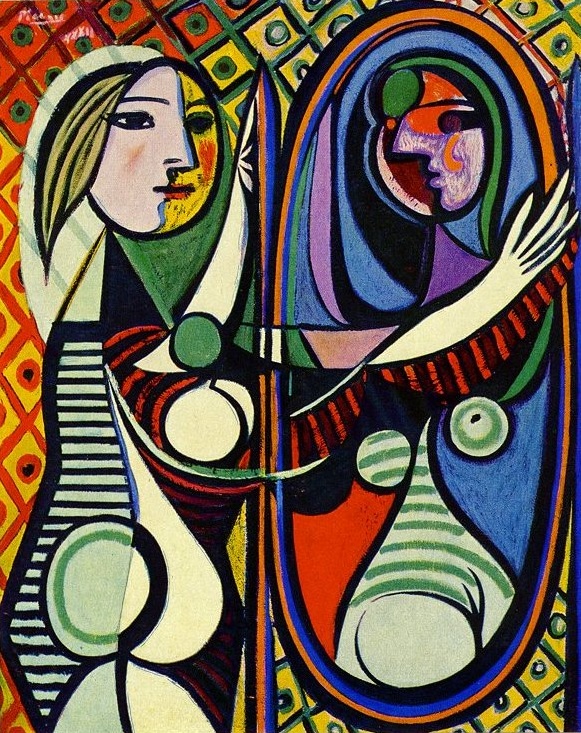
Stylistic choice. The same reason Picasso for instance went from 'realistic' images to abstract images. Was it because he suddenly lost the ability to draw realistically? Is the first more technically sophisticated than the second? Of course not. He was experimenting and trying new ways of representing an image.
Rules of perspective and realistic representations of scenes were well-known in earlier centuries such as this image from Pompeii, this gospel illumination from Charlemagne's time, and this portrait from the 1st century. You can see that linear rules of perspective are known and used and realistic representations are possible. But strict and consistent mathematical use of these rules weren't important and no one seems to have turned perspective illusions into a strict system. Why would they? The Romans and the Greeks knew how to use tricks of linear perspective to force illusions of depth. But it seems to have been a novelty and to have fallen out of style very quickly. Linear perspective may be a neat trick, but artists appear to have preferred other ways of representation as more aesthetically, and symbolically interesting.
Fascinatingly, linear perspective is commonly reversed in Byzantine art, preferring to converge the lines on the viewer rather than on the horizon such as in this image. This again is a stylistic choice, created for effect. It is not that the artist does this because he can't draw persepective properly, but because he thinks this better suits what he is trying to convey with his art.
You may describe certain artistic styles as childish and technically unsophisticated. But this is a subjective choice on your part, and means very little to the artists of the time, and those who enjoyed it.
Maybe a better question is why are we calling your second painting more lifelike? I do not know anyone who looks precisely like that, and I doubt you do as well. There is much that is unnatural in this painting as well. The skin tone and texture is such that the figure of St. Peter has an unnatural hardness, rather more like a piece of sculpture-compare with the medieval paintings, where the bodies are softly painted enough that they seem supple and flexible like living bodies. We are rather calling this lifelike and better because it accords with what sort of things we are inclined to seek in a picture and expresses emotions in a certain highly dramatic way that presents a set of cues we are used to. Realism, as a rule, is less an absolute than a relative term; we call something realistic because it seems to us more natural than something else because it follows the sort of cues we are taught to expect from a painting more closely. In fact, we might even say that a medieval painter of the 14th century is apt to consider elegance and grace in line a more important pictorial value and a neapolitan baroque artist of the 17th century(which is what Reni is) is more likely to consider a strong sculptural quality and dramatic shadows important. In fact, we can see this even in Renaissance painting if we compare for example Michelangelo and Raphael as two painters from roughly the same time and place and both very highly regarded painters at the top of their profession.
Were Roman portraits very realistic as they replaced sculptures? Did any of these survive?
I'm going to go ahead and reply specifically about the basis of your question, and then when I have time (its thanksgivings and family is over) ill come back and address the topic more broadly and with better examples. Also your question seems to be addressing European art specifically so I will stick to that.
First I completely disagree that the paintings you found would be something made by 12-14 year olds. Using your example of the battle scene you see many elements that you would not expect a 14 year old to reproduce at that level. The landscape is highly detailed and layered, the armour is well painted and detailed. This painting wasn't just made for aesthetic reasons- it tells a story. Your first example is in a similar vein- the composition is highly arranged and well layer out. You can figure out what was going on very quickly by looking at it. The focus here isn't on emotions like in your 'realistic' example- its telling a story or conveying information. I am going to reverse image search your examples because I am certain their context is crucial to understanding their style (and it is important to point out they are both different styles and periods).
Now to dispel the notion that European drawings before 1300 were not lifelike or capable of realism I will take a look at Roman and Greek art. As a counter example of 'flat' or 'unreal' art I will contrast Byzantium and specifically their iconosos so we can get a better look a the interaction of 'real' and 'unreal' art and outside influences upon them and on each other.
Several clarifications for my answer to you: I am guessing you are using the 1300s as a cutoff date because of the rise of the Renaissance a combination of many elements not the least of which was the 'rediscovery' of Roman and Greek art and works. I am also going to include mosaics as examples despite them not being drawings, since the question seems to be more concerned with the depiction of realism in two dimensions.
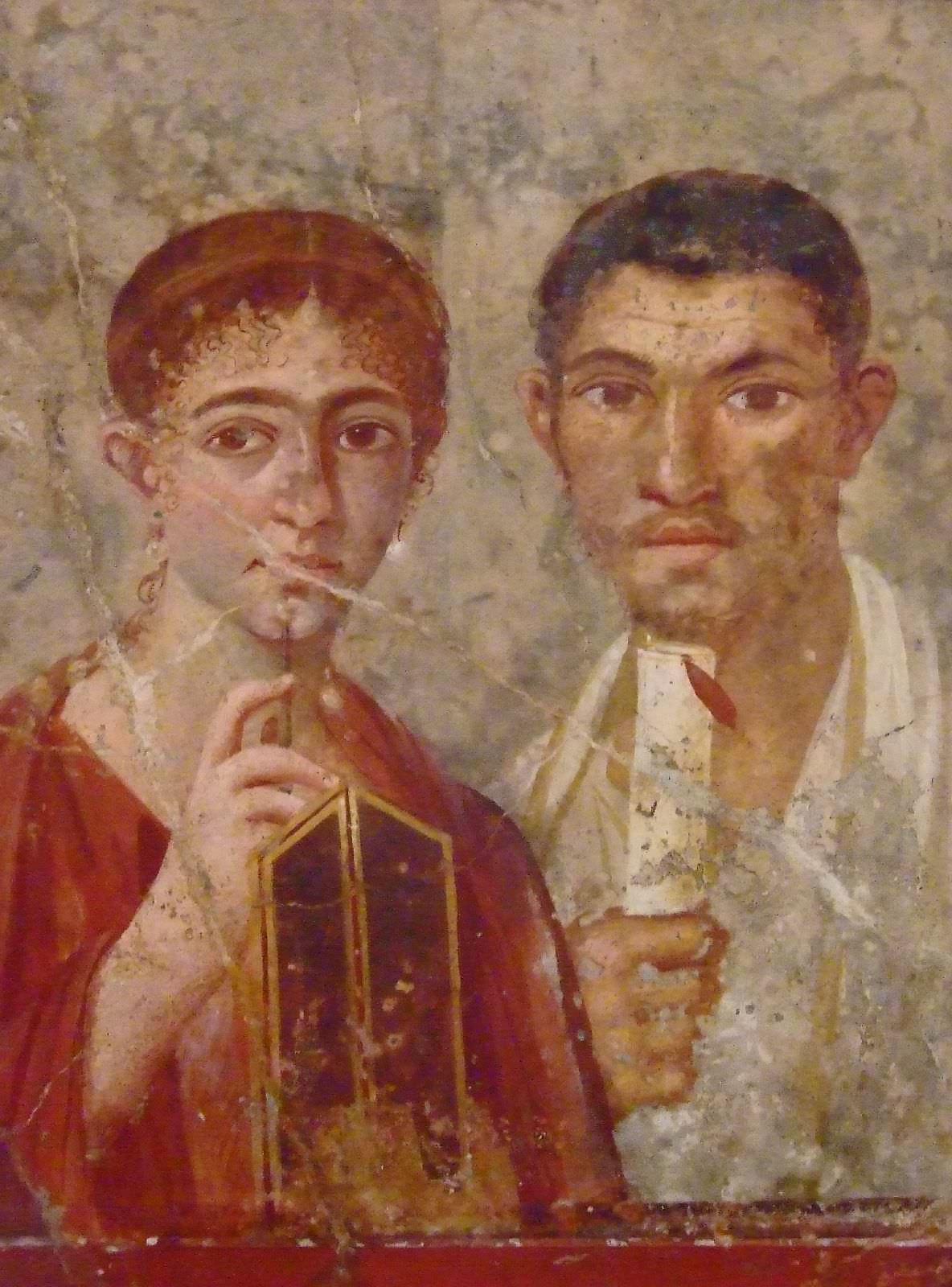
Roman art could be highly emotive and realistic. Everyone knows about their wonderful statues and architecture, but the drawn art is less known. There are several reasons for this but one of the main ones is that they were not as well preserved and there are less surviving examples. Pompeii and Herculaneum are were many examples of period Roman art come from. This portrait of a man and wife is a good example. There is both symbolism and realism portrayed here. His hand clutching the scroll shows he was likely an official, and the woman is showing she can write- a distinction at the time. They face head on to the viewer and the eyes are a bit large, but there are also shadows and objects in the foreground are roughly proportional to those farther away. The subjects are being portrayed realistically, but also in a very composed manner containing symbolism. In these paintings 1; 2; 3 The subjects are posed, but the human body is clearly being put on display in a proportional and realistic manner. Perspective is present, even if not perfectly executed.
Other similar ruins you can visit today still have bits of original paint still attached. Hadrian's Villa even still has a little bit of paint on it if you look closely in the right places (the Grand Thermae has some). Ruins underneath Rome also have some fantastic art preserved. Grotesque artwork itself is actually directly inspired by Roman art unearthed centuries later. The term doesn't mean the creations are disgusting, the term comes from the frescoes painted on grottoes. While it isn't a particularly emotive style (and humans aren't often the main subject) the artwork does not appear static or particularly flat.
Roman art wasn't afraid of realistically portraying the human body. The statues from Rome that everyone know and love are an excellent example of that. Unfortunately the drawn artwork hasn't survived to the extent the stone has, but what has survived shows a richness and complexity exhibited in their other art and architecture.
Edit: more to come
Edit 2: still more to come, about to talk about Byzantium, the Orthodox church, the fall of the Roman empire, and 'unreal' art.
Something to remember is the purpose of the drawing. In a lot of Byzantine and early medieval art, the purpose was to convey a message or a story. Much of this art was targeted to illiterate people. Much of this art were depictions of events or stories.
And much of this art was a part of something bigger, like a manuscript, or a church stained-glass window. The artwork itself was not usually the purpose.
If you know the story behind the artwork, you would probably better understand why the artist included this object there, or made the subjects expression this way. Sometimes adding realism detracts from the story-telling in a single-frame medium.
Other posts in this thread point out that there are examples of pre-1300 art can be realistic and beautiful. So, the skill-level is there. But with the examples provided in the original post, the purpose was likely to just tell a story.
Just saying "drawings" is misleading - what you linked are probably paintings, or if the first image is from a book may be some type of print that was mass-produced. So let's look at art as a whole to include paintings and sculptures.
Greek and Roman art was incredibly life-like and reference for later realistic art in the Renaissance and Neoclassical periods. Art shows us what was important to a culture - Greeks, Romans, Renaissance Italy, Neoclassic France... all these places were in phases of appreciating beauty and the human form, so their art reflects a valuing of that.
The first picture you linked looks like it belongs to the Medieval period, which was a time of oppression and shaming of the human form and of superfluous things like beautiful art and decoration. Art was used to communicate stories and values, so things are simplified and reduced to childish picturebook forms.
Look at art in various cultures today. We have all kinds of materials for artists, and there are all kinds of cultures and freedoms to express yourself... yet some artists still choose to do very 'not good or lifelike' representations of the human form, or other off the wall wacky stuff (paging Yoko Ono). This is because of our culture, not because of materials available. In order for art to be 'good' it doesn't necessarily have to be any one particular thing - it's up for interpretation.
In religious art, at least in icons, symbolism of spiritually trumped realism to the extent that one icon I read of, having been made by someone who had known the saint in his youth, was condemned as being too realistic. On the other hand, the secular Ravenna mosaics of Justinian and Theodora with their retinues are clearly portraits of the principal subjects. Moreover realism in sculpture was quite vibrant throughout the middle ages. I don't think enough attention is given to medieval German wooden sculpture. Again, in book illustration detail was not important any more than it is in books for very little children today. An artist illustrating Jesus in a boat cared not a bit about the accuracy of the boat for its own sake only about illustrating the spiritual text. It is very difficult (impossible?) for us today to get into the mindset of someone back then who cared only about the message not the facts, who didn't have a sense of history or of change generally, who had no concept of science. To get away from art a bit, one can condemn Thomas Aquinas for not being honest in his philosophy but he had no intention to discover truth. To him he had the truth from scripture and only had to justify it to nonbelievers. Things like advancing technology, or discovering anything new, or historical analysis would have been meaningless. History and biography was a morality play and it didn't matter if there were more relics of a saint than he had body parts. I'm getting away from your question but only to show that with a few notable exceptions the medieval mind was not concerned with fact, scientific, historical, or artistic, only with the message. Even when I was a boy priests and ministers would twist the words of scripture entirely out of context to illustrate some unrelated message.
The development of optics made a difference as well - David Hockey wrote an entire book about it :) Basically the idea is that lenses allowed projection of mages, which could then be copied in a very lifelike manner.
There's a lot more to it than that, and I highly recommend having a read if you're interested in this subject.