Given the controversy surrounding the casting in the newly released Moses film, a lot of people have been giving different takes on the primary race in Egypt. Some say, at the time, people were more lighter skinned and closer to being white than they are today, some say they've always been more tan.
Given Egypt has a very long history, I am really only asking specifically about the time period Moses took place. If you want to shed some light about race during other times in Egypt's history, feel free to do that also.
One final note, I had read that the Ptolemaic dynasty was white, since that were Macedonian Greek in origin, and then became rulers of Egypt and, through constant inbreeding, remained white until their rule ended with Cleopatra VII.
This question pops up all the time, which means I've become a bit of an old hand at answering this, especially with regard to Cleopatra VII. So let's dive right in, shall we?
First of all, let’s look at Lucan, a Roman poet from the 1st century AD, who technically described Cleopatra as being white, when referring to her as candida (Latin for white/pale/fair-skinned) in the following lines: “candida Sidonio perlucent pectora filo / quod Nilotis acus conpressum pectine Serum / soluit et extenso laxauit stamina velo” (Luc. 10.141-143).
Now I am a Classicist, a Latinist to be more precise. I’ve dedicated nearly 10 years of my life to the study of the ancient world. That being said, this was one of the very few references to Cleopatra’s “skin color” in antiquity that I was actually able to hunt down. Plutarch tends to focus on her surprising linguistic abilities, her charm and general bearing, while Florus and Appian remark generically on her pleasing figure. Even Cicero mentions Cleopatra to his friend, Atticus, though it is only to complain that she was haughty and did not give him a gift (grow up, Cicero). And then we have stereotypical calumny from the Augustan poets, such as Horace, who described Cleopatra as fatale monstrum (I don’t think I even need to translate that. It means exactly what it looks like). Similarities can and have also been drawn between the infamous and tragic Dido, Queen of Carthage, from Vergil’s Aeneid and the fatal queen of Egypt (and while my love for Dido knows no bounds, I can with certainty say, “Dido est monstrum”).
However, this isn’t to say that multiculturalism wasn’t a concern of antiquity; we have only to look to Juvenal’s Satire 3, wherein he complains that jobs in Rome were taken up mostly be ethnic minorities. Or Valerius Maximus’ Facta et dicta memorabilia 2.2.2, which stresses the importance of using Latin instead of Greek. (This all sounds very similar to contemporary issues, doesn’t it?) Cleopatra would have been the object of such slanderous words because it suited politics at the time.
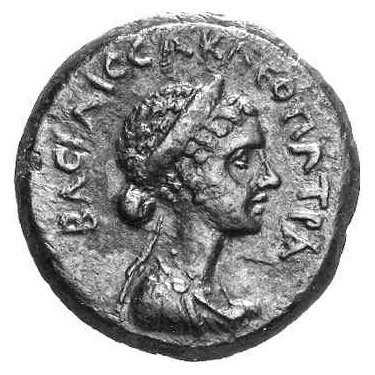
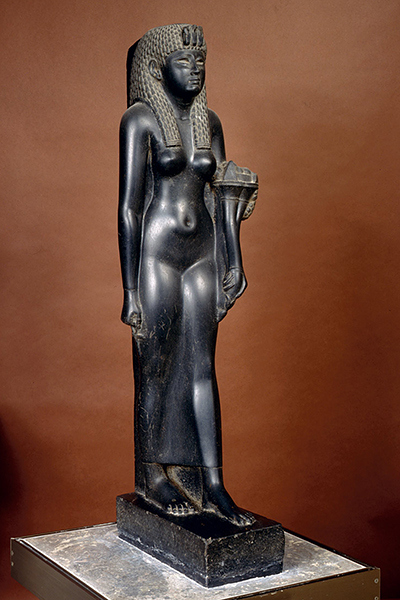
Moreover there are extant portraits of Cleopatra VII from antiquity, but these must all be analyzed with a grain of salt. Cleopatra is known for being the only Ptolemaic queen to print her own image and name on her coinage, but these icons, like the marble busts of her that remain intact, are highly stylized in the Hellenistic custom. Indeed many scholars believe that her later coins were made to have her more closely resemble Antony; an obvious choice, concerning all the other ties she made to her consort in order to strengthen her position — a foolish queen Cleopatra was not. There is also a basalt statue of her in the Egyptian style, in which many of her predecessors were also carved (though good luck telling them apart without brushing up on your cartouches).
Which brings me back to Lucan. Lucan’s poetic description of Cleopatra was exactly that: a poetic description. Stylized. All of these images and descriptions are so highly stylized, it boggles the mind; were a name and author not attached, I’d be inclined to believe they referred to Zenobia, or a whole host of other queens from the Hellenistic period and onward. For fuck’s sake, I’ve seen cattle described as candida in Latin poetry (coughs Ver. Aen. 4.61 coughs).
Just because Lucan called her candida does not make Cleopatra “white.” Just because there’s a basalt statue in the Egyptian style of Cleopatra does not make her “black.”
And now for the punchline of this post: One of the main problems when discussing the white-washing of ancient figures is that the very concept of race in the ancient world was vastly different. As Denise McCoskey so starkly puts it when describing a class she taught on race in the ancient world, “Students were ask to historicize their understanding of race and ethnicity and, in doing so, were quickly forced to confront the fact that racial and ethnic discourses are not universal, but are dependent on social and political contexts for their formulations. My students, for example, were quite surprised (in many cases shocked) to discover that at the outset that race in antiquity was not primarily determined by skin color, as it so often seems today” (McCoskey, Answering the Multicultural Imperative: A Course on Race and Ethnicity in Antiquity, p.555, Journal of the Classical World published by Johns Hopkins University Press).
In other words, it’s a complex world out there.