(The title of this theme is cribbed from one of my favorite history books. And this theme definately wasn’t thought up while pissily doing housework.)
Previous weeks' Tuesday Trivias and the complete upcoming schedule.
What sort of work was done by women in your favorite time and place? It can be about work traditionally done by women in that society, or it can be women doing work outside of their traditional purview (like maybe Rosie the Riveter stuff), or it can be how certain gendered work either switched which gender it “belonged” to, or became ungendered. Or any other interpretation of “women’s work” you can come up with is good really.
Next week on Tuesday Trivia: Siblings! We’ll be telling stories of historic siblings.
Is today’s theme just an excuse for me to post a long winded ramble about my hobbies? Of course not.
But it’s time to talk about knitting and its fantastically understudied history. Knitting gets very little attention from “real” historians, its history and folklore was only passed orally for a long time, and today it is primarily discussed in pattern books, blogs, and forums. I know of a whopping TWO academic-ish history books about knitting. It’s a history you don’t think about unless you start doing it I think.
I knit my share of junky modern stuff with fun-fur eyelash yarn and such, but I try to do some historic and vintage things because they make me feel a connection with women of the past that I really can’t get elsewhere, even from cooking historic recipes which I also like to do. (I suspect my foremothers would laugh at me feeling historical by making anything in my modern kitchen on my clean electric stove.) Knitting is kinda extra-historical because its largely unchanged from its murky invention, sure there are innovations, like the knitting machine, or those sweet rubber caps for the tips of needles so your stitches don’t slide off the ends, and the fun of superbulky yarns knit on needles the size of Olive Garden breadsticks, but in the end hand-knitting is still just you making some fabric with 2 or more pointy sticks and some string. Just like people (especially women-people) did generations and generations before you.
I’ll steal a quote from Franklin Habit who really sums up the appeal:
Whenever I work through an antique pattern, my thoughts inevitably turn to another knitter, long gone and utterly forgotten, who may have pursued the same course of knits and purls [...] Sometimes she’s an expectant mother puzzling over the Baby’s Hood, or a grandmother with a quiet afternoon turning out yet another Pence Jug. She may be called Ada or Isabel. She may live on the American frontier or in a London row house. She may be knitting under a tree, or beside a coal fire. She often, when confounded by the same vagueness in the pattern that confounds me, indulges in unladylike and possibly anachronistic vulgarities. (“Oh, @#$!% this @#%@^ nightcap,” said Aunt Ada.) (source, I’ve been meaning to make the Mrs. Roosevelt Mittens for like 5 years now.)
Another reason I am drawn to knitting is because it was a skilled cottage industry for a lot of centuries, especially for Scottish women, who would be the bulk of my ancestors. Scotland in particular was known for socks and lacework. Knitting was a source of money people who otherwise couldn’t do any useful labor - it doesn’t require a lot of investment in materials (you just need needles and yarn), nor does it require physical strength, it could be done by people otherwise unemployable like the elderly or infirm, or just farming-people in winter. Another reason knitting is so lovely is because it’s a social or asocial activity as you see fit. You can knit in a group, you can knit with a friend, you can knit on the couch with your husband, or you can knit all by yourself. Many of the women who had to knit for money or to keep their family clothed did that shit on the go between other work.
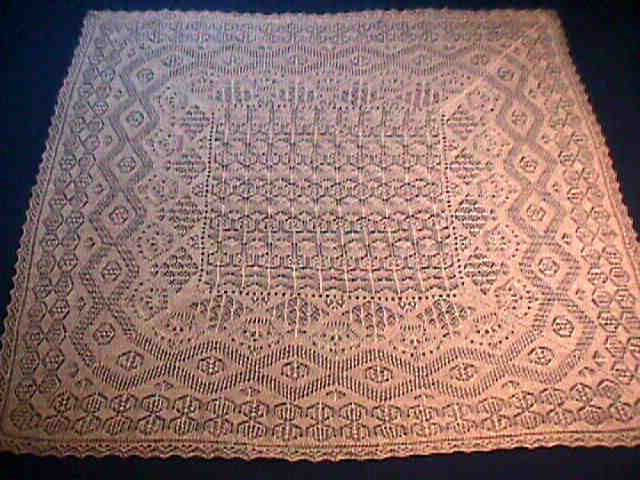
My favorite type of knitting is lace knitting, my goal is to someday make a Shetland lace “wedding ring” shawl, which is the pinnacle of a lace knitter’s art. But for the meantime I stick to simpler lacework. Like most knitters, I have a habit of buying yarn that I think looks really cool in the skein, getting it home, forgetting about it, and years later discovering some butt ugly yarn in my closet and then desperately trying to think of something to use it up on. Here is my yarn of the moment, a bulky weight dark purple mohair with a sparkle running through it, which I know must have seemed awesome at the time but now strikes me as compelling evidence that I have truly awful taste and should not be allowed to dress myself. It’s also itchy, and I had 8 goddamned skeins of this to somehow make into something acceptable. I decided on a lace wrap (as wraps/shawls don’t get too close to your body so the itchy wouldn’t be too bad). Mohair yarns’ fuzzy halo kinda “muffles” the visual impact of lace patterns, so I wanted a bolder, simpler lace that would still be visible through the eye-stunning fug of a sparkly mohair. I settled on Old Shale Stitch, which is an old Shetland lace pattern. It’s actually really “Shell Stitch” because it looks like seashells but the early knitting pattern collectors didn’t speak Highland brogue so it got put down in the books as Shale. It’s the traditional edging on hap shawls which are big wool shawls that would be everyday wear, so I thought I’d make my wrap something of an homage to those. It’s also an “unbalanced” lace (that doesn’t stay square as you knit up), so I thought the way it pulled itself into ripples was also kinda neat.
So, my husband was unexpectedly in the hospital for a few days 2 weeks ago, and when I rushed home after he was admitted I had a few minutes to gather some overnight stuff and then just anything to distract me, and I grabbed: a gay romance novel, a Tupperware container full of soynuts (I don’t remember what the thinking was on this one), and my knitting. And boy did that damn knitting just about save my life. I did not have 2 brains cells to rub together long enough to do any sort of reading so the book got left in my bag the entire time, but I think I knitted about 5 skeins in 48 hours. “I’m sorry about all the mohair!” I said to the cleaning staff as I shredded like a dog blowing coat, compulsively knitting in the guest chair. But that repetitive, productive movement of knitting gave me a comforting connection to countless women before me who had no doubt sat at many besides waiting to see what would become of their loved ones. Husbands have always gotten sick. Illness has always been fearful. And women have always worked through it. (And after all this I forgot to take a picture of the final product last night, I'll see if I can update with a photo when I get home.)
Anyway he’s fine. After Christmas is done I think I’m going to make good on my threats and finally make him a historic Scottish-pattern gansey and force him to wear it.
Anyway, if you’d like to read about the history of knitting, here are the two books:
A History of Hand Knitting by Richard Rutt, from 1987 and EXTREMELY British
Knitting by the Fireside and on the Hillside: A History of the Shetland Hand Knitting Industry c.1600-1950 by Linda G. Fryer, from 1994 and not so terribly British
OMG, so I recently got a book about propaganda posters during the Cultural Revolution in China, and in it, there's a section about women as subjects, called "women hold up half the sky". I'M SO EXCITED TO TALK ABOUT WOMEN IN MY AREA OF HISTORY OMG YAYYYYYYYYYYYYY.
(I know, I was really informal and rather unbecoming in my tone, but I've been excited to write this post all day, or at least since I saw this thread at eight this morning. Please forgive me for the informality of the preceding paragraph. I'll try to contain my excitement a bit.)
"Women hold up half the sky" was a propaganda slogan that came into prominence during the Cultural Revolution in China. This was yet another way in which women's roles had been changed, continuing a tradition of redefining a women's place stemming from discussions on how to make China a stronger country in the 19th century.
Some background. Women and their role in society has been a part of national debate and intellectual discussion since the late 19th century. Their status was linked to the country's prosperity and health (of sorts). Intellectuals came to believe that the Chinese woman, with her bound feet and her restrictions encoded in Confucian ideology, was a sign of China's backward nature. As such, it was believed that reforming or revolutionizing her status would lead to a stronger, more modernized China. Reforms included abolishing the concubine system, banning the practice of foot binding, educating women, free choice marriage instead of the arranged marriage system, the right to divorce, and encouraging women to take part in the political -- and outer -- sphere. Most of these early reform efforts were led by men, although some women did take part (both on the Nationalist side and the Communist side).
(I'm getting rather off topic, but if you're curious about this topic, I highly recommend the book Engendering the Chinese Revolution, Radical Women, Communist Politics, and Mass Movements in the 1920s by Christina Kelley Gilmartin. The focus is on the Communist Party's gender politics, but there's a chapter in there that does discuss how the Communists and Nationalists worked together to advance women's rights during the First United Front of the 1920s.)
Anyways, so the Communists come into power, brought about various reforms such as the Marriage Law of the 1950s and the land reforms (which allowed women to own land), etc etc etc. Now we get to the topic of this post: propaganda posters!
The Cultural Revolution had new goals for women, new roles. Women were being encouraged to take on traditionally masculine professions, to stop wearing feminine dress, and to otherwise help build a better Communist nation. For a woman to act more masculine is to lead revolution; being concerned with things like beauty and fashion were seen as bourgeoisie and otherwise bad. Because of this, many of the women depicted in these posters have short hair and are dressed in clothes that don't emphasize curves or the feminine form. Furthermore, attention wasn't being drawn to her because she was a woman, but because she was accomplishing tasks that would further state goals and lead to revolution and another new China. Whether she was working in the capacity of an agricultural worker, a student, an air force pilot, an electrical worker, a chemist, or more, she was furthering revolution. It didn't matter what her sex was; what mattered was whether she could do these jobs. And as these propaganda posters show, the Chinese Communist Party believed that she could. She held up half the sky, remember?
This time period saw the introduction of the Iron Girl, a woman who was able to take on jobs in heavy industry, construction, and agriculture alongside men. She was able to do the same work that the men did, and she did it well. She was the epitome of what an ideal woman should be during this time period: more masculine, equal in status alongside men, and holding her half of the sky. These Iron Girls were the subject of many propaganda posters, serving as a prominent symbol of the Chinese Communist Party's gender ideology during this period.
However, when the Cultural Revolution came to an end, the Iron Girl served as a symbol on what was wrong with Party ideology prior to economic reforms. Femininity became an important trait again, with publications emphasizing that men and women were inherently different from one another. Instead of being held up to the standards of men, people during the 1980s believed that a new standard should be made for women to live up to, in order to account for this "inherent difference" between the sexes. (See: Personal Voices: Chinese Women in the 1980s by Emily Honig and Gail Hershatter, which discusses this topic at length).
Sorry this is a tad lazy, but I've written on Chinese immigrant prostitution a few times in the past on /r/askhistorians, so I'm going patch together my previous posts on the topic. Excuse the lack of context, these were all answers to distinct questions that were not 100% about prostitution.
One type of Chinese slavery that did occur with more frequency, even after the passage of the 13th amendment, was the sexual slavery of Chinese prostitutes. As with anything, the individual quality of life for these prostitutes varied, but was of course abysmal. They were often beaten, abused, etc. The prostitutes came from China (typically southern, Cantonese-speaking provinces like Guangdong). They were usually lured over--either with trickery or outright kidnapping, made to sign a pretty malicious contract, and worked for somewhere around 3-5 years, during which time they were completely the property of the brothel owner, or "pimp" to use the modern-day terminology. I am not aware of any black prostitutes in California at this time (though I'm sure they existed), so I can't speak to that. I can tell you that Chinese prostitutes had a better time within the Chinese community than white prostitutes had in the white community. The Chinese prostitutes were usually prostitutes due to family necessity--their homes in China couldn't take care of them, the family needed money, etc. The Californian Chinese community knew this, and thus treated the Chinese prostitutes not as "dirty whores" the way some white prostitutes were looked at, but instead as disadvantaged women, trying to do what was right for the family.
.
In the earlier days of Chinatown, the Chinese quarter had a significant seedy underbelly, which had things like opium dens. One of the businesses more frequently attended by whites were the brothels. Rumors that Chinese vaginas were shaped differently than American ones led to the popularity of the "ten-cent lookee"--providing a cheap sexual outlet for young white laborers, sailors, et al.
.
Because of the under-the-table nature of prostitution, as well as Chinese presence in general, it's hard to estimate how many women served a prostitutes. If we look at the numbers and err on the side of more prostitution, we can get a figure as high as 85% for the peak percentage of women serving as prostitutes (this number is specific to San Francisco). This percentage declined over time, as more women came and started taking the roles of housewives or even laborers and wage-earners.
Excuse me for offering such a dismal portion of "women's work"!
While my post won't compare to Caffarelli's, my favorite time to study in history was WWII, and place would be Germany, the United States, and Great Britain. Most of us know how the role of Women changed in the United States and Great Britain with women moving into the jobs held by men because the men were all off fighting the war, as well as the women working industrial jobs due to the huge demand for heavy industrial products thanks to the war, but the change of roles in Nazi Germany for women is quite different, and very interesting. In Nazi Germany, women actually went away from the workforce and back to being housewives, a change rarely seen during wartime. Hitler saw no purpose or reason for women to work, and their main job was to take care of the house and MOST importantly, produce children. That is, only if they were of Aryan descent. Women deemed "unpure" that wouldn't be necessarily prosecuted under Nazi rule (so not jews, gypsys, etc.) but still deemed second class citizens because they were not of Aryan blood would sometimes undergo forced sterilization. To enforce this, all marriages had to be approved by local government officials, and if a member of the SS was seeking a bride, they potential bride had to undergo a very extensive background check to ensure they were "worthy" to marry and have children with Hitler's elite Aryan soldiers. This whole obsession over large families and motherhood started because in the 1920s Germany had the lowest birthrate in Europe, and this was viewed as a problem by Hitler because he thought a high birthrate meant a better chance at victory, not to mention he wanted future Aryans to continue conquest and to settle in what he envisioned as "the thousand year Reich" The Nazis declared mothers day a holiday and started giving gold cross awards to elderly mothers with lots of children. Although the award itself was not valuable and held little meaning, it was viewed as a prestigious honor and encouraged women to have children. This along with extensive state propaganda, and a plenitude of financial benefits to young women deemed worthy to have children made the German birthrate take off from it's extremely low point in the 1920s and early 30s. There was a sort of cult of motherhood in place, and it was very desirable and encouraged to have a large family. In fact, the term family was reserved for couples with four or more children. While this may seem off topic since the topic of this thread was Women's work and I discussed the birthrate and motherhood in Nazi Germany, it's really not as that WAS women's jobs in Nazi Germany. It was accepted that women and their fertility belonged to the state, and they owed it to the nation to have a large family. (If they met the standards of course).
Once again I'll deal with some hockey history. This is about Marguerite Norris, the first woman to have her name engraved on the Stanley Cup.
Norris' father was James Norris, Sr. Through a series of questionable business dealings that aren't relevant here, he had control of three of the six teams in the NHL when he died in 1952. To sort this out, his sons had to relinquish control over his initial, and favourite, team, the Detroit Red Wings. James' 24-year-old daughter Marguerite was named president of the team. Ostensibly this was done so the brothers, James, Jr. and Bruce, could exert control over the Red Wings; she was just supposed to be a figurehead.
However that didn't work, and she took her job seriously, while ignoring her brothers. Already a strong team (they won the Stanley Cup in 1950 and 1952), the Red Wings won the Cup again in 1954 and 1955.
By this time the Norris brothers, and the GM of the Red Wings, Jack Adams, had had enough of a woman running the team, and worked to oust her. James, Jr., or Jimmy as he was known, sold his share of the Red Wings to Bruce in exchange for shares in the Chicago Black Hawks. This gave Bruce enough leverage in the Red Wings to appoint himself president of the team, demoting Marguerite to Vice-President, a largely meaningless role. With the Norris' still controlling three of the teams (and they would until the mid-1960s), the NHL was sometimes referred to as the "Norris House League," and not in a positive manner (not that it helped; except for 1961, no Norris-controlled team would win the Cup again).
Marguerite kept on with the team until 1957, when an abortive attempt by several players, including key members of the Red Wings, to form a players' union fell through. She opposed Bruce's reaction, which was to trade the offending players away, and resigned shortly after. Detroit would then endure decades of poor play and humiliation, and not win the Stanley Cup again until 1997 (the Norris family sold the team in the early 1980s).
Well, I had done a little prepping for questions about the role of women in the Spanish Civil War, and then no one asked about it in the AMA! So while it doesn't 100 percent fit, here is a bit I had already done a rough write-up of.
Views on gender roles between the Nationalists and Loyalists were quite stark in their differences. Spain had been way behind the rest of the west in terms of women's rights, but the rise of the Republic in 1931 set the country on a crash course of liberalization - one of the major criticism of the Popular Front from the right prior to the war. By the mid-30s, Spain was at the forefront of women's liberation!
In the case of the Loyalists, progressive attitudes saw women not only being encouraged to work outside the home in in formerly male dominated jobs such as factories, but in some factions (especially the Anarchist CNT-FAI), women fought side by side with men in the militias as they battled the Nationalists. This would become less common however with the consolidation of forces under PCE (Communist) control later in the war.
While the Nationalists did encourage women to contribute to the war effort as well, it was much more constrained within framework of traditional domesticity. The Auxilio Social, for instance, was a humanitarian arm of the Falange’s “Seccion Femenina”, and provided nursing and relief work for both soldiers and civilians in Nationalist controlled areas. Such work was only for young, unmarried women, and leaders made clear that a woman’s most important role remained in the home with her family.
With the defeat of the Loyalists, what changes had happened were quickly reversed. Women were back to being seen as mothers and wives, and lost the equality that they had briefly enjoyed. Spain would again fall behind the rest of the west - only women who were heads of households would be allowed to vote until the 1970s.
So this is one of my favorite stories. It's about a woman named Barira, who was a slave in Arabia in the early 600s. Her example became an important legal precedent for early Islamic scholars. The first scholar to organize stories about Muhammad into a collection of precedents for use by jurists (the Sahih al-Bukhari, c.840s) included the story of Barira in 33 different places, suggesting just how important he thought it was.
Aisha said:
Barira had come to her seek help with her emancipation contract. She had to pay five ounces (of gold) in five yearly installments. Aisha said to her, “Do you think that if I pay the whole sum at once, your masters will sell you to me? If so, then I will free you and your wala’ (loyalty) will be for me.” Barira went to her masters and told them about the offer. They said that they would not agree to it unless her wala’ would be for them.
Aisha continued: I went to God’s Messenger and told him about it. God’s Messenger said to her, “Buy Barira and manumit her. The wala’ will be for the liberator.” God’s Messenger then got up and said, “What about those people who stipulate conditions that are not present in God’s laws? If anybody stipulates a condition which is not in God’s laws, then what he stipulates is invalid. God’s conditions are the truth and are more solid.”
This story doesn't tell us much about Barira's day-to-day work. Other stories about the life and sayings of Muhammad make it clear that some slave women worked as cooks, fortunetellers, household managers, prostitutes, shepherds, tanners, and wet nurses. Not all this work was licit, but Barira's example shows that slave women could engage in these or other types of work to earn their own money, and eventually to buy their freedom.
What I think is even more interesting about this story is the opportunities taken by both Barira and Aisha (one of Muhammad's wives). Barira, a slave woman, negotiates and enters into a contract with her masters (i.e. she's partially owned by several different people). Aisha herself has access to what seems to be a substantial sum of money. Between the two of them, they negotiate not only for Barira's freedom, but they also establish who will receive Barira's wala’. This is an important relationship, similar to the patron/client relationships of antiquity, and it guarantees that Barira will still have someone obligated to provide for her once she's free. In return Aisha will receive a client obligated to support her, including providing food, hospitality, and requested services. And the hadith ends with Muhammad standing on a pulpit, affirming that these two women had the right to enter into such an agreement, purchasing Barira for manumission and clientage, even on the false condition that her wala’ will go to her previous owners.
So although the story of Barira doesn't tell us about the particular labor that women were doing, it does tell us a bit about their legal personhood, their abilities to enter into contracts, and their abilities to accumulate and discharge wealth. Altogether, I think it's a very surprising precedent for what women should be able to do, set by none other than a slave woman laboring at the birth of Islam.
Well I'll shoot. Women had huge networks of seed exchange as part of the settlement of the west. Women would be all alone on these absurdly isolated farms and one of the ways they would keep materially in touch was exchanging seeds for various crops, vegetables, decorative plants, and flowers! It would be an incredibly difficult project, but someday when tenure is assured and/or I have tons of time, I'd love to travel the country digging through archives to compile a history of women's seed networks across the spreading US through the 19th to twentieth century! sighhhhh . . . . . .