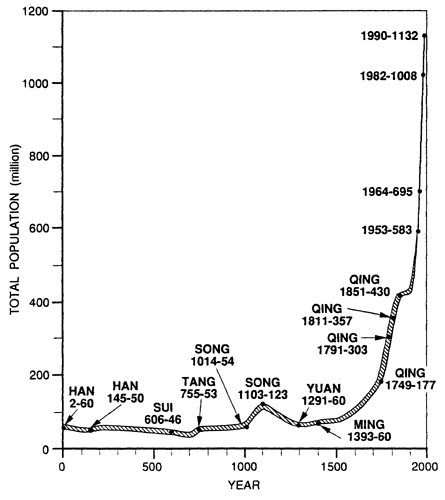
Looking at graphs like this, China's population shot up massively in a very short period. How did China adjust to this growth or even manage to feed these people?
The key element in the 17th and 18th centuries was a major increase in agricultural output due both to increase in ag-technology, and (much more so) new world crops. Corn, sweet potato, double and triple yield wheats and rice, all combined to provide an immense supply of cash-crops. This accompanied in the 18th century an incredible rise in the standard of living for certain areas, particularly the lower yangze region (which interestingly saw the decrease in fertility with increase in SOL that would become standard in England shortly after, and in most of the world by the 20th century). The population kept climbing, having fully bucked Malthus, even through the terrible 19th century - which saw widespread crop devastation (due to over-farming of the same new world crops), and the miserable 20+ year period of war between the 40's and 60's. This is again, primarily due to the immense agricultural potential and output of the Chinese sphere.
EDIT: I was reading a bit more in Wilkinson's Chinese History manual, and therein it is suggested (from the work of Hans Bielenstein) that some of the growth of the 18th century must be attributed to improvements in women's health, particularly the survival rate of girls to childbearing age.
As already answered, New World crops were a major factor. Crops such as corn, potatoes, sweet potatoes and peanuts had longterm effects. They could grow in areas that were too dry for rice, and too wet for wheat, while growing faster than both crops. Potatoes grew in the same climate as wheat, but produced several times as much food. They could also grow at higher altitudes, and require little care. Peanuts are a very extremely high in calories, and they could grow along rivers and coastlines. These crops could be grown in areas that had never been cultivated before, and could be harvested when rice and wheat failed, averted the famines that were so common in early Chinese history.
The peace during both the Ming and the Qing are also major factors. The ming unified China in 1368, and there were no long wars for quite some time. The population had declined under the Mongols, either from the violent conquest, or, as some think, because of the spread of the Black Death.
The population growth continued during the Qing. This is also due to New world Crops, but also due to improved agricultural technology, territorial expansion and the reclamation of new farmland. It grew most rapidly in the peripheral areas of relatively new settlements, such as Xinjiang and areas outside of the Yangzi delta and major cities. The Qing government modified their policies regarding internal movement, and actively encouraged the settlement of these areas.
No one is quite sure of the exact population of China, but Hansen summarizes in The Open Empire that it was reduced to a low 85 million in 1380, rose to 165 million in 1500, 260 million in 1600, 310 million in 1650, 500 million in 1900, and 600 million in 1950. Different scholars will give you different numbers, but they will be similar to these, although I think these are on the high side compared to many.
Sources: Valerie Hansen's The Open Empire and William Rowe, China's Last Empire.