From my history readings, early North American explorers would adventure through the NA interior, and spend the winter in NA. Come spring, they'd rebuild a boat (one of my texts mentions forging their armor into nails), and then voyage home. I can see how they'd be able to craft a new caravel with hand tools and a shipwright, but how did they fabricate the sails they'd need? Did they always bring an extra set, or was there a simple sail-weaving process they'd use with native raw materials?
Most of the time, they sailed home on the same ship they arrived in. This was the case with Jacques Cartier's expedition, for example. They spent the winter of their second expedition with their ship anchored near Stadacona - now Quebec City.
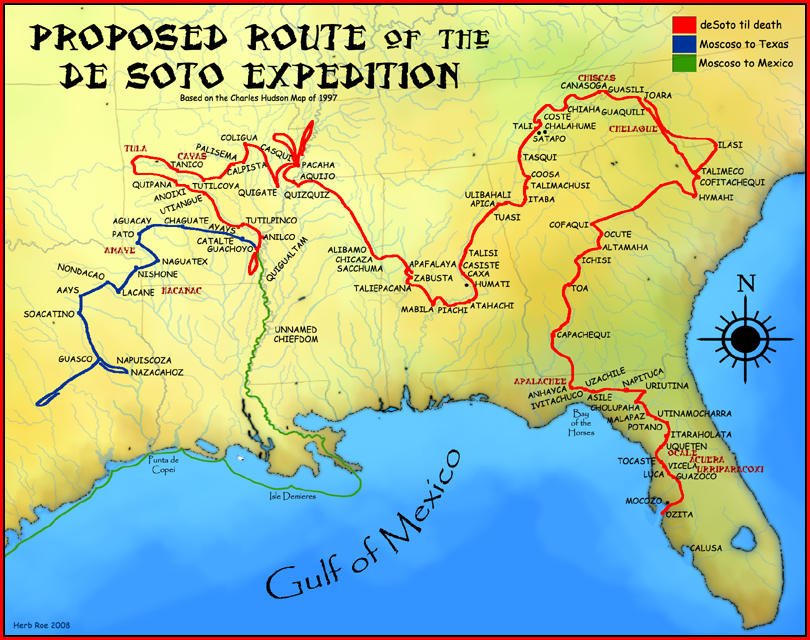
Needing to build an entirely new ship was an rare and extreme occurrence, but it did happen from time to time. One of the more famous incident of this sort happened during the winter of 1542-43, when the survivors of de Soto's expedition through the southeast had to build new boats to travel down the Mississippi and return to Mexico.
This was an option of last resort for them. Back in the fall of 1540, shortly after the Battle of Mabila, de Soto had learned that a small fleet of ships were in Mobile Bay, waiting to take them home. But he refused and kept marching west, ultimately to his death.
After de Soto died, his remaining men tried to reach Mexico overland but as the winter of 1542 set in, they feared they would not find enough food to sustain them on the journey and turned back to the towns on the Mississippi they had passed through earlier.
It was in Aminoya (map, it's not featured, but it was about where the red, green, and blue lines all come together) that they built their boats for their voyage home.
They scrapped the iron chains that had held the slaves that had been captured along the expedition to make nails. For caulking and rope, they used a local plant - probably snake-root - but it was in limited supply and had to be supplemented with bits of old cloth made locally. The sails came from a similar source. Luis de Moscoco Alvarado, who commanded the expedition after de Soto's death, ordered that the local people to provide the Spanish with their shawls, which the Spanish sewed into sails. Fortunately for the Spanish, not only did the people of Aminoya cooperate, but so did they people from towns of Guachoya, Anilco, and Taguanate, which were a day or two away. The chroniclers aren't specific about what the shawls themselves were made of, but considering the area they could have been made from mulberry bark, wood nettle, snake-root, and a few other plants. Cotton is a possibility, but it was a rare import into the Mississippi valley from the west at this time, so it would have been luxury that few would be willing to part with under the circumstances. The sails were probably a patchwork of various fabrics, really.
In case you don't feel like hunting down the four chronicles of the de Soto expedition, I recommend Charles Hudson's Knights of Spain, Warriors of the Sun as a good synthesis of the historical and archaeological information on the topic. The description of building the boats in Aminoya begins Chapter 16.