Just to give some examples of why I say this:
I still don't know how Africa, South America, Turkey, the Middle East, India, and Southeast Asia participated in WW1. Of course they probably provided supplies and some volunteer troops, but when has that not happened in any of the past wars? What was the effect of WW1 on China? No clue tbh. What about INdia? No idea. That's like 2/5ths of the world which I have no idea how they participated in the world war.
As for the second WW, why does it "start" at 1939 and not 1937 when Japan attacked China? I mean America didn't even declare war on Japan until 1941. The two wars in Europe and Asia were essentially cut off. Volunteers aside they're pretty much two separate wars until 1941.
I'm not quite sure where you get the idea that WWII was 'essentially' fought in Europe. In fact, one could argue that very little of WWII was indeed fought in Europe; considering the periods of the heaviest campaigning in the political west was limited to the years 1940, 44 and 45. The Germans pushed so far into Russia that they were considered into Asiatic Russia during Case Blue. Semantics? Perhaps so, but they were not in the political west for their largest operation, and this is undeniable. Regardless, even if one believes the heaviest and most significant fighting happened in Europe (and, despite playing the devil's advocate, I do), its still an irresponsible conclusion to reach by saying that the wars remained essentially European in nature. Peoples of all cultures were deeply affected by the Second World War; to a family in London, to a tribe in Oceania, to a household in China.
This, of course, is to say nothing of the fighting in Mediterranean North Africa (1940-1943), the Middle East (1940-41), Atlantic North Africa (1942), near the Indian subcontinent and Indochina (1940-44), the South Pacific (1940-45), and the North Pacific (1940-42/3).
As for the second WW, why does it "start" at 1939 and not 1937 when Japan attacked China?
Because it was not yet a world war! The Japanese incursions into China were at the time VERY much regional; and World War was kicked off when international powers declared war upon violation of Poland's borders. Japan expanded it further with the drawing of the United States into the war.
The two wars in Europe and Asia were essentially cut off. Volunteers aside they're pretty much two separate wars until 1941.
Tell that to American and British manpower. Germany wasn't the only nation under the stress of a two-front war. Americans, despite contrary belief, actually suffered a crisis in infantry manpower in their main theater of war: NorthWestern Europe through a combination of expansion of other arms and just straight up stretching of the population to the limit. The British just straight up began almalgamating units in 1944 for the same reason; despite the commonwealth, such as Canada, helping to shoulder the burden in North Western Europe.
Tthe Japanese began waging actions against British and French possessions on the Subcontinent as early as 1941; one of Japan's greatest victory's on the continent comes against the British at Singapore (in 1942); a particularly bloody conflict was fought in Burma, and the Malayan campaign began early in 1941.
Then you have unrestricted naval warfare; there are cases in both world wars of Naval clashes happening off the coast of Brazil, for example. Mexico and Brazil both contributed notable forces to the American war effort in Europe in WWII, the Panama zone was militarized further leading up to American involvement; NY Harbor was closed off by mines on several occasions, Submarine wolf packs hounded around Newfoundland, Iceland was occupied...
Shall I go on?
I'm not sure where you got the idea they were both "essentially European wars fought in Europe"? Just because Europe was where the lions share of the fighting took place does not mean the rest of the world was without fighting or significant participants. I hate to be crass but it really comes down to you just don't know about it and just because you don't know about it doesn't mean it's not there.
I still don't know how Africa,
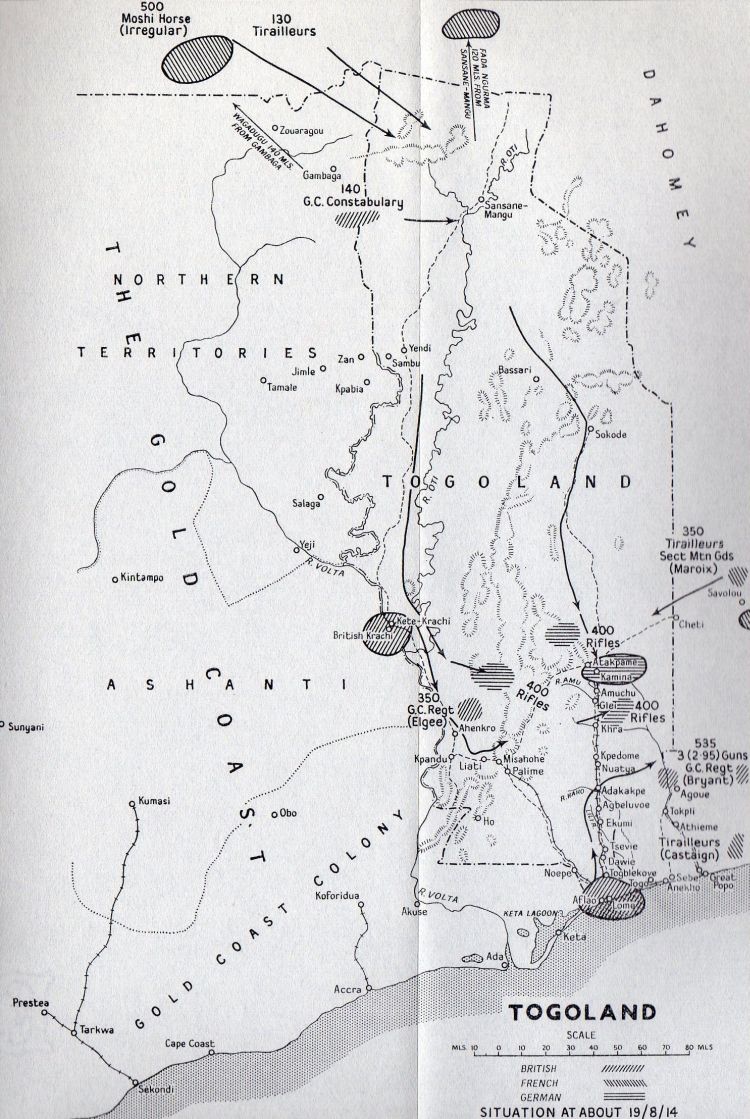
Africa was fought over in just about every single corner of it. The British and French would, in the opening days of the war, perform a combined offensive into German West Africa and seize it. The far more extended offensive in West Africa would be in German Kamerun which would last into 1916. In South-West Africa, there would be a two year struggle over German territory. In this battle Native South-Africans, not British regulars from the home island, would struggle against German colonial forces. The Germans in this time would also move North and attempt an invasion on the Portugese colony in Angola which was briefly repulsed.
In terms of East Africa there would be numerous major clashes between the British and German navies for control of the coasts. Considering the placement of the German colony there would be, up until 1918, significant fighting. Even the Belgians would get a piece of the action!
South America,
Brazil declared war on Germany in 1917 and naval clashes would occur on the Brazilian coastline. Leading up to this declaration of war Brazilian shipping would be directly attacked by German unrestricted submarine warfare. They would send numerous dreadnoughts and generally partake in anti-submarine operations against the Germans.
Turkey, the Middle East,
Turkey would join the war in 1915 and would partake in major offensives against the Russians. The British would also be directly clashing with the Ottomans in the Middle East by funding uprisings through tribal leaders. It would be these uprisings that would undo the Ottomans on the home front and cause the dividing of the Middle East that we see today. Between the Turks, Brits, and Russians along with the ethnic groups vying for independence (Kurds, Jews, Arabs, Armenians, etc...) up to 3,000,000 million total casualties would occur in the Middle East alone. To not miss as well the Gallipoli Campaign in 1915, the attempt of the British ANZAC forces to perform a massive seaborn landing on Ottoman territory, would be the worst loss of the war for the Entente powers and arguably one of the worst in all of British history.
India,
India would provide the backbone of Britain's manpower throughout the war, especially early on. Over 1,500,000 total Indians would volunteer to go off to Europe and Africa to fight. Hardly "some volunteer troops". They were also primary actors in Indian Ocean operations in East Africa and generally ANZAC operations in Europe as a whole.
and Southeast Asia participated in WW1. . .What was the effect of WW1 on China?
Southeast Asia specifically did not have much of an impact on the war outside of rebellion against French control but the Pacific theater as a whole was a case of Japan seizing all of Germany's Pacific and Chinese holdings. It would also be where Japan tried to strongarm its control over China through threats and diplomatic cause which would, obviously and ultimately, fail. This also brought China into the war on the side of the Entente (partially to protect itself from Japan) who contributed well over a hundred thousand laborers to assist the building and sustaining of Allied trenches on the Western Front.
Of course they probably provided supplies and some volunteer troops, but when has that not happened in any of the past wars? . . . What about INdia? No idea.
You reduce these things to "provided supplies and some volunteer troops" but you're really just missing the point entirely. It wasn't just some volunteer troops it was the entire nation of India falling in support of Britain and sending millions off to fight. You seem to think that just because massive fighting on the scale on the Western Front didn't occur throughout the world equally that it can't be labeled a world war and that's just unfair. The point is is that this was a war which changed everything and affected everyone like never before. South Africans, Indians, Australians, Chinese, Japanese, Germans, Arabs, Kurds, Armenians, Egyptians, Moroccans, Portugese, French, Indo-Chinese, Brazilians -- they were all directly affected by this war and by the fighting of it as quasi-independent actors. They all sent thousands and at times millions away to go fight.
It wasn't just "some European war" it was a European war that bled into North Africa and the Middle East in terms of heavy fighting. It was "some European war" that prompted United States and Japanese intervention. It was "some European war" which brought millions of Indians and Australians and Canadians and South Africans to willingly go fight and by 1918 they were not fighting as Brits they were fighting as Indians, Australians, South Africans, and Canadians -- something totally unique from, say, colonial forces clashing in the Napoleonic Wars. Japan and China's relationship would mature throughout this conflict and is directly linked to the Sino-Japanese Wars of the future as Japan tried to posture upon China. Pacific Islanders, as said below, along with French and British colonials throughout Asia, India, and Africa all alike would find their national identities and their justification for separation through this war. The entire modern Middle East would be born from this war throughout the partitioning and rebellion in the Ottoman Empire. The United States would leave its isolationist bubble as the #1 industrial power and become part of the worlds congregation of "Great Powers".
That's really what separates it from every other global conflict before it (though the 7 Years' War and Napoleonic Wars are the only ones which can really be shoehorned into that category) -- it was not the Brits fighting in Southwest Africa they were Boers, Rhodesians, and Zulu's. It was Indians going to fight for Britain, not Brits. You see where I'm going with this? Nonetheless even if we go beyond this providing material support alone constitutes direct involvement and impact. That's really the point. Only a select few people in the world were totally escaped from the realities of this war whether it was direct fighting or economical unlike in these previous conflicts which were, essentially, European wars fought for European goals between European powers.
TL;DR: Europeans in Europe (shouldn't need explanation there), Russians in the Central Asia, Turks in Anatolia, Arabs in the Middle East, a tsunami of ethnic groups in Africa, Indians in the Indian Ocean and Europe, and the Japanese in the Pacific all performed non-arbitrary military actions in those theaters. Add in the United States coming in later and naval clashes on the Brazilian coast and it's pretty darn conclusive that, yes, this was a truly global conflict between not just Europeans.
Using the Oxford English Dictionary the term world war came into the English language (most likely from the German term Weltkrieg) just a few years before the First World War. The definition was a war involving important nations and not how much of the world the war was fought over.
World War One or the Great War has been labeled essentially a European civil war because as you say, the fighting was mostly in Europe.
That said; there was fighting in China, skirmishes across the Pacific and off both coasts of South America, and German raiding in the Indian Ocean. So while the main theaters were in Europe, there was fighting internationally- after all the European powers were also colonial powers and had territories across the globe; Japan for instance took the opportunity to invade and take control of a number of German possessions in the Pacific.
The presence of colonial subjects on the battlefields of Europe is an important aspect of the war that I would encourage no one to ignore. For many of these volunteers and conscripts this was their first time seeing Europe and European society up close and Trench warfare did not leave them with a good impression of Europe. In the areas thAt I specialize in, the Pacific, veterans came home from the war and began demanding rights and representation; Pouvana a Oopua in Tahiti argued that if he can die for France than he should be represented by France and receive citizenship and locally elected government- and he was hardly the only one to make that argument after the war and begin the process of pushing for local autonomy within the Empire and later on independence.
Not sure why you say Turkey was not involved in the First World War; the Ottoman Empire was one of the Central Powers during the war and heavy fighting took place along its borders and within as Russia, Italy, and Greece looked to gobble up Ottoman territory and Britain looked to knock it out of the war at Gallipoli; to say nothing of the Armenian genocide taking place within the Empire and the resulting international migration of hundreds of thousands of people.