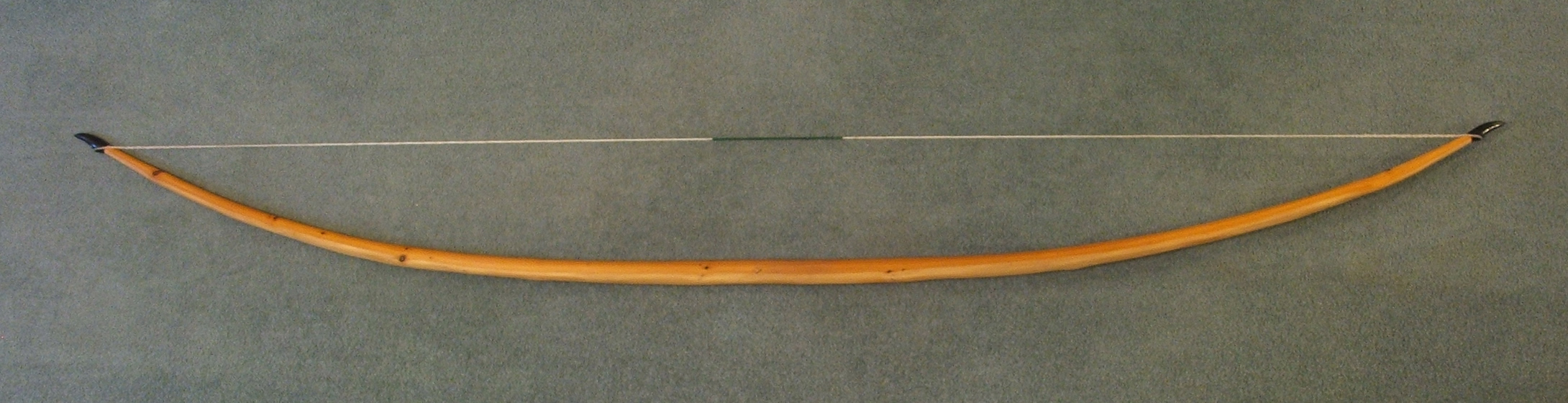
I would note that some Europeans throughout the Middle Ages, such as the Byzantines, Hungarians, and even sometimes the Italians, used composite bows, but I have the sense that you were asking more about the wooden self-bows more popular in England, France, Wales, etc.
I would say there are three angles through which you can look at this: technology, craftsmanship, and draw strength.
When it comes to technology, we're talking about things like the shape of the bow, the materials used, etc: the difference between this, this, and this.
By craftsmanship, I mean the quality of the product within the parameters of the technology used. You can have an advanced fiberglass compound bow that is rather shoddily made, and you can have a simple wooden self-bow that is very finely crafted. One question might be: who made these bows? Did each archer typically make his own (which would probably result in lowest quality of craftsmanship)? Was it a dedicated woodworker who made bows, along with other wood products like furniture? Was it a dedicated bowyer who made nothing but bows?
Finally, there's draw strength. This is really more an issue of the training of the archer than the advance of bow technology in the traditional sense. To the best of my knowledge, humanity since the upper paleolithic had has had the ability to create bows which were stronger than humans who would realistically draw them.
On the question of technology, I would say the there was really no progress in Western European-style self-bows. They had very basic, simple design principles in 1337, and they couldn't easily have been much simpler in 937. Oddly enough, they are, in some ways, technologically less sophisticated than some European self-bows that date from mesolithic Denmark, circa 5000 BC (e.g., Møllegabet, Holmegaard). I think Jim Bradbury mad a fairly good case in The Medieval Archer that the "English longbow" or "Welsh longbow" was simply an extension of the traditional European self-bow that had been in used since prehistory, not some 14th century technological leap.
On the question of craftsmanship, I'm not sure. It's possible that toward the high middle ages, the English were using higher quality yew, by trade with Italian sources, which might have provided an edge over local English yew. In addition, it seems probable that as archery came to play a more established, widespread role, a more specialized economy developed, including specialist bowyers and the like
Draw weight is an area where I think that you'd see a lot of progress in England between 937 and 1337. Archery had come to play a much more significant role in 14th century Plantagenet England than it did in 10th century Anglo-Saxon England. While archery was not completely absent among the Anglo-Saxons, dedicated military archery was not an established tradition, and the bows used in battle were probably those that the occasional fyrd militiaman might have used for hunting game (on the order of a 50 lbs draw weight). By the 14th century, the English yeomanry was obliged to practice archery for war, and low-end estimates of the draw weight of the bows they used are around 100 lbs, with higher estimates going to 160 lbs.
However, you might not see much progress in draw weight in Wales from 937 to 1337 (where highly practiced archery was already well established in both periods), or in France from 937 to 1337 (where archery was poorly established in both periods). The increase in draw weights I believe you'd find in England was not universal to Europe.