A very similar question was asked about four months ago, although it was referring to German tanks, not British tanks. http://www.reddit.com/r/AskHistorians/comments/2av959/why_did_the_tiger_i_not_incorporate_sloped_armor/
/u/MrDuck linked to a good thread that covered most points.
One of the comments by /u/Type-21 is worth reproducing here
sloped armor limits the gun size. This is one of the major points against sloped armor. The maximum width of a tank is pretty much fixed because it can't be wider than the railway system allows. So assuming you place the sides of the tank at that maximum width and slope the armor plates inwards. You are now reducing the roof width of the tank. Why is that important? Because the turret ring has to fit between the sides, essentially onto the roof. So by sloping your sides you are reducing your turret ring diameter. And the turret ring size is the greatest factor that determines turret and therefore gun size. You want a big gun, you need a big turret, you need a big turret ring diameter, you need a wide roof. The turret ring diameter actually is what prevented the T-34 from being upgunned even further after the 85mm gun was installed. There were are few more tests with bigger guns, but it was a nightmare for the loader.
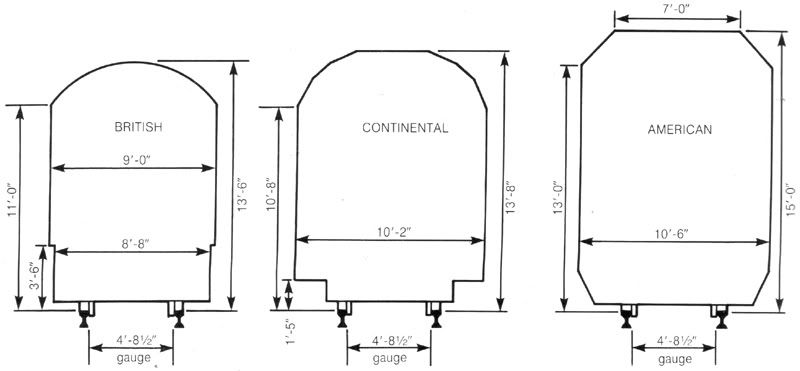
The problem of railway loading gauge was worse for the British than for anyone else because the British loading gauge is quite a bit smaller than the continental (and US) loading gauge, as shown here
This meant that fitting large guns onto British tanks was really very difficult. For all the impressive bulk of the Churchill, the turret was simply too small to accommodate the 17-pdr, and the Churchill was built to the maximum possible width allowed by the loading gauge - even then, the radiator louvres had to be removed and stowed on the engine deck before they could be moved by rail.
Interior space was also a concern on British cruiser tanks like the Cromwell as they used Christie suspension, which as you can see in this picture eats into your hull space quite a bit. Of course, the T-34 also had Christie suspension but the T-34 had quite appalling ergonomics as a result
Its also worth reitering the trigonometric disadvantage that sloped armour brings.
Imagine you want to cover the front of a tank with 100mm of steel plate. Fine, if its flat, then its just 100mm of steel.
Now lets think that you want to make a sloped "beak" shape as shown on the schematic here. You will of course notice that instead of simply having a flat plate, you now have to have armour comprising the two sides of a triangle.
Thus while sloping armour does mean the effective horizontal thickness is increased, or that you can achieve the same horizontal thickness with thinner steel, you actually need more steel to make your sloped armour, negating any weight saving.
Finally, we have to bear in mind the concept of overmatch. Basically, this is where the calibre of the shell exceeds the width of the armour, thus nullifying, to an extent, any effect of armour sloping.
Thus, an M4 with 51mm of armour sloped to give about 100mm effective armour, could "bounce" smaller calibre shells, for example from the 37mm Pak37 or 50mm Pak38, but it was easily overmatched by the German 88mm Flak36, as was the T-34's 45mm of frontal armour, despite the excellent 60 degree slope.
On the other hand, the Panther had 80mm of frontal armour, which could not even be overmatched by the 17pdr, which explains why the Panther was such a tough proposition if met head-on.