Two points to make here; Mutilation was a particularly gruesome tool used by the Byzantine (and lots of others), and they used blinding to far greater scope and effect than purely as a way to eliminate potential rivals.
There is an inherent second level to this question that greatly effects the outcome; what was the reason for the blinding?
Sometimes they were done to instill fear in a conquered people, sometimes mutilation happened to eliminate a rival from making a move on the throne (Castrated men could not be Emperor), sometimes it was done to punish criminals. The list goes on and on.
There is evidence that this was a special skill of executioners (even if it didn't result in death) or that they at least had people who explicitly focused on this method of mutilation, as the Byzantine Emperor Diogenes was overthrown and as a punishment, he was explicitly blinded by someone who had no practice, resulting in his death by infection (probably sepsis) several days later.
The Byzantine did develop eye-scoops, but there were a variety of tools this could be done with. Daggers, knives, tent pegs, sometimes burning coals, and heated metal bowls.
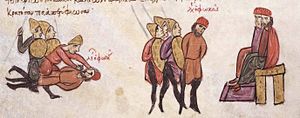
I am not aware of any material that explicitly describes the method, however I was able to find depiction of the blinding of Leo of Phokas, that suggests they basically just held the guy down by sitting on his legs and pinning his arms behind his back, and gouged his eyes. I cannot tell you if this was "normal", or particularly personal, however Leo Phokas (Leo the Younger) lived in the 10th century, so this was still 'sort of early' in the perfection of this gruesome technique.
I have come across articles that suggest boiling vinegar was used. Other, similar articles have suggested that Byzantine would explicitly "fake" blinding on certain people, in an act of cruelty and punishment, or even force them to blind themselves by putting cloth over their eyes and being unable to take it off. However I have been unable to satisfactorily substantiate either of these. I included them merely as a frame of reference to the depth and breadth in which mutilation could be used.