Watching Top Gear, they had a cool segment where they drove early cars to see the development of automotive controls we have today (accelerator-brake-clutch as pedals from right to left, gearshift by hand). I was hoping to get a more in-depth and technical historical perspective on this, beyond seeing how old cars work. How were early cars controlled? Why were they laid out this way? Is there any particular reason the modern layout was favored over early alternate designs? Thanks!
(Note: this answer will mostly look at the American industry, which is my area of expertise, and will focus only on internal-combustion automobiles)
The internal-combustion automobile was patented in 1886, and the first car with a modern control layout (left-hand drive with a steering wheel, a foot-pedal accelerator positioned to the right of the brake and the clutch to its left, and a gear selector and handbrake operated with the right hand) was the 1916 Cadillac type 53. The thirty years in between saw a bewildering variety of control layouts - it would take an entire book to address each of the near-infinite permutations and combinations employed.
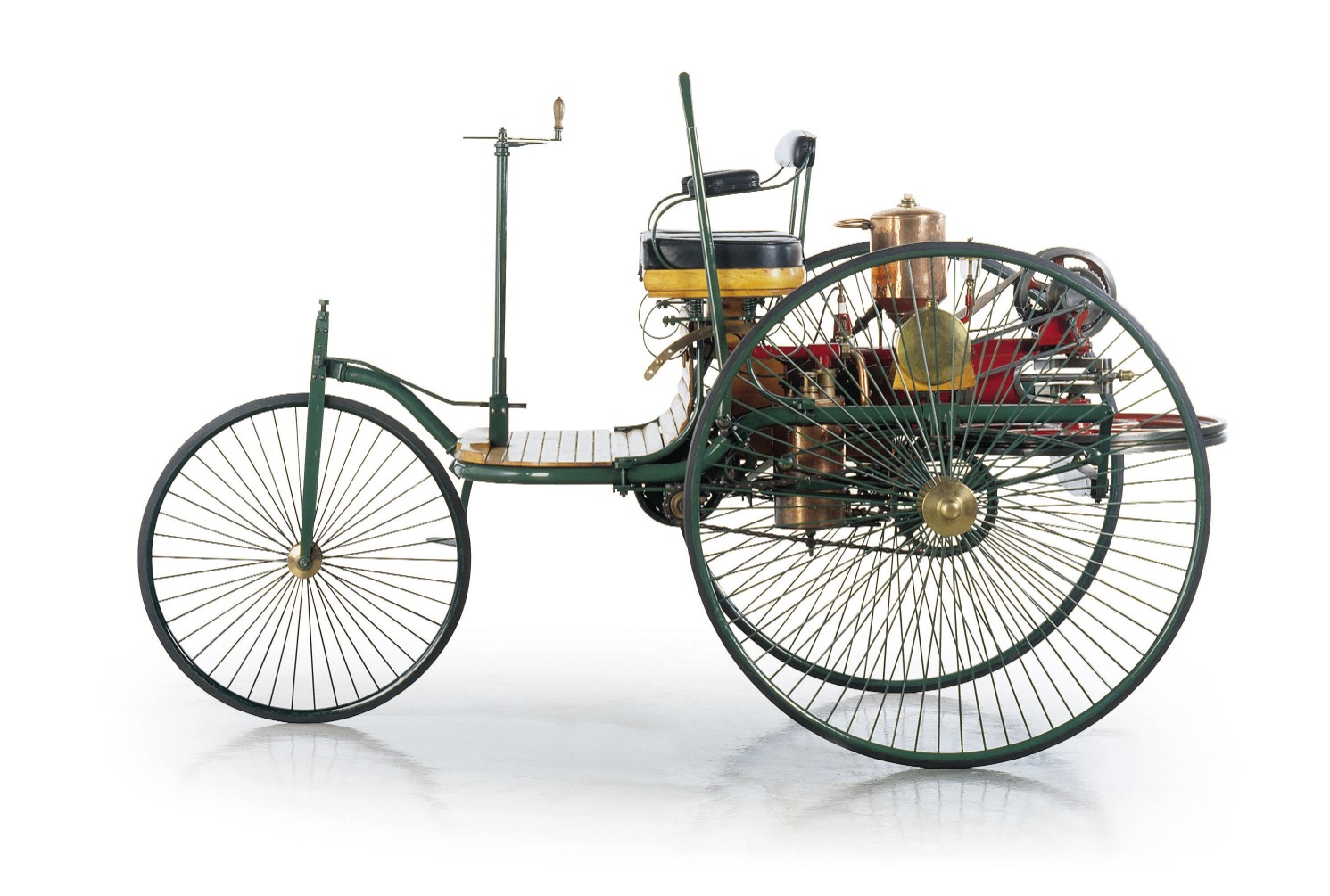
There are surprisingly few identifiable trends or identifiable turning points in the evolution of automobile control layouts, but I will address two of them here. The first is the adoption and evolution of the steering wheel. The earliest automobiles, such as the Benz Patent-Wagen used a tiller, mounted either to the side as on this 1903 Knox or directly in the middle, like the Curved-Dash Olds. Tiller steering was less complicated mechanically, but was impractical for sharp turns (a sharp left turn in the Curved-Dash Olds, for example, would require the driver to push the tiller into the passenger's lap) and high speeds. The first steering wheels were introduced during the last years of the 19th century on cars like the French 1898 Panhard-et-Lavossor and the 1899 Packard, and became standard on upper-end vehicles by 1905. The tiller did not go gentle into the good night, however, and would remain popular on low-end economy vehicles (which were often little more than motorized surries) around for another fifteen years or so - see the 1912 Sears motor buggy, sold through the Sears Roebuck catalog.
The second turning point is the swap from right-hand drive to left-hand drive, which began around 1908 and was firmly established in the industry by 1912 or so (although the more conservative marques like Packard held out for a while longer). This switch was necessitated by the rapidly increasing number of cars on the road: right hand drive is useful when your top priority is staying out of roadside ditches, but less so in navigating oncoming traffic.
Besides those two developments, however, there wasn't much in the way of directional evolution - the modern pedal layout, introduced on the Cadillac 53 in 1916, took at least another decade to catch on. The Model T with it's eccentric layout didn't end production until '27, and many marques offered hand-operated auxiliary throttles (white lever on the steering wheel) into the thirties. Cars offered a number of different pedal arrangements (although it made sense to have only one leg for the gas and brake, so you don't accidentally step on both at the same time): hand-operated throttles, foot operated throttles, pedals that were clutch-brake combos, reverse pedals, footbrakes with ratchets that doubled as parking brakes, H-shifters, selective shifters, sequential shifters ... the list goes on and on.
I'm not 100% positive why the modern pedal layout caught on, but in some ways it is intuitive. Obviously, it's a good idea for the driver to have one leg operate the both the accellerator and the brake, so he doesn't step on both at the same time by accident, but I'm not sure if there's any obvious advantage to having the clutch in the middle or the throttle.
Hope that helps!
Sources and further reading:
America Adopts the Automobile, 1895-1910 by James Flink, The American Heritage History of the Automobile in America by Sephen Sears