Hello,
Lately I've been rekindling my interest in WWI-WWII armoured combat, and reading up on a lot of various models of tanks and other armoured vehicles. One class of tracked vehicle that I keep on stumbling upon references to the "tankette" - small, tracked vehicles with around 2 crew members, generally armed with a simple machine gun.
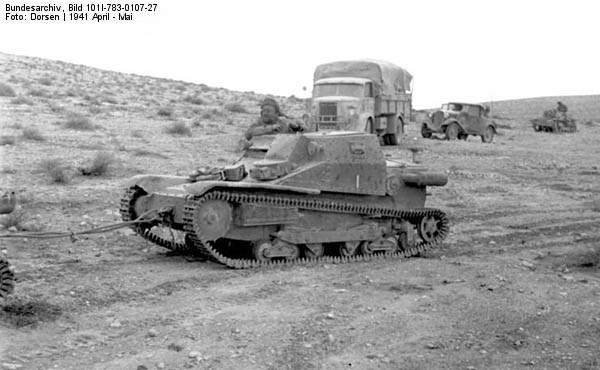
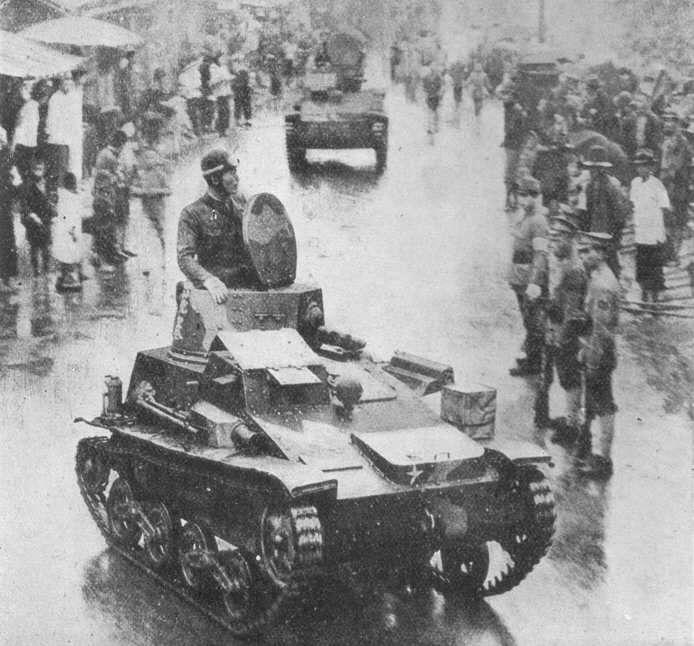
Lots of nations came up with tankette designs - the Carro Veloce (Italy), Carden Loyd (UK), Type 94 (Japan), TKS (Poland), et cetera - but the concept seems to have faded during the war, like so many of the pre-war eccentric ideas that designers came up with (like sticking multiple little turrets on tanks).
As a result, I've always mentally dismissed tankettes as being death traps for the unfortunate soldiers assigned to drive them about. But I've never really studied them, so I could be being quite unfair to the tankette!
Basically, did tankettes ever successfully carry out what they were designed to do in any campaign during the various wars they were involved in?
Tankettes were fairly successful for the Italian troops in the Corpo Truppe Volontarie during the Spanish Civil War. At the Battle of Guadalajara, Italian tankettes were able to punch through Republican lines and nearly achieved a breakthrough despite poor weather and a complete lack of support from Nationalist forces (despite Franco's promises to the contrary). The Republicans were able to finally blunt and throw back the Italian advance, partly by using a number of Soviet-supplied tanks.
Those are the facts, but the interpretation of the battle is where things diverge. British and French observers concluded that armored breakthroughs were unlikely, and that it would be better to widely distribute one's tanks so that a defense could be made anywhere along the line. German observers of the same battle concluded that if the Italians had pushed harder and had some more support (both from Franco and from the air) that a breakthrough was tantalizingly close. They were convinced that with advanced armor and air support such an attack could succeed.
Still, the Italians faced limited opposition at Guadalajara. This isn't to denigrate the Republican defenders--quite the opposite. The Republicans simply did not possess large amounts of artillery, either indirect artillery or anti-tank guns. The few Republican tanks that were deployed to the battle were effective, but we're talking about relative handfuls of vehicles when compared to battles in WWII. So perhaps a good deal of the success of the Italian tankettes at Guadalajara should be mitigated by acknowledging that the defenders had little in the way of weaponry that could hope to stop them.
I am not an expert in tankettes, but the times that I have seen them referenced as being successful are generally when their opposition had little in the way of weaponry that could penetrate armor of any type.
The problem with tankettes is that we view them from the point of view of ww2 armoured combat - large mechanised formations creating deep breaktroughs and fighting the counter-attack by the enemy's similar formation. In such warfare the tankette is indeed a death trap - however, this is not the kind of combat the tankette was designed for.
After ww1, tanks had shown themselves extremely vaulable for infantry support, allowing direct firepower (MGs and/or guns) to be brought directly to the enemy quickly and with its crew protected by armour. The tank was in essence a mobile machine-gun bunker and as such extremely valuable on the battlefield.
The tankette was an attempt to create a cheap, small, reliable and quick mobile MG bunker to ensure that it could be produced and manned in quantities to provide all infantry divisions with their own integral armoured support.
The tankette was a late 20s and early 30s design, and when it was created, AT guns and AT rifles were rare or non-existand in most armies. Ten years later, when ww2 started, most if not all armies had acquired extensive supplies of AT mines, AT guns and in many cases AT rifles. It was not until then the tankette became vurnurable. However vurnurable the tankette was, it was still a protection against rifle caliber fire from MGs and rifles, which helped.
By the time ww2 started, most nations had either abandoned the tankette or had programs in place to up-gun them. The Poles planned to upgrade their TKS tankettes with 20mm wx.38 automatic cannons with decent AT performance. They also experimented with mounting 37 and 47mm AT guns on them.
The Italians experimented with replacing the MGs on theL3/35 with a single 13,2mm MG that could destroy most light tanks and tankettes and with modern torsion bar suspension.
The British had long since abandoned tankettes as design and had replaced them with infantry tanks (primarily Matilda I and II when ww2 broke out).
The large stocks of tankettes available to the Italians, Poles and Japanese were assigned as infantry support or recoinnasance vehicles where they served as well as they could - and were still better than nothing.
Were tankettes created as a response to a specific problem like trench warfare in WW1 or were they more a case of "lets throw some ideas at the wall and see what sticks"?