EDIT: Reading this question after i posted it made me realize that it sounds completely idiotic. But i still want to see what y'all have to say.
I'm going to assume by the last part of your question, that you mean discovered by Europeans. Though I suppose in some circles, North America is regarded as having always been inhabited by Native Americans in a literal sense. I'll set those arguments aside for the moment. For me, 16,000+ years is long enough to be regarded as always for any practical human purpose.
This Sunday, we'll be doing a mega-AMA on the Pre-Columbian Civilizations of the Americas (see the AMA schedule in the sidebar). So rather than go into a huge amount of detail here, I thought I'd give you a taste of the potential topics available for discussion from just one part (the Eastern Woodlands) of one of the two continents will be covering. If you can't come by on Sunday to ask more questions, I'll see about handling some follow-ups here.
The Old Copper Complex: From ~6000 BCE to 3000 BCE. Located in Wisconsin, the Upper Peninsula, and neighboring areas.They extensively mined the copper deposits in the Upper Peninsula, producing a wide variety of copper tools, weapons, and ornaments. Known to have wide-ranging trade connections with its contemporaries, both eastward along the Great Lakes and south along the Mississippi.
Poverty Point: From ~1700 BCE to 700 BCE. Located in northeastern Louisiana and portions of neighboring states. Poverty Point itself consists of six concentric half-rings of earth (each of which held a row of houses), an earthen pyramid (which would remain the largest of its kind for nearly 2000 years), and several other earthworks. The linked reconstruction is out-of-date however, because more recent excavations have revealed additional residential areas near the Ballcourt Mound.
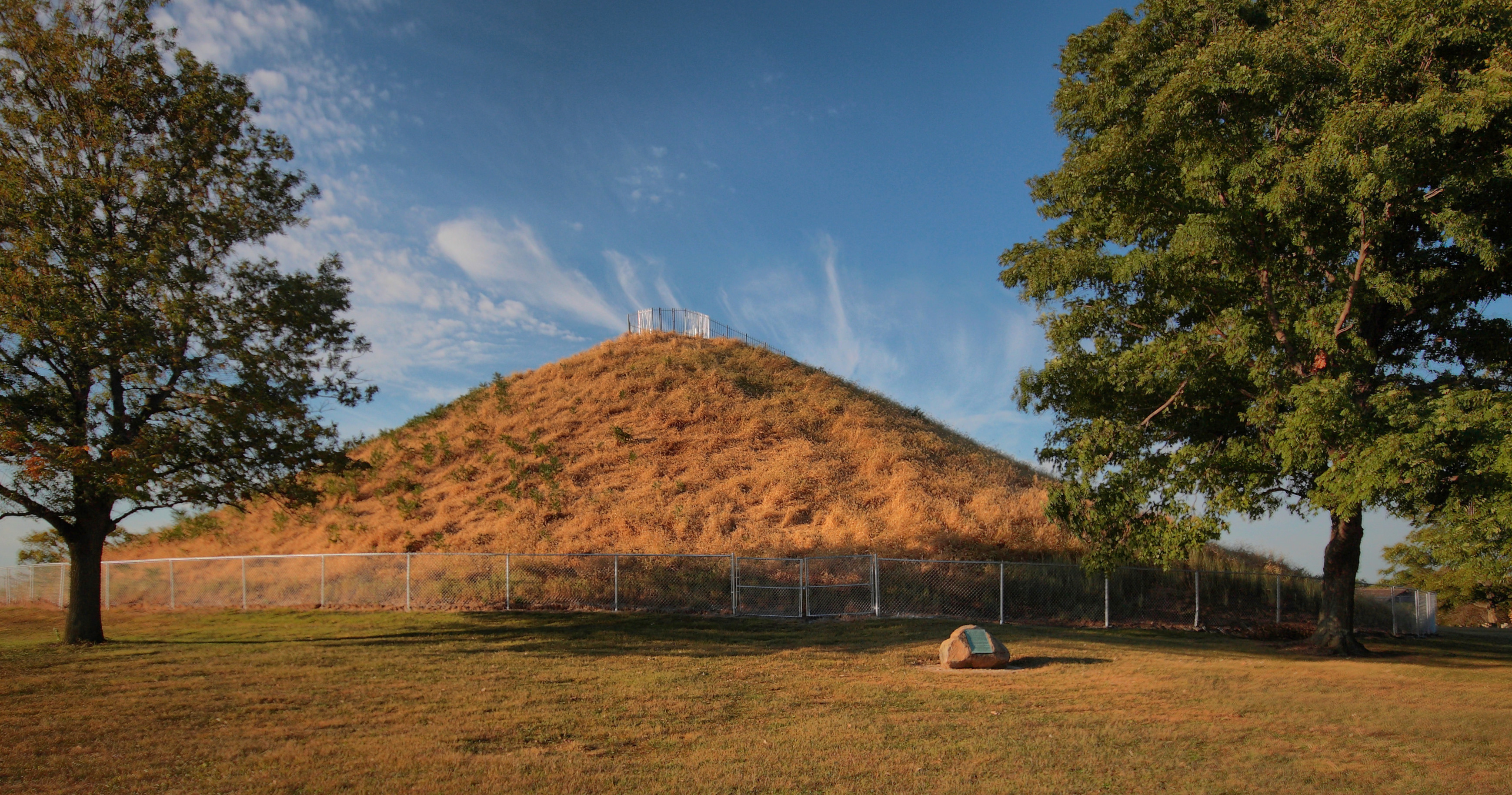
The Adena: From ~1000 BCE to [a debate I won’t be getting into now]. Located in Ohio, Kentucky and West Virginia. They built sites like Grave Creek Mound, the Miamisburg Mound, and the Wolf Plains. Seem to have had a class of hereditary elites distinguished by body modification (skull flattening). Other forms of body modification also existed - one man had his front teeth removed so he could wear a set of wolf dentures.
The Hopewell: From about ~200 BCE to 400 CE. Located, well, best to consult a map. This is a huge collection of individual cultures that were linked together by common ceremonies, long distance trade, and some other traditions. The Havana Hopewell in western Illinois got things started, but once the Adena adopted these Hopewellian and became the Ohio Hopewell, they became the epicenter of the regional complex. I could go on and on about the Ohio Hopewell (and have elsewhere). Right now I’ll just say that the Ohio Hopewell had transcontinental trade routes, an apparent standardized unit of length, made decade-long astronomical observations, and they built expansive earthworks.
Cahokia: from ~600 CE to mid-1200 CE. Located in western Illinois. For the first few centuries of its existence, Cahokia seems to have been first-among-equals within the Middle Mississippi. It was a large and prominent town, but there were others comparable to it in the region. Around 1050 CE, however, it begins to take off. The town is redesigned, new construction methods are introduced, and the population rapidly expands to number into the tens of thousands. And someone finally got around to building a bigger earthen pyramid than Poverty Point’s. Directly or indirectly, its influence extended from southern Wisconsin into western Tennessee. Set the stage for the rest of the Mississippian cultures. Recently I discussed two later Mississippian cultures, Coosa and Apalachee, in this set of posts.
Haudenosaunee: From 1142 or sometime between 1350 and 1450 CE (the debate regarding this debate can be saved for another conversation). Located in upstate New York. You probably know them better as the Iroquois Confederacy. The creation of the Gayanashagowa (the Great Law of Peace) established the confederacy after a period of internecine warfare between the Five Nation, making it one of the earliest constitutional governments. Became increasingly powerful through the colonial era, but fragmented during the American Revolution (the Six Nations of Grand River is one of its modern continuations).
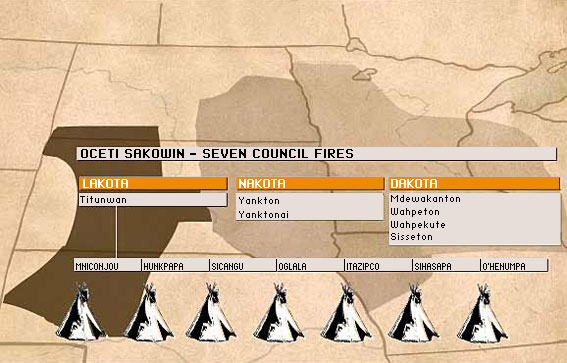
Oceti Sakowin: By 1300 CE. Located in Minnesota. We only have a rough estimate for when the Seven Council Fires (the old Lakota-Dakota confederacy) formed. They formed from seven communities located, at the time, in the vicinity of Mille Lacs Lake. By the mid-1600s, the Oceti Sakowin began spreading west, with one of the seven - the Thítȟuŋwaŋ (the Tetons, better known as the Lakota) leading the charge. As the Seven Council Fires spread, its constituent parts became more independent. We know of it mainly from the oral history of its Lakota and Dakota, and a bit from archaeology.
Calusa: By 1500 CE. Located in southern Florida. While the Calusa culture is much older, we’re not sure when it started to become a major power in the region. By the time Europeans arrived, it had spread from its capital of Escampaha in Charlotte Harbor to encompass the southern half of Florida and the Keys. The Calusa built canals through the islands and the Everglades. One of their subjects, the Mayaimi built Big Mound City near Lake Okeechobee. When the Spanish invaded the Caribbean, some Cuban Taino fled to the Calusa and were permitted to establish the village of Abaibo on the mainland. The Calusa successfully repelled the Spanish for decades. They sent spies to Cuba and, later, once a peace with the Spanish was established, they sent traders too.
I'm sure you'll find a lot of answers to that question by rummaging through the FAQs about pre-Columbina America (see: FAQ, Americas Before Columbus and Native American History).
About sources, we've got a wide diversity of sources ranging from oral tradition and written records (Aztec codices, for instance) to the archeaological record and lake bottom sediments.
These sources inform us about migrations, trade routes, metallurgical practices (OK, a Peruvian example, but you get the point), cultural and agricultural practices, and so on. As you doubtlessly realize, there is a vast sea of knowledge about pre-Columbian america.