Hey everybody,
I am currently writing a short paper about medieval depictions of the devil and demons. While the above question can be neglected in my paper, I'm just wondering what it represents, since it seems to be a recurring motive.
I haven't done truly extensive research but all my books about demonology have seemingly turned up nothing. The books containing the images also fail to elaborate on the meaning of that particular demon.
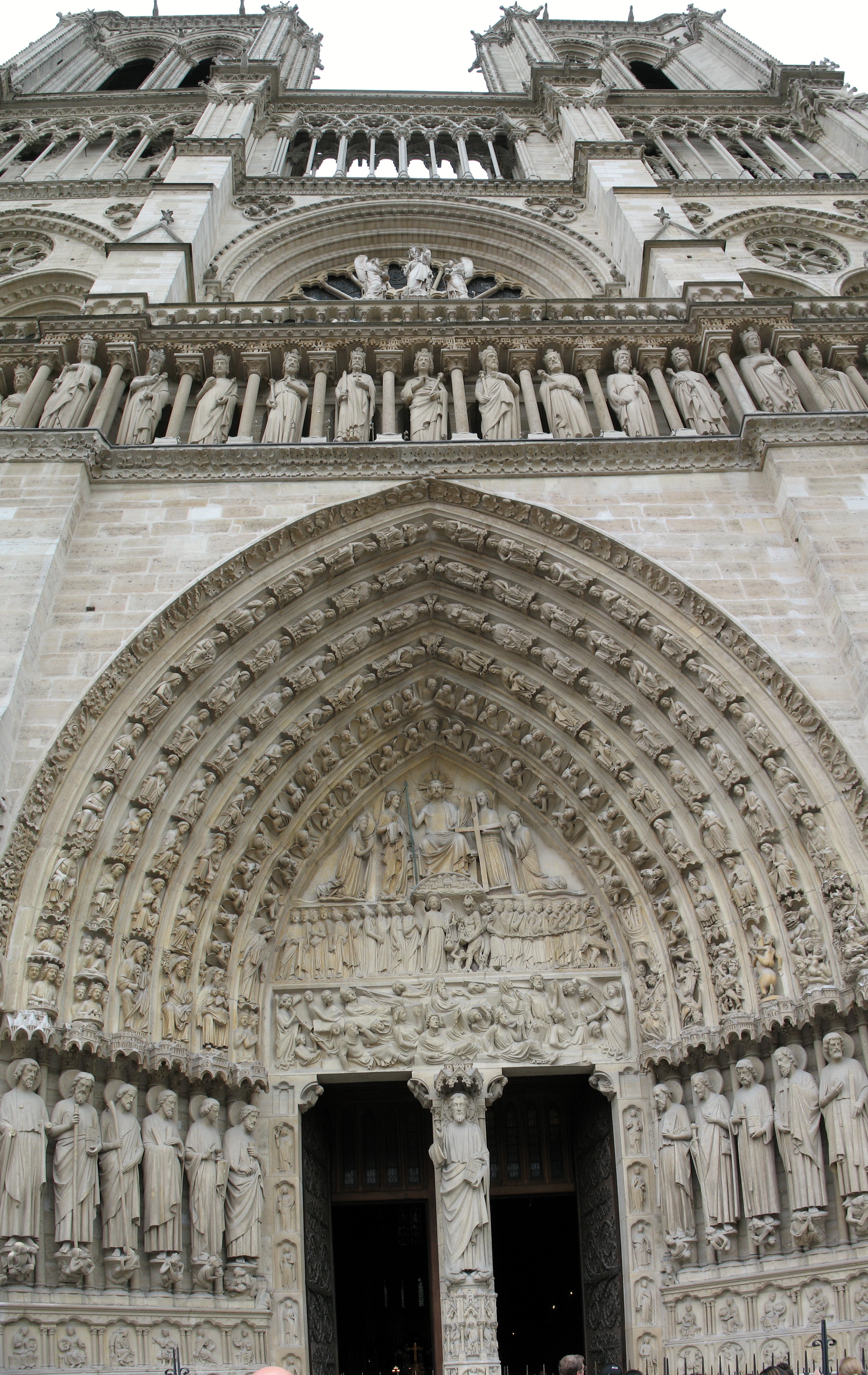
Example one: Portal of the last judgement on the west facade of the Cathédrale Notre-Dame de Paris.
Example two: Altar table from the 13^th century from the Catalan Museum in Barcelona.
Is it just trying to change the odds in the devils favor? But why? How does the devil benefit from getting more souls to torture? Since at least on the Paris one, Jesus is actually judging the souls, how would he even be able to? Complete image of the Notre-Dame facade here.
Thank you for reading!
Medieval Latin Christian theology was concerned entirely with the fate of the soul, it was a war, figuratively and literally. You can in fact see similar iconography to your Notre Dame example in this 10th century cross from a monastery in Ireland. I wrote here about the representation of the devil on it - the iconography is identical, but the scale is below. You'll see another demon on it blowing a trumpet leading the parade to damnation.
Effectively, the demons assisting the Devil in your images are allegorical representations of sinning. The allegory allows whatever story needs to be told at the time as part of pastoral care (sermonizing and instruction): so the demon could be usury, gluttony, price, vanity, etc.
Medievals rarely named the demons outside of the Devil himself, except for the form the demons might take such as incubus and succubus, or references to familiars of witches in the 15th century. The work of iterating through demons and their representations (for example Solomon) was done by post-15th century demonologists, in particular ones with fascination for hermeticism.
You'll want to look at these works by Russell to have a full sense of what is known, unknown, and speculated, about the Devil and his demons in the middle ages :
Jeffrey Burton Russell, Satan: The Early Christian Tradition (Cornell, 1981)
Jeffrey Burton Russell, Lucifer: The Devil in the Middle Ages (Cornell, 1984)
The answer to your question of the motivation of the devil and his procurement of souls is entirely fluid and changed with time. In fact the obsession with the devil and his role in the fate of the human soul changed a lot during the middle ages, intensifying, as did the notion of heaven. One could say that Jesus, the Devil, Heaven and Hell became more 'real' to Christians as the middle ages wore on. Purgatory itself was an invention of the middle ages and not found in early Christian theology per se (or rather, it was written backwards as allegory to early Christian writings).
A word about the façade of Notre Dame. I walked by there last week (I currently live down the river from it) and was fascinated by the detailed sculptures. After staring at them for an hour in their marvellous detail I was struck by how out of place they seemed in style and state. Here is a picture I took, note the Devil boiling victims descending into his cauldron in the lower right. Although they are beautiful images, they are far too naturalistic to be medieval.Sure enough, those specific sculptures are recreations by the famed 19th century restorer Viollet le Duc whose 'enthusiastic' hand can be seen on many medieval buildings across France. He did quite well for himself in 'repairing' the destructions wrought by the French Revolution on works representing the ancien régime and the Church. There's been quite a bit of controversy about whether Viollet le Duc should have left them alone as his recreations have distorted ('idealized') middle ages imagery. You'll have to leave this carved representation out of your paper because it's not from the period.