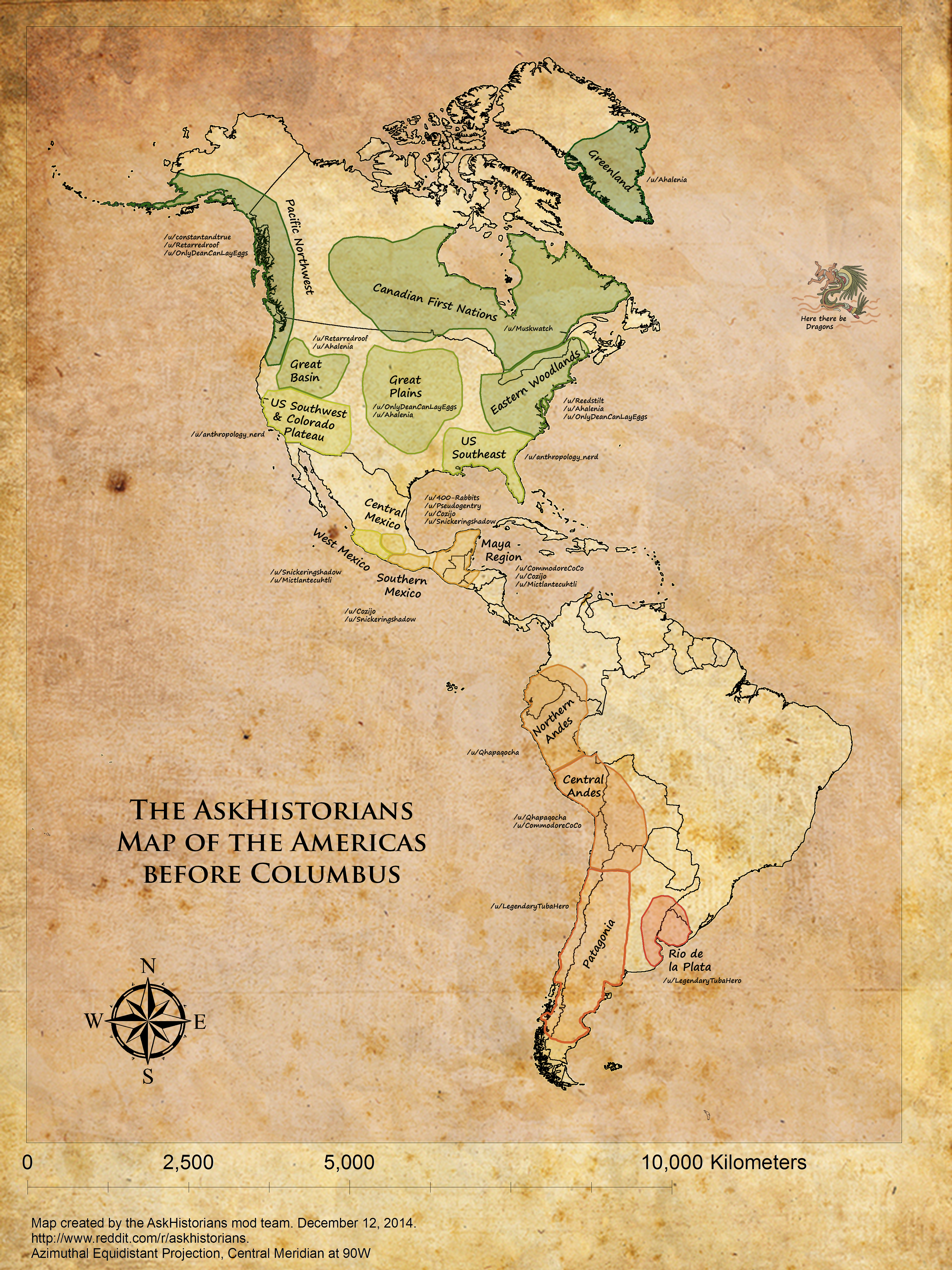
Hello everyone! This has been a long time in planning, but today is the day. We're hosting a massive panel AMA on the Americas before Columbus. If you have a question on any topic relating to the indigenous people of the Americas, up to and including first contact with Europeans, you can post it here. We have a long list of panelists covering almost every geographic region from Patagonia to Alaska.
You can refer to this map to see if your region is covered and by whom.
Here are our panelists:
/u/snickeringhsadow studies Mesoamerican Archaeology, with a background in Oaxaca and Michoacan, especially the Tarascan, Zapotec, Mixtec, and Chatino cultures. He also has a decent amount of knowledge about the Aztecs, and can talk about Mesoamerican metallurgy and indigenous forms of government.
/u/Qhapaqocha studies Andean archaeology, having performed fieldwork in the Cuzco basin of Peru. He is well-aqcuainted with Inca, Wari, Tiwanaku, Moche, Chavin, and various other Andean cultures. Lately he's been poking around Ecuador looking at early urbanism in that region. He can speak especially about cultural astronomy/archaeoastronomy in the region, as well as monumental works in much of the Andes.
/u/anthropology_nerd's primary background is in biological anthropology and the influence of disease in human evolution. Her historical focus revolves around the repercussions of contact in North America, specifically in relation to Native American population dynamics, infectious disease spread, as well as resistance, rebellion, and accommodation.
/u/pseudogentry studies the discovery and conquest of the Triple Alliance, focusing primarily on the ideologies and practicalities concerning indigenous warfare before and during the conquest. He can also discuss the intellectual impact of the discovery of the Americas as well as Aztec society in general
/u/Reedstilt studies the ethnohistory of Eastern Woodlands cultures, primarily around the time of sustained contact with Europeans. He is also knowledgeable about many of the major archaeological traditions in the region, such as the Hopewell and the Mississippians.
/u/CommodoreCoCo studies early Andean societies, with an emphasis on iconography, cultural identity, patterns of domestic architecture, and manipulation of public space in the rise of political power. His research focuses on the Recuay, Chavin, and Tiwanaku cultures, but he is well-read on the Moche, Wari, Chimu, Inca, and early Conquest periods. In addition, CoCo has studied the highland and lowland Maya, and is adept at reading iconography, classic hieroglyphs, and modern K'iche'.
/u/400-Rabbits focuses on the Late Postclassic Supergroup known as the Aztecs, specifically on the Political-Economy of the "Aztec Empire," which was neither Aztec nor an Empire. He is happy to field questions regarding the establishment of the Mexica and their rise to power; the machinations of the Imperial Era; and their eventual downfall, as well as some epilogue of the early Colonial Period. Also, doesn't mind questions about the Olmecs or maize domestication.
/u/constantandtrue studies Pacific Northwest Indigenous history, focusing on cultural heritage and political organization. A Pacific Northwest focus presents challenges to the idea of "pre-Columbian" history, since changes through contact west of the Rockies occur much later than 1492, often indirectly, and direct encounters don't occur for almost another 300 years. Constantandtrue will be happy to answer questions about pre- and early contact histories of PNW Indigenous societies, especially Salishan communities.
/u/Muskwatch is Metis, raised in northern British Columbia who works/has worked doing language documentation and cultural/language revitalization for several languages in western Canada. (Specifically, Algonquian, Tsimshianic, Salish and related languages, as well as Metis, Cree, Nuxalk, Gitksan.) His focus is on languages, the interplay between language, oral-history and political/cultural/religious values, and the meaning, value, and methods of maintaining community and culture.
/u/ahalenia has taught early Native American art history at tribal college, has team-taught other Native American art history classes at a state college. Ahalenia will be able to help on issues of repatriation and cultural sensitivity (i.e. what are items that tribes do not regard as "art" or safe for public viewing and why?), and can also assist with discussions about northern North American Native religions and what is not acceptable to discuss publicly.
/u/Mictlantecuhtli studies Mesoamerican archaeology with a background in Maya studies (undergraduate) and Western Mexico (graduate). He has studied both Classic Nahuatl and Maya hieroglyphics, although he is better adept at Nahuatl. His areas of focus are the shaft tomb and Teuchitlan cultures of the highlands lake region in Jalisco, Nayarit, and Colima. His research interests include architectural energetics, landscape, symbolic, agency, migration, and linguistics.
/u/Legendarytubahero studies colonial and early national Río de la Plata with an emphasis on the frontier, travel writing, and cultural exchange. For this AMA, Lth will field questions on pre-contact indigenous groups in the Río de la Plata and Patagonia, especially the Guaraní, Mapuche, and Tehuelche.
/u/retarredroof is a student of prehistoric subsistence settlements systems among indigenous cultures of the intermountain west, montane regions and coastal areas from Northern California to the Canadian border. He has done extensive fieldwork in California and Washington States. His interests are in the rise of nucleated, sendentary villages and associated subsistence technologies in the arid and coastal west.
/u/OnlyDeanCanLayEggs focuses on savannas and plains of Central North America, Eastern Woodlands, a bit of Pacific Northwest North America. His studies have been more "horizontal" in the topics described below, rather than "vertically" focusing on every aspect of a certain culture or culture area.
/u/Cozijo studies Mesoamerican archaeology, especially the cultures of the modern state of Oaxaca. He also has a background on central Mexico, Maya studies, and the Soconusco coast. His interest is on household archaeology, political economy, native religions, and early colonial interactions. He also has a decent knowledge about issues affecting modern native communities in Mexico.
So, with introductions out of the way, lets begin. Reddit, ask us anything.
These two questions particularly relate to the Mississippian cultures and eastern north America:
How "Mississippian" was the Mississippian culture? By which I mean, was it heavily dependent on the river itself as an exchange network? Does the material culture indicate that the rivers themselves were central to the diffusion of culture?
What did the landscape look like in terms of settlement patterns? What sort of settlement did most people of the time live in? And what sort of settlement hierarchy (ie, orders of settlement size that is often used to indicate political consolidation) was there?
One about the southeast US in particular:
One about the Caribbean:
And one about the Andes:
EDIT: I remembered one more. This is primarily of interest to those studying state societies, but I'm happy to hear anyone's perspective:
We think of the Aztecs and Incas as getting steamrolled by the Spanish. Correctness or not of that image aside, I feel it speaks to a general impression we have of non-western warfare as being very primitive, while avoiding the fact that at least in part this is a product of unfamiliarity with the style of combat that the Conquistadors imported with them.
So what kind of strategic and tactical complexities did Incan and/or Aztec warfare display in the pre-Columbian era? Do we have much in the way of records about this? I've done a bit of reading on the Aztecs at least, but sources seem to be pretty sparse, at least for the layman.
Did Montezuma actually think Cortés was a God? If so, what evidence is there that he did? If not, where does this idea come from?
I'm interested in knowing about the Mapuche. Did they have contacts with other indigenous groups? Did they have a certain characterization of these groups? Did they trade with these groups (if so, what did they trade?) How did the Mapuche society function?
Hopefully this isn't too late time period wise, but I'm also curious about the Incas in Chile. Why did they expand further south? Do we know anything about their perceptions of the Mapuche (and vice versa)? Was there any pre-expansion Mapuche-Inca connections or exchanges?
How do we feel about "1491: New Revelations of the Americas Before Columbus" by Charles C. Mann? I read it a few years ago and it really blew me away, but there was always a nagging part of my brain reminding it was written not by an expert in the field but a rather inquisitive journalist. So then, is it on the level?
Do we have any idea about the level of literacy among, say, the Maya population? It seems that Epigraphy (Stelae for rulers, inscribed panels with royal deeds and such, dipinti on personal possessions) played at least some role in their public life. So, how big was the "sense of audience", the expectation that the things that were inscribed could be read by those viewing them? Could a member of the middle strata be expected to understand the text? A peasant?
Also, how easy could they communicate between each other, could a highland-Maya easily talk with someone from the coastal lands, or were the dialects too different? Were the logogramms mutually intellegible? Or were they maybe used to set one culture apart from the other ("we do these in our style, not like the people over there who are not us")?.
Another thing I wonder about when looking at the map: What happened in those empty areas? It seems to me that the Carribean Islands could have facilitated some exchange between Florida and Yucatan, how close were the people there to the other cultures that surrounded them? Sorry if this is kind of a broad question, just something I noticed.
What about the environments that the Mesoamerican groups lived in was more conducive to large and complicated civilizations that aren't really found anywhere else in the Western Hemisphere until contact? In other words, why aren't there pyramids in Ohio?
In the Classical World, we see gods "travel" such that Romans ended up worshiping Isis, and Mithras, and Orpheus, and many other cults that did not originate within their home territories. Do we know if similar things happened in the New World? Obviously, we have things like the Ghost Dance which traveled far in the Post-Columbian world, but what about the Pre-Columbian world?
Did any of the Meso-American civilizations develop systems of currency? If not, what, if anything, acted as a medium of exchange in economic transactions?
2 related questions:
How much did the widely separated civilizations in the pre-Columbian Americas know about each other or trade with each other? Were there regular trade routes between, say, the Mississippi Valley civilizations and the Valley of Mexico or between Yucatan and Peru? Were they mostly by land or sea?
Is there any evidence of regular contact between the cultures of pre-Columbian Americas and Siberia/Asia, other than the people living around the Bering Strait? I recall hearing an account of annual messengers being sent from central Mexico to keep in contact with their ancestral homelands in Asia- is this plausible, or just a myth?
Why was Cahokia able to become the large cultural and economic center of the Mississippian cultures? Why didn't other cultures from the Great Plains grow to become such large centers of population?
What would Cahokia have looked like while it was still being maintained? I've read before that it may have been covered in some sort of white material and decorated with red and blue flags, but I have no clue how legitimate that is.
Also what is the modern consensus on the population of North and South America pre-contact, and what percentage of this population was wiped out by disease?
Thank you very much for your time!
You were not kidding when the sidebar said "and many more". DAMN.
Anyways, jokes aside, back in I believe July or August, a friend and I went to the Museum of Man (anthropology museum), specifically to check out the display that they had about the Maya. One of the things that struck me was the large hieroglyphics of some of the reconstructed... I think the proper terminology is stelae? I was curious as to how we were able to decipher the meaning of these hieroglyphics. In the case of the Egyptian hieroglyphics, we had the Rosetta stone. Was there a similar discovery that led to our being able to translate Mayan hieroglyphics?
I live in southern ohio right where lower shawnee town was and where numerous other large earthworks are. I've read multiple books saying that some earthworks were built for defensive purpose these were all older books and the books that have been published more recently dismiss this theory. So my question is what's the overall consensus on their purpose? I know many were built for ceremonies and burials and even crematories. So my question is really pertaining to the larger sites like fort ancient for example. also any information about the inhabitants of southern ohio would be great!
Thanks for organizing this! I'm excited to read all the fantastic answers you guys give.
I do fieldwork (animal behavior, not archaeology or anthropology) in Ecuador so I have a couple questions about there.
One is that in the highlands the indigenous people are thoroughly Inca. Place names are frequently in Kichwa as well; I've been to Yanacocha, Yanayacu, Puyucunapi, and my field site has a Río Chalhuayacu (I know the name is redundant) running through it. However, my understanding is that Ecuador was the northern frontier of the Incan Empire and was only incorporated a few decades before the Spanish conquest. How did the rapid acculturation happen? Did it even all happen before the Spanish?
The other question is about the lowlands and foothills, specifically the foresty ones. Did the Inca, being based in an area with a temperate climate, have any of the same troubles in the lowlands that Europeans sometimes had in the tropics? Did they encounter diseases or difficulties with conducting military campaigns in tropical forests (and were there even New World diseases in tropical forests before the Columbian exchange)? (I got this question because I once read that one of the emperors had conducted a campaign against the Shuar and the idea of highland Incas going into the foothills and lowlands of the east rightly or not seemed weird to me)
Lastly, I really like birds and South America is pretty crazy with birds. Were there any birds that were thought of highly or depicted a lot or symbolically important among the Inca the way Mesoamericans really liked the Resplendent Quetzal? I would especially be interested if we know of what any native peoples thought of manakins and manakins' elaborate displays but I'm not holding my breath.
to /u/anthropology_nerd "Most geneticists agree that Native Americans are descended from Siberians who crossed into America 26,000 to 18,000 years ago via a land bridge over the Bering Strait. But while genetic analysis of modern Native Americans lends support to this idea, strong fossil evidence has been lacking.
Now a nearly complete skeleton of a prehistoric teenage girl, newly discovered in an underwater cave in the Yucatán Peninsula, establishes a clear link between the ancient and modern peoples, scientists say." -The New York Times
I read also that Native American people share the same haplogroup of a small group of a Siberian tribe. I would like to know, how high is the Neanderthal percentage in North, Central and South America? Do they also have Denisovan's traces? Are they affected more or affected less, compared to let's say Europeans, when it comes to syndromes like autisme or diseases like diabetes?
Alright, first I have some Northwest Coast questions
What is the current estimation of pre-contact population? I've heard that some estimates place population as being very high before the epidemics swept through, making really massive villages and structures (like the Old Man House on Bainbridge island) fairly commonplace in the Salish Sea region.
Is it known what sort of environment and culture inhabited the area immediately after the glaciers retreated? When did the stereotypical Northwest Coast culture become dominant?
Why did Chinook Wawa become the lingua franca of the PNW? Also, is it true that in some places, children learned Wawa as a first language before mastering their native language?
And I have one Andean/Inca question
How mutually intelligible were the languages within and between the civilizations? Was there a "Koine" that people spoke for transactions, or were there multiple translators involved in diplomacy, like the roundabout way De Gama communicated with Indian leaders through multiple translators translating to other translators?
The Inca Empire is sometimes described as "socialist". How accurate is this label? Is it anachronistic?
I've actually got about a bazillion questions I could ask but in the interest of time I'll pitch some about the teaching and study of native North American art:
How do scholars and tribe members decide what objects are not safe for public viewing? What kind of procedures are there to discuss this? Are these objects usually deaccessioned to tribes, retained by the museum but kept off exhibit, or something else?
How have curatorial practices surrounding Native art changed in recent years?
What's it like to teach Native art at a tribal college and how is it different from teaching it at a state university?
One of the concerns in teaching arts of native peoples in my mind(and all nonwestern art really) is the temptation to place them in a "historical present" where they are defined by certain immutable characteristics and not treated as having a certain historical development. How do you deal with this and, so to speak, put the "history" in Native American art history?
I would just like to start by saying thank you to the panel members, I have been eagerly waiting for this AMA. I have a few questions here.
If Peruvian societies were so skilled at working with metals like gold, silver and copper, how did they not discover the benefits of working with iron?
I get that the Spaniards had the advantage when it came to guns and cannons and horses, but did they really carry enough gunpowder, bullets and cannon balls to defeat Aztec and Incan armies hundreds of times their size? Do we know what military strategies they used to be able to defeat such large armies? I know Cortez used the fragmented society to raise a rebellion which he led, but even so, shouldn't the sheer size of the Aztec and Incan armies and their knowledge of the local geography been enough to win?
If the city of Tenochtitlan was bigger and more advanced than many European cities, why did it disappear (as in why is it being excavated and we are still learning about it, rather than there being extensive records about life there before and after European contact)? Why hasn't the city been continuously lived in like Paris or Rome despite those cities being sacked and destroyed in the past?
What kept Native American civilizations north of the Rio Grande from developing into massive formal empires like their Mesoamerican/Andean counterparts?
Why were so few animals domesticated in the Americas. Even if they had no beasts of burden, wouldn't animals like buffalo be domesticated eventually?
Thanks for taking the time to do this btw!
How quickly did disease spread through north/south america? Were the Incans dying of smallpox before the Spanish even reached them, for instance? Did the Apache or Paiute go through epidemics of European diseases decades before contact from trade or something similar?
Given the compulsory education set in place in the Aztec Empire, were there any specific significant scientific findings or learning made by the Aztecs that greatly influenced the world?
Are they evidence of south Americans having real contact with Pacific islanders pre-Colombus? Polynesean chickens and whatnot.
What is the most ancient civilization in the Americas, and what happened to them?
What attracts you to your field of study? What's the draw and how did you find yourself doing it?
I have some question on Mayan religion.
I remember learning about the process of Mayan bloodletting, which was done by threading a thorny cord through the tongue, like so, but also that this was done with the genitals on occasion.
What do we know about this practice? What determined whether the bloodletting would occur through the tongue or through the genitals? How did the practice develop?
What was the approximate population of Pre-Colombian North America? South America?
To /u/anthropology_nerd: Have we figured out what happened to the people of Stadaconé and Hochelaga after Cartier's and Roberval's voyages? Is there any evidence that they were decimated by European-borne disease?
Any good podcast or audio book advice? And while I have your attention, thoughts about 1491? That was the (audio) book that first blew my mind on this topic.
I have two questions:-
A) For political reasons, the origins of the Mapuche are controversial, with some claiming they were one of the newer inhabitants on the Araucania before the invasion of the Incas and later the Spanish (from the region of what is today Bolivia), however there seems to be some archaeological evidence that suggests a much longer inhabitation of the area, and the Bolivia one is obviously a very political narrative about the Mapuche. What do we know about the early Mapuche and the pre-Inca Mapuche, and about their origins/migrations?
B) Whatever happened to the Diaguitas? I know a few exist, but I could find only a little information about their civilization and history. Did the civilization degrade and die out? Was it conquered by the Incas or Mapuches and destroyed/assimilated?
Hi there! My question is about pre-Colmbian explorers apart from Columbus and the Vikings, whose presence in the New World is documented. What about other hypotheses, like potential Chinese exploration on the western North American coast or African kingdoms like the Mali empire coming across present-day Brazil? I've seen the Olmec Heads used to support the African theory, but how "good" is it as evidence?
Thanks for organizing this AMA, thanks for all those participating!
I'm curious about the Pre-Columbian civilizations of the North American Southwest. How centralized were the states of the various native communities there? Would a "nation-state" be a suitable descriptor for any of the peoples there at any point in time? If not, how would you, as historians, describe the government styles of these entities?
EDIT: Another question I just thought of. How do you regard P. Hamalainen's *The Comanche Empire"? I know it is fairly successful commercially, but is it well regarded among scholars in that field as well?
This question is purely speculative and holds no real historic relevance but I really want to know what the panel thinks America would look like today had Europeans never set foot in America (never explored Asia, Africa or Americas)? Who would rule North, Central, South America? What kind of government might be in place, etc etc.
What were some of the different methods of organizing 'the commons' in the Americas before processes of colonialism imposed systems of private property and how effective were they?
What were the different reactions or modes of resistance of indigenous communities to the imposition of such systems?
Thanks!
It says that Mexicas came from Aztlán before establishing in Tenochtitlan? Is this true? and where was Aztlan in the maps?
Huitzilopochtli asked the Mexicas to establish their civilization when and where they have found an eagle eating an snake. How true was this story?
Technically the Mexicas established on top of what it was Teotihuacan? And what happened with Teotihuacan civilization?
Thanks for this AMA!
Did North American Native Americans hunt, eat, or use cicadas in anyway? What did they think of these loud, numerous insects that only appear every decade or so?
Is there any evidence of prehispanic music on the Aztec Empire or Mesoamerica?
What were the estimated population of major pre-Columbian civilizations at their peaks, and what was the total population of the Americas then? How does historians estimate this, given that most of these people got killed by diseases before Europeans even met them?
I hope that I'm not too late. I'm curious about the hopewell Indians. The term hopewell seems to be a modern person that named this group of natives. But do we have any idea as to what they actually called themselves? Did they have a system of writing that has been translated? I'm also interested in the currency they used. Thank you In advance.
Another question--this one for US Southwest scholars.
I've heard that calling the Anasazi tribe by that name is considered improper. I've heard that the tribe may alternatively be called the Ancestral Puebloans, but that some genetric work has uncovered that the moden Puebloans do not, in fact, descend from the so-called Anasazi. Can someone give me a more thorough overview of the controversy, the arguments for each name, and if there are any other alternative names?
Did the Huastec people actually lose against the conquistadors do to a solar eclipse, or is just a tale.
Regarding the idea of an Axis Mundi (Center of the world), was the city of Tenochtitlan the Aztecs Axis Mundi?
This one is from my dad, who was curious--
Of the known archaeological sites of the Inca, Maya, Aztec, and Olmec, roughly what percentage have been thoroughly excavated and identified?
Do we have a good grasp on the chronology of the invention of agriculture in the Americas?
I know that the exact pathway for domestication of maize is still a subject of active research?
Did the Mayans use writing to send messages to one another, as opposed to just inscribing it on monuments and pottery? Did they write down stories and/or poems?
Did the use of writing among the maya decline in postclassic period?
How much do we actually know about the pre-Contact Native societies of the Eastern Seaboard of North America? I'm especially interested in to what degree early explorers like John Smith and Samuel de Champlain can be treated as reliable sources.
How interconnected were the Pre Columbian Americas? How far would goods produced in one area, Mesoamerica for example travel outside of that area?
I'm curious about the Norte Chico civilization.
Why were they the first to develop? I make the assumption that natives originally came over the Bering Strait Landbridge and made their way down North and South America. So why were the northern Andes the first place to develop a civilization? What made that area special when compared to other areas on the west coast or where the Olmecs would develop?
What do we know about the populations of present day northeastern United States? In particular the Lenape who populated present day New York. They were all hunter gatherers, right? And didn't develop cities or even towns?
I would like to know what evidence has come to light to support a migration route by boat of Polynesian or Lapita culture into the Americas? How could they have possibly made land fall on tiny secluded islands like Easter Island and not made it to the west coast of the Americas?
I have a few questions. First I was doing some research on slavery, and I realized I know nothing about how it functioned in pre columbian america, so if anybody has any details about that, I would be interested.
Second looking at the map, it looks like there weren't too many settlements on the Brazilian coast, is it just that the map didn't include them, or is there a reason most of the settlements in South America were on the west coast?
For /u/Reedstilt:
How reliable are European adventurers like Samuel de Champlain and John Smith as a source of ethnographic and cultural knowledge of the Pre-Contact social and political structures of the peoples of what is today the Northeastern U.S. and Canada?
I know that John Smith is widely belived to have fabricated, or at least massively misunderstood, much of his accounts of the social and political structures of the peoples he encountered. Hence the entire Pocahontas story being largely legend.
More generally, to what degree can post-contact ethnography of the Eastern Woodlands be considered useful for discerning pre-contact social and political structures, given the massive demographic changes that took place in the first century or so after European contact in the mid-1500s?
I know that the arrival of humanity in the Americas did not bring also technology such as writing; it developed independently of the writing of the East. My question: how much native weaponry developed after the arrival of humans, and how much was taken with these forerunners from the Old World? Are there any weapons/tools of war that, though they appear or function in a notably similar manner to certain European, African or Asian weapons, developed completely independently?
Not sure if relevant, but is the hatred of Christopher Columbus justified? I've read of rape, murder, genocide, slavery, and other heinous stuff. Not sure if this is "new age" perception of him or a modern day smear campaign. I'm leaning towards, "He's an $@&@&&" but not informed enough to know if I'm really justified.
What would surprise the average person about South American civilizations in term of cultural or technological advancements? This might be a generalization, but most people would consider South American cultures to have been pretty 'far behind' Europe and Asian by the time we made contact.
How would you approach that subject? Were they more advanced than we give them credit for?
how much "evidence" (if any) is there of voyagers from africa reaching the americas before columbus?
How much do we know about the Nazca lines? Were they just decorative, or did they serve some purpose like alien ship landing strips navigation?
What was the furthest extent of trade carried out by Aztec culture and Mayan culture? Did either group ever attempt to explore or colonize further into North America, such as into Texas or the SW United States? Did they encounter other North American tribes such as any of the Pueblo people in New Mexico and Arizona?
This is especially regarding civilizations north of Mexico: How complex did the government/political systems get in the Americas? Almost every civilization gets called a chiefdom (or a "culture"), except the the Aztec Empire, the Inca Empire, the Tarascan Empire, and the Mayan city-states. Are there civilizations that are normally called chiefdoms/cultures that would be better suited with a different term?
Are all new discoveries of pre-Columbian America happening in archaeology? Is there anything going on in anthropology (i.e. using contact with living Natives) or in history (i.e. interpreting written documents)?
This question is mostly about non-Maya/Inca/Aztec civilizations, especially those north of Mexico:
How big did things get? You hear all the time about European castles, and large Renaissance cities. Did the (non Maya/Inca/Aztec) Americas compare? How high did they build? How many people did their towns get to be? How large (in size) were the towns?
This is mostly related to the last question, but often I learn about ancient structures like Tiwanaku, Old Stone Fort, or Casa Grande, and often, all I can find are the ruins that are left, with no idea of what they looked like? I'm not asking about only these ones, but often if I'm not looking at something that is preserved (e.g. a Mayan pyramid) or something really famous (e.g. Cahokia, Etowah), I'm often confused about how big the place really was. When I look at images of Huaca de Luna, it looks incredibly big. Was it really that big?
What do we know about the literature, theater and music of pre-Columbian Americans? All I'm really familiar with is the Popol Vuh (more or less).
On a similar note, I read Aztec Thought and Culture a little while ago, and it was very enlightening. Were other cultures as advanced philosophically?
Also, did the Mississippians/Hopewell influence how America developed? Do we still use their roads? Did cities purposefully form on old Native cities?
Also, what books would you recommend to someone starting out in your region/time? Basically, what should one read after 1491?
Sorry for the large number of questions.
I have 2 questions:
How connected were Pre-Columbian societies? For example was there trade going on from Florida to Mexico?
How sophisticated was warfare? By this I mean how much a of it was motivated for territory versus something like goldmines or trade rights?
Alsow can you give me a brief description on Aztec and Inca religious beliefs?
General question:
I just finished reading The Ceren Site, and I found it interesting that Sheets really never stated an affiliation for the people that had occupied that village. He stated that they were on the southern periphery of Maya territory, and found some artifacts that might be interpreted as Mayan. But he left the possibility open that they associated with another tradition.
So, is this common? Is it difficult to determine form which tradition a site is associated with? Or is it just the fact that this was a small commoner village that was largely self-sufficient?
I guess as a student I always assumed that it was more obvious than that. This is the first time I had considered it.
So, it's been long enough now that I feel okay doing this. I have a question for another panelist: /u/Mictlantecuhtli
What can you tell me about the people who built the shaft tombs in West Mexico? The shaft tombs seem highly elaborate in terms of both construction and grave goods. Does this indicate the existence of a hierarchical elite? Or was their society more egalitarian? And if their society was more egalitarian, for whom were the shaft tombs built?
The sweet potato moved west. What moved east?
Did any precolumbian societies make use of metal for everyday tools, as opposed to decorative objects?
Did the Tarascan civilization use metal weapons?
Was the Incan empire responsible for the spread of Quechua? Was this spread intentional on the Incans' part?
Why are none of you studying the cultures of the amazon?
What do we know about the environmental conditions of state formation in the americas? For example I often read that elsewhere in the world, a combination of plantable crops (wheat, millet, etc.), available freshwater, and small climate crises might force people to cluster together and pool resources to sustain agriculture, therefore generating state formation. What sort of environmental conditions influenced, for example, the formation of the Olmec civilization?
This is somewhat to /u/ahalenia but anyone can answer:
Was there any presence of gender ambiguity in pre-Columbian art or mythology (e.g. Hermaphroditus's myth or that Ometeotl has a male and female part)? I know of the concept of Two-Spirit people, but were similar ideas present in the art or mythology of pre-Columbian people? Also, were Two-Spirit people present south of the modern U.S.?
Also (this is a question to all), how was homosexual/homosocial behavior and actions perceived in pre-Columbian art, mythology, and/or culture?
How many waves of movement into the Americas does current scholarship and DNA analysis support? How many? From where? When?
Can you give me the story of various mythological cosmogonies and general theology of these cultures? I find them fascinating. As I assume it would be very tedious to type in full, I could also read other sources.
what do you know about the Ancient Earthmovers of the Amazon? is there any good book about the subject?
Two questions about the Maya; They seemed to be way more advanced than other peoples in mesoamerica in math, astronomy, medicine and writing but somehow this didnt help them prevail over the conquering armies from the north... How can that be interpreted? About the preclasic Maya, recent publications (Wiki :-P) seem to indicate that the maya and Olmec cultures were paralel and not derivative... How are scientists describing this relationship now? Finaly, I would be very thankfull for a few good online sources for Maya investigations... Thanks!
Hi, perhaps this is a question directly for /u/anthropology_nerd, My question is regarding the amount of people that died directly from diseases caused by Spanish conquistadors during the siege of Tenochtitlan, I've encounter contradicting information in several books and would love your input.
Pseudoscience alert: I've been reading Frank Joseph's Advanced Civilizations of Prehistoric America, a book that covers a lot of fascinating archaeology from the Adena to the Anasazi, but wraps it around a thesis that the Adena were basically Celts who'd come over from Europe and set up shop in North America.
Yes, I know. But humor me for a minute.
Just how loony is this thesis?
And... were there actually tablets engraved in Iberian Punic or Gaelic found in the Gennessee River Valley?