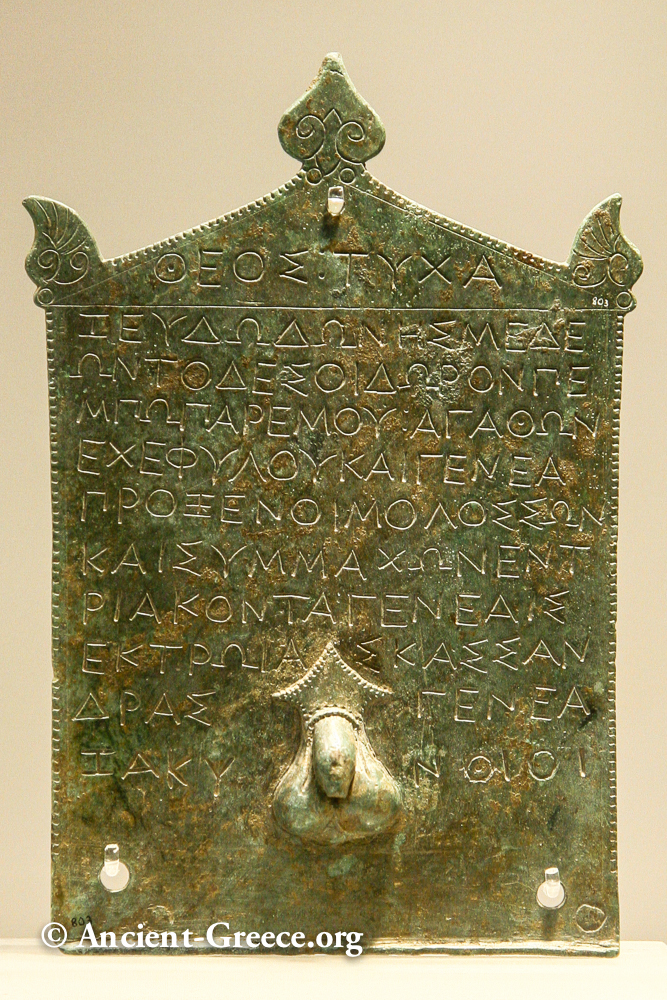
This is IG IX 1^2 , 4, 1750, dated to the late 4th/early third century BC. It was found in the 1874/1875 excavations at Dodona.
How did you come by this? It should be in the National Museum in Athens (E.M. 803), so I guess this is a replica.
Translated:
Hail, God! O Zeus, who takes care for Dodona, this gift I send from me to you, Agathon, son of Echephylos, and his tribe (the exact translation of genea here and the cases below is apparently up for debate), who are Proxenoi (guest-friends) of the Molossoi and their allies. In the thirtieth generation after the Troian Kassandra, the tribe from Zakynthos.
It's a votive inscription, by an individual named Agathon of the Zakynthioi (from Zakynthos, a Greek Isle), offered up in the Zeus sanctuary at Dodona. Interestingly, he both proclaims the friendship with the Molossians as well as the trojan ancestry of his people. The phallus probably symbolized the vitality of Agathon and his family.
More on it can be found in this jstor article.
Quite a curious object. Apparently it's a modern museum quality replica of a late 4rd Century BC (possibly dedicated in the reign of Alexander I. 'the Molossan' of Epirus (ca.350-331 BCE) votive bronze tablet from the Zeus Sanctuary/Oracle of Dodona, currently conserved in the Athens National Museum.
EDIT2: Here's the original plaque and more finds from Dodona
It's a dedication to Zeus made by a 'Zakynthian, by name Agathon, [which] records a link of proxeny between himself and his family and the Epirote koinon of the Molossians, through Kassandra, the Trojan prophetess. The plaque is decorated by a prominent phallus with testicles, which the author interprets as referring to the continuity, past and future, of the γενεά of Agathon.'
My Ancient Greek is quite rusty, so I can't translate the whole text (I found this article by deciphering proxenon Molosson kai symmachon = 'allies of the Molossians and fighting along side with them'), but the text is Inscriptiones Graecae (IG) IX.12 4.1750, which you (or some helpful philologist ;) could probably find (untranslated) on e.g. http://epigraphy.packhum.org/inscriptions/ EDIT1: seemingly not digitalized yet :(
It's seemingly a quite heavily debated source on 'Epeirote hellenization' - the process by which the 'semi-barbarous' Northwestern Greeks (compare the much more famous Macedon) politically/ideologically integrated themselves into the more 'traditional' Greek cultural sphere in the 4th Century BC parallel to their rise as military powers (don't quote me on this, Art historian with Archeology Minor here ;))
Non-native speaker, hopefully I didn't butcher the english language too much... :(
EDIT: damn, typed this for an hour and u/Astrogator preempted me :(