My friend insists that the Sherman was a bad tank, simply for the reason that it was incredibly flammable. He says the British called it the "Zippo" or "Ronson", and the Germans called it the "Tommy Cooker". Is there any truth in what he claims, or is it just a myth?
EDIT: I have asked him and he is refferring to the M4 not the other flamethrower tank.
So as /u/XenophonTheAthenian said, judging a tank simply on how readily it might burn when knocked out is a pretty narrow metric with which to measure the effectiveness of a tank, and by that metric the Sherman doesn't actually do that poorly. Xenophon already mentioned the problem wasn't unique to the Sherman at all but I figured I would back that up with some actual data, and then I wanted to add some actual context to what the Sherman actually was and what it wasn't because I have a feeling that your friend wont simply be convinced just by learning that the Sherman didn't catch fire any more than any other tank did (and less often than some other famous tanks).
So how often the Sherman was considered to burn really depended on the circumstances in which the data was collected. An American study conducted in France for instance found that 65% of Shermans burned when they were knocked out.^1 While a study of the British 8th and 24th Armor Brigades found that about 56% of there tanks burned when knocked out.^1 Another study found that they burned about 80% of the time. These rates all really depended on the sample of course so you are never going to get a single definitive rate.
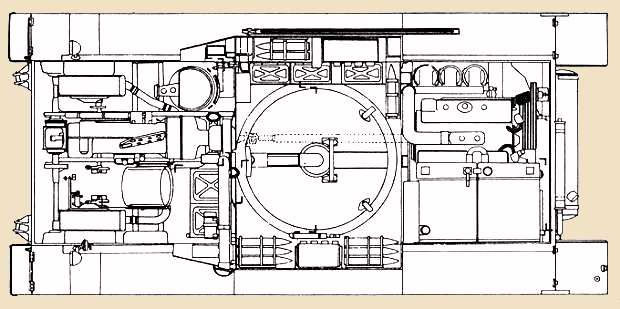
The causes of this was primarily the storage of ammunition. In the early version of the Sherman, which I will refer to as "small-hatch" Shermans from now on, all of the ammunition was either stored in the turret (the ready-rack) or in the ammunition racks in the sponsons over the tracks. The problem with that location is that most of the time when tanks were knocked out, it was from hits to the sides which meant that the ammunition racks were quite often directly in the line of fire!
Even so, the Sherman was by no means the only offender in this regard. The Panther stored its ammunition in literally the same location, so did the Panzer IV, and the Tiger. This meant that any time these tanks were hit from the side they were very likely to burn. And according to an allied study the Panzer IV was the worst, burning more than 80% of the time.
The American's however recognized this as an issue with the Sherman and quickly set about attempting to fix the issue.
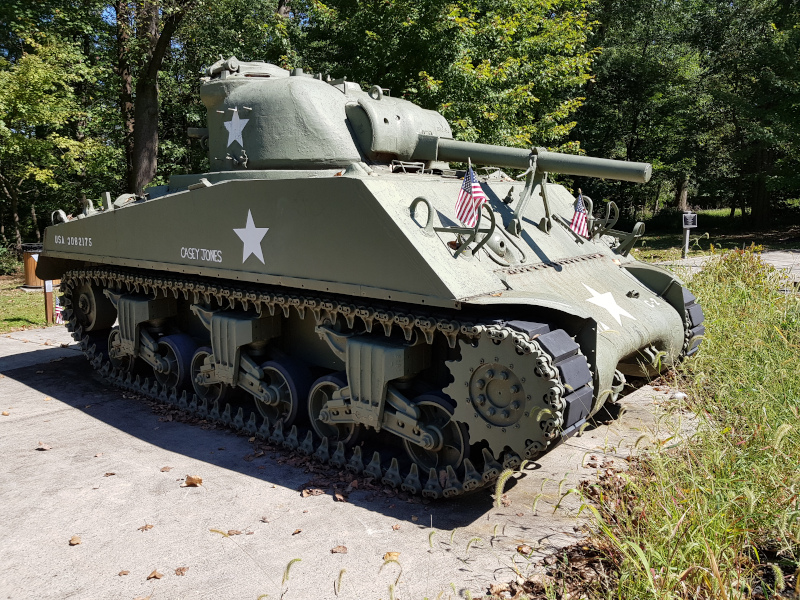
The first thing the US did was to issue an armor applique kit which would be applied in tank depots before being issued to troops in the field. There were four different kits but the one I am referring to can be seen in this picture. Each of those armor plates were intended to simply increase the thickness of the hull armor over the ammo racks. Eventually the applique armor, on M4A1s at least, was made part of the actual hull casting, but on tanks like the M4, M4A2, M4A3, and M4A4 the applique armor was simply welded on till the production of those tanks ceased.
The applique armor was never seen as the final solution however, and in December 1943 the second generation of Sherman's, or large-hatch Shermans, began rolling off the production lines. This new generation of Shermans included a number of improvements but perhaps the most obvious change was the the front of the hull which can be seen in this picture of a small-hatch and large-hatch M4A3. The important thing to note however is that on the large hatch Sherman there is no applique armor plates.
This was one of the major improvements of the large-hatch Shermans, at least as far as fires go anyway. According to studies conducted by the Ordnance Department the best place for the ammunition was on the floor of the tank, and in some reports they specifically refer to this arrangement as the "Soviet manner", because this was how ammunition was stored in the T-34. So all the ammunition was moved to the floor in armored containers, and the turret basket was removed to allow access to the containers. Another feature that was added was called Wet Storage.
Wet Storage was basically this: all the ammunition boxes which were in the floor were surrounded by a water jacket. The idea was that if the ammunition racks were hit they would be flooded with water and put out any fire. On 75mm armed Shermans the water jacket could hold 38.1 gallons or .366 gallons per round (104 rounds total) and in 76mm armed Shermans 34.5 gallons or .515 gallons per round (71 rounds total).^2
Wet Storage worked extremely well, Shermans equipped with it now burned between 10 - 15% of the time as opposed to the 55 - to 80%^3 of the time, making the Sherman by far the safest tank on the battlefield as far as fires went anyway.
Another thing your friend will probably mention is the Sherman's gas engine, and he will probably cite this as a source of the fires in the Sherman. If he does this, you should point out that all German tanks also had gas engines, and ask why didn't their tanks have the same reputations. (Though they really ought to have anyway, they caught on fire just as often).
Now as for the context as the first comment here put it. Now I could go on and on but I figure a good way to give you sort of the readers digest version is by addressing most the points I mentioned in this post. So lets do each one in order.
This simply isn't true, and when the evidence is examined you will see that US forces did quite well. In a study of 87 tank engagements involving involving the 3rd and 4th Armored Divisions the US actually destroyed more enemy tanks and equipment then they lost, and in these engagements they were quite often fighting Panthers.^4
In the first 3 examples in the study, which involved a total of 27 engagements, a total of 155 M4s faced off against 114 Panthers. The US lost 10 M4s while the Germans lost 70 Panthers^4.
And the Sherman had been designed from the get go to fight other tanks. In FM 17-10 it states explicitly that both medium and light tanks should be used to fight other tanks. In 1942 the Sherman was more than capable of taking on any tank on the battlefield. Its 75mm gun could kill any German tank at the time and with 90mm of armor on the front of the hull (effective) it was mostly impervious to any German tank except at close range.
This situation remained about the same until mid 44, yes the Panzer 4 was upgunned, but even the 7.5cm KwK L/48 couldnt penetrate the front of the Sherman beyond 1100 meters while the Panzer IV remained vulnerable from about the same distance.
The Panther did outclass the Sherman, there is no doubt of that, and unlike what that other poster said it even outclassed the late war Sherman, but the Panther had its own issues, and while it did outclass the Sherman one on one, it was not so superior that it couldn't be overcome as the study I mentioned showed.
2.It took X number of Shermans to kill Panzer IV/V/VI
This is a very silly claim and there is no basis for it. Keep in mind that the Germans lost more tanks to the US than the US lost to the Germans.
Really, the Sherman was a tank that was comparable to other medium tanks of the era, for instance the T-34. Both tanks were armed and armored in similar ways, and they both served about the same roles in their respective armies. Neither tank was perfect, but they were good enough to do the job that was expected of them and they did them well.
Anyway, I feel that the second part wasn't all the eloquent but I am way past my bed time. If there was anything I did not explain well, let me know and I will clarify, I admit I was sort of pulled in all directions wile trying to put this together.
Oh by the way, the Ronson nickname is almost certainly anachronistic. The "lights first time, every time" was a slogan that didn't come out until the 50s. Ronson did make flamethrowers for Shermans though and I think that is probably where the name came from.
List of sources:
John Buckley, British Armour in the Normandy Campaign
R.P. Hunnicutt, Sherman: A History of the American Medium Tank
Steven Zaloga, Armored Thunderbolt: The U.S. Army Sherman in World War II
David Hardison, Data on Tank Engagements involving the 3rd and 4th Armored Divisions
As we can see from my flair I'm hardly a tank expert, but if flammability is the only criterion for being a bad tank the M4 was certainly a whole lot better than most of the tanks that one might laud as excellent. The Tiger was know for catching fire even when it hadn't been shot, as was the Panther. The T-34 statistically caught fire more than any other tank in the war, and I believe had proportionally higher cases of fire as well (because of its crappy engine that overheated easily and the silly method of storing ammunition). Indeed, with the introduction of wet stowage the M4 became extremely safe from ammunition fires and explosions