I could only think of Western figures, but I don't mean to limit the scope to that.
Well we do have some possible specimens of Ashurbanipal's handwriting. We have several tablets signed by him and they are notable in that they are clearly not written by a professional scribe. So they may actually be by him.
Edit: /u/farquier's post trumps everything I've written here in terms of fame and early date, but I'll still leave this up as it may possibly have some interesting points in it.
No - or at least, not the writers/figures you're thinking of. First off, signatures (in the sense of someone signing their own name) are a comparatively recent phenomenon: not that people in antiquity would never write their own name, but that signing off with your name, or giving an autograph to someone as a souvenir, wasn't really a thing.
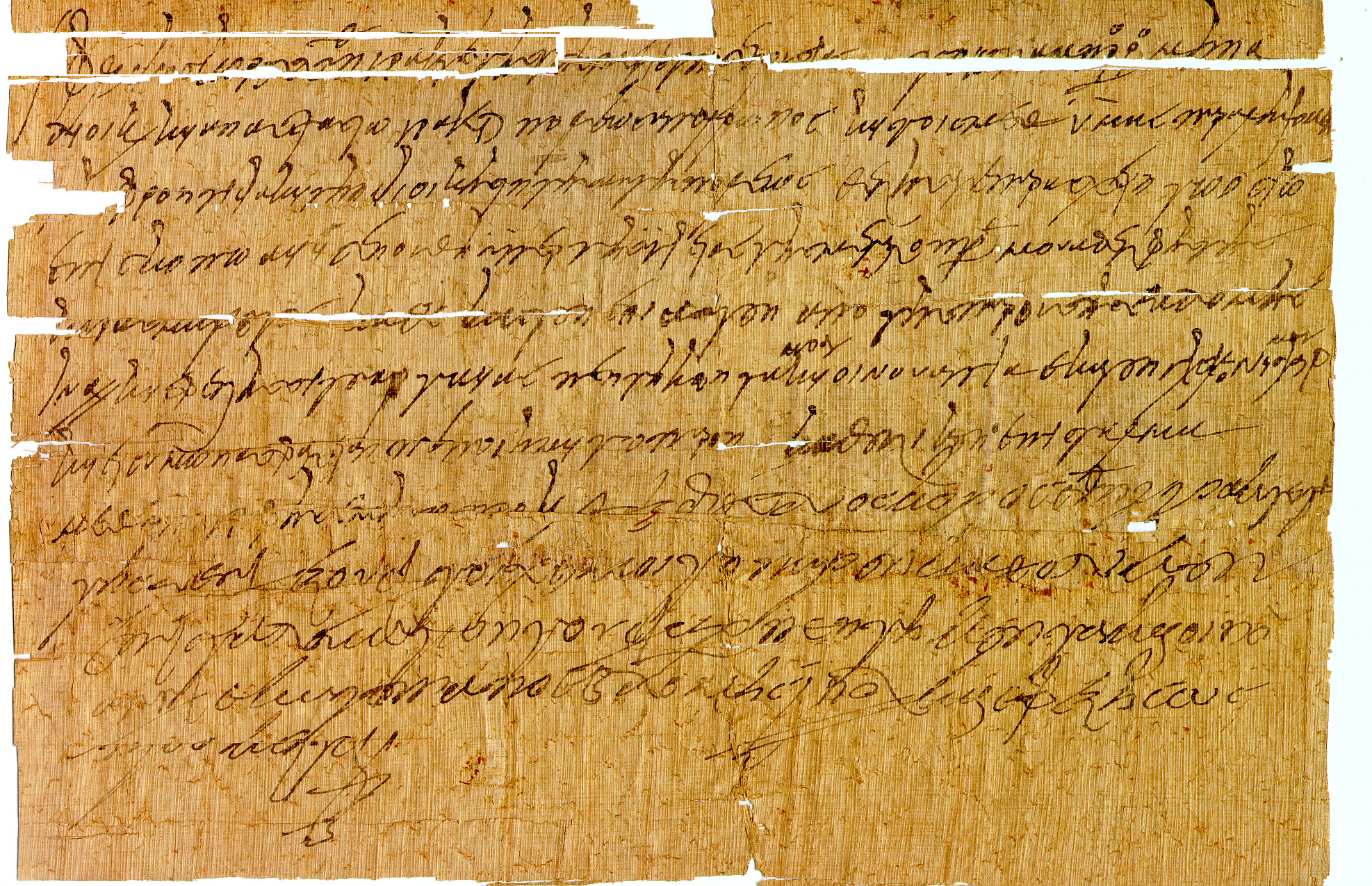
It makes a bit more sense to talk about autographs in the sense of a document written by the author's own hand. Several months ago /u/georgiusflorentius traced the earliest extant autograph of a complete work to Flavius Dioskoros, an obscure 6th century CE Egyptian poet whose work is only known from a set of papyri found in 1905 that are written in his own hand. Here's a sample of his writing, though it's a business document, not one of his poems; his name appears as the first two words at the top of the papyrus.
There are of course earlier documents written in the hand of the person who composed the text, but we're not talking complete literary works, and we're not talking famous authors. This 1991 article (in German) discusses a few literary works going back to the 1st century CE which are apparently autographs, but they're not by known authors, and they're very fragmentary. Greek vase painters sometimes signed their work, so for example we have a signature by one of the most famous 6th century BCE Attic black-figure painters, Exekias, on this vase, which is one of his most famous pieces (the signature is at the top left, behind Achilleus' head: "Exekias painted and made me"). And most inscriptions are trivially autographs; but they won't be well-known authors.
We get a little closer to famous authorship if we look at Bronze Age documents, especially the correspondence that has been found at places like El Amarna and Hattusa. Ramesses didn't write his letters himself, but scribes would sometimes add "piggyback" letters to each other, as a kind of secret appendage to the main letter, as a way of keeping in touch with other scribes who were their pen pals (and of course the scribe at the other end would be the only person who would see the piggyback letter). In those cases we can be sure that the author and the writer are one and the same. Here's a sample of a piggyback message, in a letter from the king of Arzawa addressed to pharaoh Amunhotep III: the scribe adds (Hoffner (ed.), Letters from the Hittite Kingdom, 2009, p. 272)
May Ea, the king of wisdom, and the Sungod of the Portico lovingly protect the scribe who reads aloud this tablet, and may the lovingly hold their arms around you. You, scribe, kindly write to me and put your name at the end. Always write in Hittite the letters that they bring here.
Or to paraphrase a little more loosely,
Dear scribe: hello, I hope you are well. I would like a pen pal! What is your name? PS: my Akkadian isn't very good.
Scribal signatures go back a long way: this site shows an inscription with reportedly the earliest signature by a scribe, dating to just before 3000 BCE.
But we're getting quite a long way from the original question, which was about literary authors and famous figures. In brief, the earliest autographs we have that are by anyone at all well known are going to be Byzantine authors, and so not terribly well known. We've certainly got stuff written by Arethas, for example. The earliest autograph that I know of by anyone who is independently "famous" is by Flavius Asterius, who was consul at Rome in 494 CE: we still have copies of works of Sedulius and Vergil in which he made corrections to the text with his own hand.