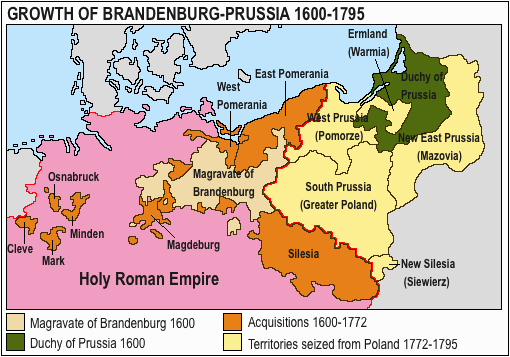
Well you're getting it a little mixed up in a few ways. Let me see if I can help clarify.
Some quick background: Prussia was created in the 16th century as a vassal (and thus a part) of the Kingdom of Poland. Since it was now "Prussia" and not "The Teutonic Order" (as in, it was a legitimate secularized kingdom rather than a religious institution) marriages could occur and they would intertwine with Brandenburg in the later stages of the 16th century. On the year of the onset of the 30 Years' War (1618) the Duke of Prussia would die without heirs and thus, since it was Brandenburg-Prussia, the Brandenburgian Prince & Elector John Sigmund would take control of Prussia.
I'll ignore the dynastic mumbo jumbo best I can from now on but from this point on Prussia was still a Duchy under Polish dominion but was controlled, by marriage, by a Brandenburgian Prince and Holy Roman Elector. While de facto in the same it is best to think of them as two separate entities being ruled by one man and that man happened to live in the Brandenburg part. If you want to think of it more simply it's called "Brandenburg-Prussia" and not "Prussia-Brandenburg" for a reason.
Why did they go to Prussia? Well the answer is the Swedish. You see this map of the war? See that little part in the East called Brandenburg where our friend Gustavus tore through? Brandenburg would be obliterated by the war -- Over 50% of the population dying in a region or town would not be unheard of. The Brandenburgian military was totally impotent in stopping the advance of, what was in many ways, the best military force at the time with one of the greatest military minds in history. The royalty would thus flee to the one place they could go that was free of the war and also being under their control -- the Duchy of Prussia.
So to tl;dr: of snapple facts up to this point:
Teutonic Order was a religious institution and is a Polish fief. Becomes secularized into "Prussia", still Polish fief. Marries into Brandenburgian Elector/Prince household. Prussian Duke dies without heir, Brandenburgian's take over. Brandenburgian land devastated totally by 30 Years' War and nobility flees to Prussia. Prussia becomes new home in lieu of absolutely obliterated homeland without an economy or manpower to sustain a state.
From this point on Brandenburg-Prussia would, as I like to jokingly (but not really) say, turned into a total asshole who played everyone off each other. Frederick William "The Great Elector" would take over on the tail end of the 30 Years' War in their hole of Prussia and create a standing, professional army that took up a significant portion of their budget. That little duchy would spend quite literally all but the entirety of their budget on sustaining their military and fighting back while also establishing a strong centralized monarchy. Frederick had total, absolute control and had his entire state sustaining a standing force. They weren't too strong but they were by default a force to be reckoned with.
This is where the constantly turning sides comes in and it's how Brandenburg-Prussia rose from nothing to the top in a matter of years (hell he's called "the Great Elector" for a reason y'all). Let's run through the facts again real quick:
Sweden declares war on Poland, absolutely destroys them.
Brandenburg-Prussia, a Polish fief, switches sides to the Swedes in return for becoming a Swedish fief rather than a Polish
Poland performs a massive counter-offensive and takes back significant swathes of land. Russia comes out of left field and invades Sweden too. Sweden is on the verge of collapse.
Sweden offers to give the Prussian lands autonomy in return for full military participation
Brandenburg-Prussia would change sides again to Poland now that they achieved autonomy in exchange for Poland renouncing claims on Prussian lands.
The result would be an independent Prussia where no one has claims on them. The nobility still lived in Prussia as it was their escape from the destruction of the 30 Years' War and the centralization of Frederick's military buildup and also where they performed all this action. It was now, in essence, their home.
TL;DR: of these latest events:
Brandenburg is ravaged and the nobility would flee to their Prussian fief. They would perform a massive military buildup to protect their disjointed empire and would use that military in the Second Northern War to constantly flip flop and gain their independence in Prussia. Since Frederick "The Great Elector" William I, who did all this between 1640 and 1688 as his tenure as Duke of Prussia and Elector of Brandenburg, would be housed in Prussia for the previous reasons. Now that everyone was there it was the center of their state and the name would shortly change to reflect that.
Epilogue:
This is a smaller note I want to leave on the end...the change of name. As we now know Prussia was the center of Brandenburg-Prussia at this point and the nobility wanted a legal title to back that up. However Prussia was still legally a part of Brandenburg as they were one in the same and no one can be a King in the Holy Roman Empire. Thus in exchange for Prussian participation against France in the War of Spanish Succession Elector Frederick III (literally at the beginning of the 18th century) would be elevated to King IN Prussia (not OF) for that reason. In Prussia he was a king, in Brandenburg he was an Elector.
It would take almost 80 years after the seizure of large parts of Poland and the seizure of Austrian lands and the results of the 7 Years' War (of which Prussia basically took on Europe by herself) she would be elevated again to Kingdom OF Prussia, leading to the borders you see here which is what they went into (roughly) the Napoleonic Wars with.
Further reading being "Iron Kingdom: The Rise and Downfall of Prussia, 1600-1947" by Christopher Clark. "The Rise of Modern Warfare: 1618-1815" by H.W. Koch is also basically 'A History of Prussia: 1600-1815' if you catch my drift so I get a lot of my info from that too!
Formally, the Emperor had to approve any elevation in title in the Holy Roman Empire.
The rulers of Prussia were Kurfurst, or Prince-Electors of Brandenbrug and became Dukes of Prussia when they inherited it.
However, Prussia was both protestant and outside the Holy Roman Empire - thus neither the pope nor the Emperor had any say in how the ruler of Prussia titulated himself.
This, the Prince-Elector of Brandenburg and Duke of Prussia could style himself King in Prussia (not the in, not of) and thus claim a position of relevance in the grand politics of Europe without directly challenging the Emperor.
There's actually an AMA about Prussia in 9 days, with some great historians. You should try asking there.