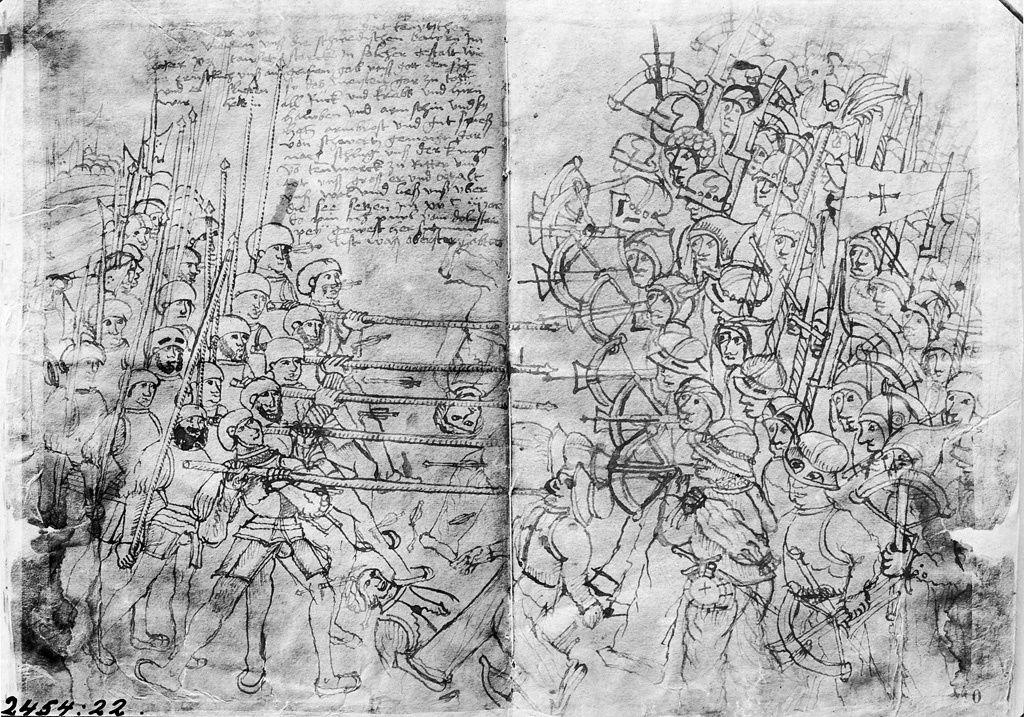
For example the equipment of the soldiers and military structure.
Right after the end of the viking age, there were no real standing armies in any of the three Kingdoms.
Great men still retained their hird as before, which would slowly morph into the nobleman retuby, a small personal force of wards, allies, relatives, friends and subjects of the lord serving him with arms.
While Norway and Denmark were each united into a single state before the end of the viking era, Sweden was not and was still divided into three petty Kingdoms (Östergötland, Västergötland and Svealand) and a few even smaller areas such as Gotland, Wenden/Småland and Hälsingland.
The things and their ounty laws continued to be the main law giver and law enforcer during this era, and we have preserved documents that show how the Ledung, the offensive war fleet, was equipped.
Each free land-owning man (which made up a majority of the male population in the entire region of the time) was required to own and train with arms - the law varies from county to county, but common was chainmail and helmet, shield and spear and sword or axe, and bow and three dozen arrows as well as supplies for three weeks. However, it is in no way certain that everyone could afford what the law specified. It is however known that bastards, that otherwise had no right to inheritance, did have right to inherit arms and armour from their fathers, to ensure that the population was armed.
Every free man was required to serve in the Ledung. However, he could if he was called and could afford it, pay for someone else to go in his place. This constituted the first taxes in these countries.
The Ledung also had to provide ships for their transportation. One ship had 24 rowers and one steersman/commander.
Added to this would be the personal guard of the King or Petty King that had raised the Ledung.
Like their viking forebearers, the Nordic men preferred to fight on foot, and only used small pony-like Nordic horses for transportation and perhaps recoinnasance.
However, this started to change during the high medieval era. The Danes moved towards a more feudal system - more and more land came under the control of the nobility, and the crown granted taxing rights to the nobility in exchange for them raising an armoured cavalryman. From the start, the Danes had split their Leding into two - one that paid taxes and one that served as a soldier. However, when the nobility gained exemption from tax, many of the military-serving free peasants saw that they could be extempt from both tax and service by being part of a nobleman's estate. The noblemen then claimed that the land of the peasant was part of his estate and thus that he owned it, and reverted the free-holding peasant to a tenant.
In Sweden, the Ledung (which was becoming less and less modern) was replaced by a formal nobility raising knights in 1280. However, there never was more than 500 knights and any given time in Sweden, so the system did not produce a force of armoured riders as the King had hoped, not even when you added the Sven class (un-knighted noblemen). The Fylke system (same as Ledung under a different name) remained in Norway though, perhaps because it was so difficult to move overland in Norway.
While the Danish peasantry started to become tenants and then semi-serfs along the lines of continental peasantry, the Swedish and Norwegian peasants remained self-owning and generally rich enough to keep and train with arms, despite no longer being required by law to do so.
The great plague eradicated the Norwegian upper class completely (and I mean completely -100%) and shook both Sweden and Denmark to the core. But Denmark by now had a reliable source of coin in the Sound toll and could raise a top-modern army of excellent mercenaries - Frisian and Lower German knights and German landsknecht pikemen and halberdiers equipped with plate armour and the best modern arms.
This type of army slaughtered the plague-depleted peasant militia of Gotland in the Battle of Korsbetningen 1361.
The Danes continued to use top-modern mercenary forces sprinkled with Danish knights and noblemen, often as officers and at times their Swedish supporters (with their retunies and raised local peasant militia) during the long civil war that was the Kalmar Union 1434-1521) while the Swedish forced developed a well-trained and experienced peasant militia that was well-equipped with captured arms and used sword-spears specifically designed to fight pike- and halberd-equipped troops.
To summarize.
Immediately after the viking age, all were equipped and fought as they did during the viking age.
From the 1100s, the Danes started using armoured cavalry or knights.
From 1280 Sweden started using armoured knights.
The plague during the 1350s eradicated the Norwegian upper class and left Norway a prize to be fought over by the Swedish and Danish upper classes (with the Danes gaining the clear upper hand).
The Swedish peasant militia became stronger, better equipped, drilled and experienced from repeated fighting of the Danish top-modern mercenary army towards the later medieval era.