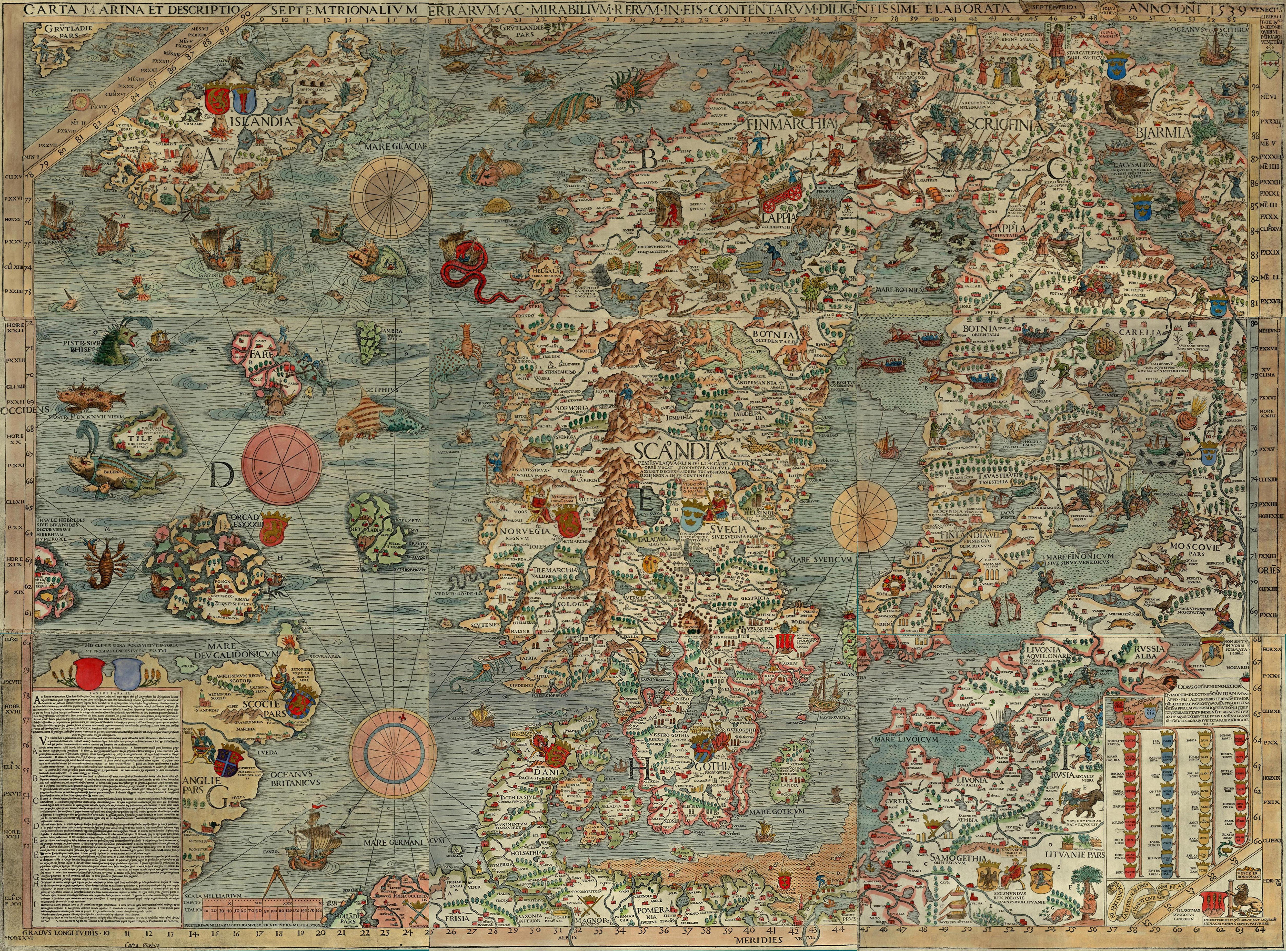
Or were they just put there as decorations?
Link to the map: http://upload.wikimedia.org/wikipedia/commons/e/ea/Carta_Marina.jpeg
At least some of the creatures appear to be fanciful - and not terribly accurate - depictions of whales: see for example the creatures labeled as "balena" and "orcha." If we can accept that some of these were not intended to be whales or any other creature that actually lives, then we can accept these as the sorts of things many people believed one might find or that had actually been observed in the distant oceans.
Because of the nature of deep sea voyages, sailors often saw things imperfectly and there was naturally a great deal of conjecture as to what was actually seen. In addition, the very nature of far-flung travel and the subsequent reports of exotic species - either on land or in water - resulted in the popular belief in a wide range of creatures, some of which may have seemed monstrous in some respect. And the same would be true for flawed reporting of distant lands - even to the extent of incorrect reports of geography.
By using the term "fairy tale creatures," I suppose you may mean to ask whether the cartographer was projecting into the ocean and distant lands the existence of fantastic creatures described in folklore. This would not be surprising if this had occurred. The folk described fantastic things that they themselves believed they encountered; these were described in legends which folklorists call "memorates," - that is, firsthand accounts or memories of odd things. The folk also told legends of the exotic that described creatures of long ago or far away, and some of these figured in folktales (which are often, incorrectly called fairytales). The folk often believed these creatures also to exist, and expecting them to exist in distant oceans or lands would have been a matter of belief for at least some. Did all - including the cartographer - believe in all of these creatures. That's hard to say, but at least some of what is depicted is based on real creatures, so the dividing line between observation, belief, and the purposefully fantastical remains impossible to define.
hi! you may find a couple of other posts interesting
this re Norse water creatures, although somewhat earlier than your example How did the Norse of the Middle Ages perceive life underwater? Along with this, what underwater mythology was there for the Old Norse?
this discussion of whether people believed Interpreting weird medieval phenomena
Interesting, they have what appears to be a Charybdis on the map. I thought it was only off of Italy. Unless, I'm misinterpreting this.