Short answer: The Turks had a better geopolitical setting
A short chronology of what befell the Byzantines. In 1054, the East-West Schism occurred. This led (partially) in Normans beginning to push forward in the Byzantine controlled regions of the Italian Peninsula, Bari was the last major Byzantine stronghold to fall in 1068.
Simultaneously, influence was lost over Croatia (which actually achieved independence for a short a while).
Simultaneously, the East was the major concern, because the Seljuk Turks made their first appearance. This actually ended in defeat, and a coup d'etat in Constantinople, which effectively allowed the Turks to establish a permanent presence in Anatolia.
Slightly before (ending in the early 1000s), the Byzantine Empire had only just eliminated Bulgaria off of the map (map at its height.) It was not this large, but still a force to be reckoned with.
I point out these events, because it shows the Byzantines were attacked on their Western (Italian) frontier, their Eastern frontier, and their North-Western and North-Eastern frontier simultaneously. This would be constantly repeating itself for the next 450 years.
Just to demonstrate, Serbia achieved independence in the 1100s, by 1300s they controlled this.
Bulgaria re-surged, controlling this in the 13th century.
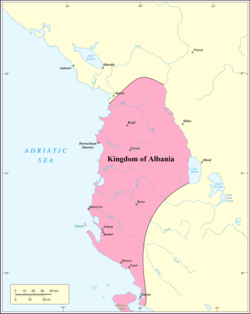
Albania had this.
In short, the Byzantine Empire was victim to its neighbours. Though I think its fate was sealed in 1204 with the Crusaders' sack and subsequent conquest of Constantinople for the next 50 years.
Comparitevely when the Ottoman incursions into Europe really commenced, the Balkans were fragmented. The Serbian Empire (probably the most powerful state there at the time) had become an unorganized group of feudal lords, warring against one another more so than against the Turks. Likewise for the Bulgars. The Albanians were unified, but only lasted as long as their leader Skender. They rolled over these neighbours, because they were weak and small. The Byzantines had to face them at their height, while dealing with many other enemies on every side at the same time. The Turks dealt with West and sometimes East, usually not at the same time. They chose when to go to war, because they were attacking, the Byzantines were always defending and had to be called to arms when the enemy(ies), rather than they themselves wished it. This would normally result in their neighbours taking advantage of their moments of weakness.
Now there were other matters, notably the Janissaries, which the Turks utilized that defeated even the largest most organized coalitions (like the Battle of Maritsa. But I believe the primary reason is that the Turkish incursions into Europe dealt with unorganized feudal lords, while the Byzantine defense wars dealt with Empires and Kingdoms (some of which, for a short while, were the most powerful states in Europe), while being simultaneously ruined by the Crusades.
EDIT: Sentence error and fixed link
I think dzoni1234 is exactly right about the geopolitical situation. Consolidation was much easier for Osman I because he integrated fellow Muslim Turks, and Anatolia was a marvellous springboard to launch raids into Byzantine lands from. By the 1450s the Ottomans had not yet grown enough to reach other nations that they could not outright conquer, such as the Persians or the later Russian Empire.
I think the matters of technology should be discussed a bit too, and the janissaries are useful to look at as they always received the best equipment possible, especially as they became the core of the Ottoman army. In 1400 there were estimated to be about 1,000 janissaries, and by 1475 there were about 6,000. Not a huge number, but this was made up for in training. The Ottomans were also quick to adopt guns and artillery; Mehmed II famously employed cutting edge cannons against the Byzantines in the 1453 siege of Constantinople. Western Europeans were importing Turkish guns at this point at a far greater rate than the reverse (despite a failed intervention by the pope). The point I'm trying to make is that the leap from swords and bows to guns and artillery was a bigger one than weapon innovations of the 1100s (though I admit, I know very little of that time so I could be entirely wrong.)
I think the Devshirme system helped as well. This was how janissaries were made; Christian boys that were captured during Ottoman expansion into the Balkans were converted to Islam, and the boys with the most martial prowess joined the janissary corps. Captured Christian and Jewish bureaucrats, administrators and scholars were often integrated into the growing Ottoman state; conversions to Islam were not often necessary, but it did happen, and many converted anyway due to the greater social mobility it granted them. To sum up, the times they were a-changing, and the Ottomans (at this time) were more adept at it than the Byzantines. The Ottomans would be the ones playing catch up in later centuries, but at this time they were one of, if not the most, innovative state in the world.
Source: Nicolle, David. The Janissaries. Vol. 58. Osprey Publishing, 1995.