So as I understand it, Dante's Inferno and Milton's Paradise Lost are the primary sources of the popular image of Hell and Satan, respectively. I had a few questions about this though!
Firstly, how true is this actually? To what extent were either of them drawing on earlier traditions, and how much of it was flat out creations of their own mind?
Depending on the degree there, what was the public reaction like to this? Were these portrayals a huge thing? Were they shocking? Or was reaction kind of muted?
What was the reaction of the religious establishment of the era? How did the Catholic Church view this bit of "fan fiction" that Dante released? What did the Church of England have to say about Paradise Lost? And for that matter, what did the Catholic Church think?
And finally, how did their works come to be so dominant in the popular image?
well, i could take a stab at milton, but i won't touch that yet. my knowledge of dante's exact sources is also a little vague, but i think that i can answer this question in a reasoned and roundabout way. sorry for playing fast and loose with citations, but i got a message asking me to look at this question.
first of all, i think a few things need to be stated about dante and his writings. first, we need to remember that the author is completely in step with his times in terms of belief. this is important for the question at hand. i'm sure there have been a number of articles written about the supposed subversive or critical side of dante, but if you read the book, he's pretty tame theologically. i think the a clear and commonly known demonstration of this is the guidance of virgil in the text. virgil occupied a position of special reverence for his supposed presage of christ in his fourth eclogue. dante also shies away from big theological questions that could get him in trouble and his reverence for the trinity as a singular triune entity is apparent throughout.
here is a link to the virgil poem, http://rainybluedawn.com/translations/latin/eclogue4.htm. it's a great poem, for what it's worth. the translation here kinda sucks though. this respect for virgil had very old roots by dante's time. check out this wikipedia article, http://en.wikipedia.org/wiki/Faltonia_Betitia_Proba. i mean, there are more reputable places to find information about this, but this is free and easy.
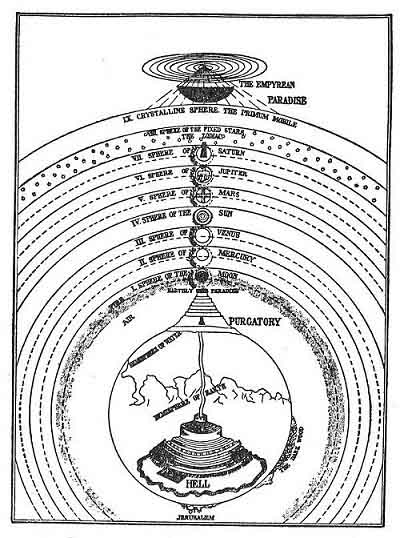
in terms of dante's personal piety, which was shaped by popular religion and the attendant notions of hell, the whole divine comedy should be thought of as a single work published today as three volumes. in the first part, the author uses hell as a backdrop to deal with many secular issues. think of dante's cosmology as a whole. this illustration helps my point, http://www.sacred-texts.com/earth/boe/img/fig091.jpg. hell is fully in the earth. as dante/the pilgrim/protagonist and virgil leave hell and ascend the mountain of purgatory, they are literally getting closer to the presence of the holy trinity with every step. as the story takes the characters away from earth and closer to heaven (and through purgatory, the most underrated and "most medieval" in terms of its humanity of the three parts) the author sheds earthly concerns to concentrate on expressing more lofty thoughts. i think the author's intended initial audience would have understood that dante was not necessarily representing a true or popular image of hell, but rather one that reflected contemporary italian culture. dante did find himself on the wrong side of some very public debates.
i bring this up because to modern readers, the fact that popes and bishops can be found in hell suggests that dante was not pious or questioned the world around him. yes, he condemns popes and archbishops to hell, but church figures also wielded secular power. wikipedia says that he began writing in 1308, the year before the french pope clement declined to take residence in rome. throughout much preceding centuries, the papal curia was often governed by some italian guy. the period of any one pope's reign would see his family's prestige increase. this process happened in miniature in each of the italian cities, including florence. the archbishop of each of the italian communes would have been occupied by a man whose family concerns became enmeshed with that of his office. because this office transferred to a new italian guy upon the incumbent's death. while i think we should be hesitant to disparage the personal piety of almost every single medieval italian, we should be equally hesitant to assume that the enmeshment of the episcopal office in italy did not significantly degrade the amount of reverence accorded to contemporary church officials during dante's lifetime. indeed, an the bishop of pisa is implicated in the tragic demise and subsequent damnation of ugolino in the inferno.
to understand dante's piety, we need to look beyond the episcopal hierarchy to parish preachers, mendicant groups, and lay orders. for example, the franciscans were formally formed in 1209. while this is quite late in dante's life, urban preachers, such as the one that compelled francis to give up the trappings of secular life as a merchant, were the individuals who shaped the beliefs of men and women such as dante. these figures would have represented a more authentic "holy" figure.
cities of god by thompson is an excellent volume that talks about how the structures of the church were integrated into the lives of medieval italians via ceremony, the creation and cultivation of local saints (this is probably the most important bit), and mendicant orders, without damaging the offices of the church, only the holder. sorry for the long sentence.
i say this because i think this would be the best way to get at dante's personal experience with popular belief. dante is quite early in terms of altarpieces. many extant triptychs and altarpieces, the most accessible "popular" images of hell available to dante, have not survived from the early thirteenth century. many of the later paintings are post plague, and really cannot be used to talk about earlier periods. while i don't want to call the plague a definitive break from the past, i don't think we can underestimate how fucked up it was and how it would have drastically altered the way every single italian lived during the aftermath and subsequent waves, and thus makes some sort of artistic of dante difficult.
we do, however, have a number of sermons and saints lives and that sort of stuff. if you want an answer to your question, there's a manchester medieval sources about popular piety in medieval italy. it contains lots of texts that dante and his contemporaries might have read or heard.
i would like to make one other point about your question. you should abandon modern conceptions of popularity when examining medieval tests. it should be understood that dante's audience would have initially been quite small. while i think dante knew that he was a pretty fucking great poet and his works would live on, to the best of my knowledge (and i am by no means a dante scholar) the author circulated his writings amongst friends. it was through these poets that his texts became disseminated.
while dante became extremely popular and eventually became regarded as "the italian work" in all of history, we should be hesitant to think of dante as "popular." dante lived in a rich literary world, one where popular saints lives were read by some segments of the population and more aristocratic french style romances were popular in other segments. dante and a network of other ("upper middle class" but overall wealthy) poets were doing something that was special if not theologically, but stylistically.
forgive me for this longer point, but i think the question at hand gets at a set of assumptions that modern non-historians use to approach the middle ages. for dante and his contemporaries, their faith occupied several overlapping spheres in their life. while most medieval italians believed that jesus christ is not only the son of god but one with him and the holy spirit, and that his sacrifice on earth enabled the salvation of the people of the world through the guidance and sacraments of the mother church in rome, whose authority was made legitimate by both divine conference attested to in scripture and legally by the (forged) donation of constantine, religion occupied so many parts of dante's life. it mediated his relation with the state, while still being a separate but often overlapping administrative entity. i think that because dante and his audience thought about and experienced religion in so many different ways, it's important to remember that it's very difficult to bridge this cognitive gap and ever truly get at what the author truly represents (intentionally or not) in a text.
this sort of approach can be taken to milton, but a number of questions would have to be answered that i'm not prepared to undertake. milton lived in the age of print and was a prolific author. dante and milton are linked by their desire to take their native language to a new level while looking to virgil as their guide. milton, on the other hand, was living in a very different time. the rise of protestantism and the spread of print culture made any sort of description of what was a "popular" image of hell looked like a very unstable category. i also think milton's personal beliefs are a little more opaque than those of dante.
with this last thought in mind, milton scholars out there,
did milton intend for paradise lost to be widely read? do any of his other published writings give any hints as to his personal beliefs? was he a catholic or a closet catholic?