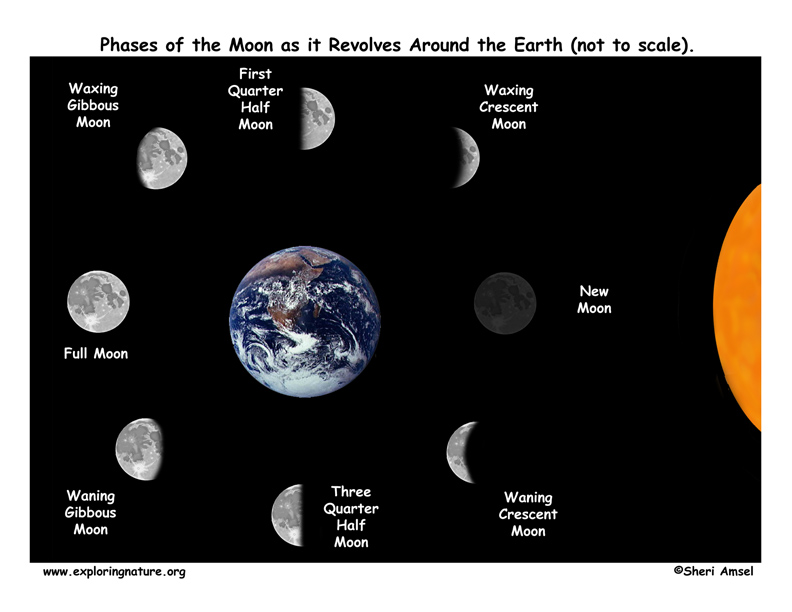
The same way a heliocentric scientist would. The phases of the Moon are caused by the Sun and the Moon not being in the same place at the same time relevant to the Earth. Because the Moon does indisputably rotate around the Earth in both models, whether it has phases is not affected. So this image would look the same in both models.
The thing that is impossible to explain under a Ptolemaic model (e.g. Earth at the center, everything rotates around it directly) are the phases of things that we know don't rotate around the Earth. So the phases of the planets, for example. Under a Ptolemaic model, Venus should not have visible phases. But it does — this was one of Galileo's most important observations. Once he was convinced of the accuracy of it, the top Jesuit astronomer, Christoph Clavius, agreed that the Ptolemaic model was indisputably incorrect.
This, by the way, does not mean that he was convinced of heliocentricity, or a Copernican model. The Church instead switched to officially advocating the Tychonian model, which can also account for phases of Venus (and pretty much all other astronomical observations that fit in the Copernican system as well up until a later period of astronomy, when things like the parallax of stars could be measured). The Tychonic system is something of a re-jiggered Copernican model in which the Earth is still fixed but all of the outer planets rotate around the Sun, which in turn rotates around the Earth — sort of an experiment in relative motion.
Which is just an indication, if you needed one, that sometimes a "simple" observation can overturn a model very quickly (as in the case of Galileo and the phases of Venus), but that doesn't necessarily mean a contrary model (i.e. a Copernican one) is immediately adopted, or that the ultimate premise of the original model (i.e. geocentrism) is immediately overthrown.
For more details:
Thomas Kuhn's Copernican Revolution is still a pretty useful text for understanding the conceptual aspects of Ptolemaic, Copernican, and Tychonic astronomy, and their historical roots
James Lattis' Between Copernicus and Galileo is sort of the only major text that takes the Jesuit view of astronomy seriously, and discusses the reception of Galileo's observations in the Church