I know it failed, but was it a sound plan that just didnt work, or was it out of desperation? On the Allied side, were there any mistakes that made it initially a success, and how were they able to correct them?
Thanks
The plan was hyper ambitious in scope and was a gamble in every sense of the word; as it sent the bulk of the OKW's (West) relatively intact and whole formations, that would be Kampfwert I ("Capable of all operations") units against the US 12th Army Group. All warfare at some point requires gambling, but in hindsight it would've been wiser for the Germans to have folder rather than go all-in in December 1944. The failure of the Ardennes offensive left very little mobile units to stop the Ruhr from falling rapidly in 1945.
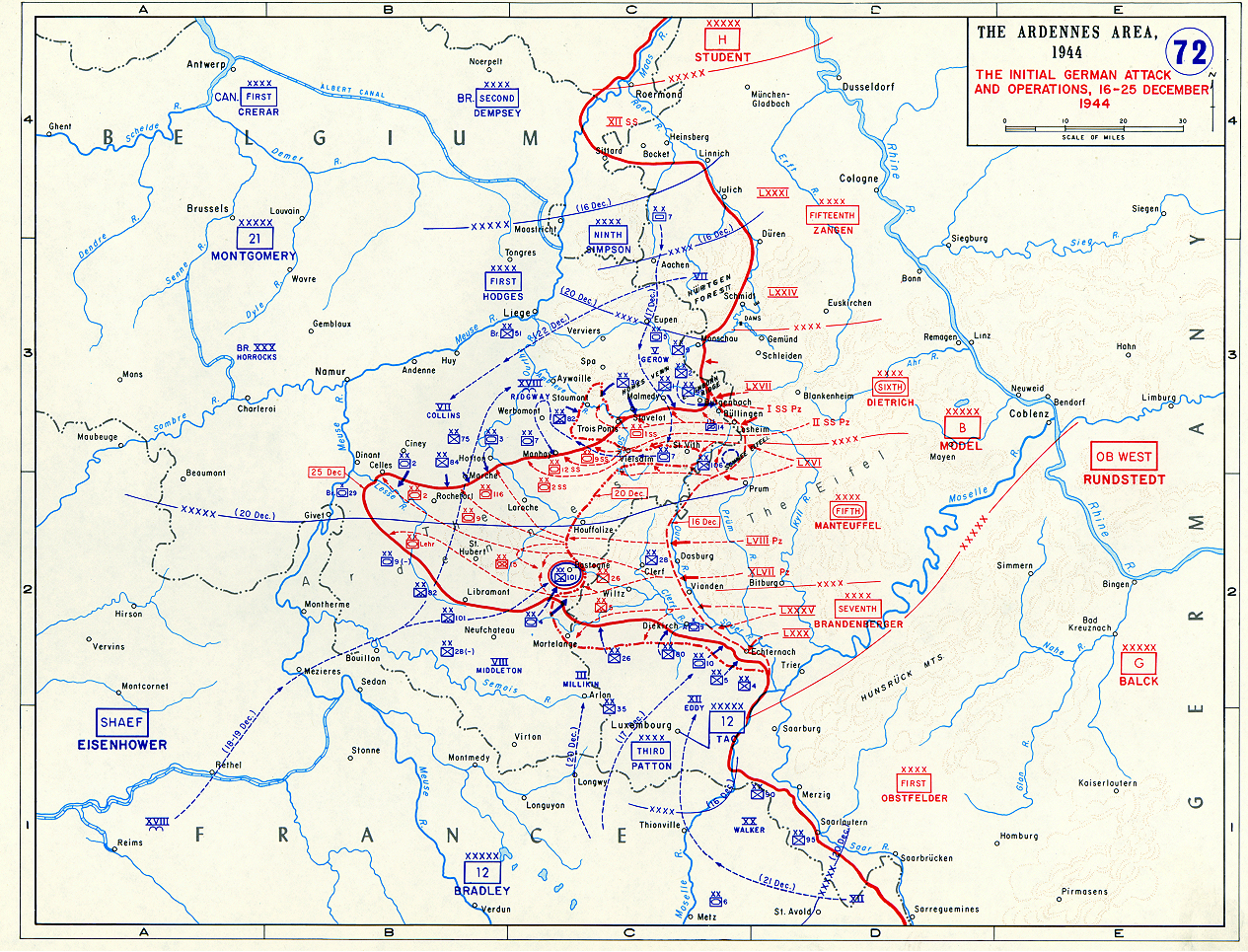
Wacht am Rhein had key flaws in its strategic planning, first off it was ambitious in scope. The plan was to split the 12th and 21st Army Groups by securing Antwerp; this involved a drive of considerable distance as well as crossing a river obstacle - the Meuse. The ambitious scope of the plan is brought home when its stressed that the German planners actually tried to factor in captured fuel into the equation. A reliance on the procurement of enemy fuel is a dangerous logistical trap to fall into; and it had bit the Germans in the butt more than once during their attacks and drives towards the Alamein line in 1942. Not only was it a gamble, it was a gamble that had not gone well for them before; and it was by no means necessary, as these excellent formations could've held the Rhineland for a considerable scope of time if we use the failure of Operation Queen as evidence.
Hitler's expectations in the event of success were...argubly in the realm of fantasy as well. The hope was to drive one Ally or the other out of the war, or at least to the bargaining table, in the event of the seizure of Antwerp. Given that the Americans and the British had just waged 2 years of global coalition warfare with only the pettiest of arguments and friction, to think this would have rent the alliance asunder is laughable. Make no doubt, it would've been a massive strategic set back for the Allies, and may have prolonged the war.
The reason the initial attacks were so violent and successful was that the Allied 12th Army group was stretched thin, and with no reserves. The US V Corps was thus ruptured rapidly and the Americans had no mobile reserves immediately to hand to blunt or seal off the penetration. The entire situation was without a doubt exacerbated by the Allied perception that the Germans were not capable of large-scale counteroffensives, and it was something of a successful deception by the Germans. As you can see the initial attacks on Dec. 16th didn't take a fantastic amount of ground, and were actually considered simply local attacks by Allied command. Many units on the flanks to the North, for example, were not given warning orders about the enemy offensive until the 18th-20th of December. A considerable amount of time for the Germans to exploit local superiority.
Gen. Bradley, once the scale of the situation became apparent, reacted by shifting the lightly engaged 3rd Army North, and the 9th Army south, to attack the flanks of the penetration. The US VII Corps, with both of the US Heavy Armored Divisions, stopped the 2.Panzer (at this point running out of gas) short of the Meuse, and annihilated it. The move was basically done around the clock and through the night to get into contact with the enemy as rapidly as possible; and Gen. Collins (VII Corps commander) deserves credit for allowing his Armored units to react to situations as they developed rather than give them stiff orders and Limits of Advance. The reaction was greatly aided by the key road junction of Bastogne not being fully secured by the German advance; which greatly hampered the distribution of fuel to the leading German formations. Gen. Bradley also made the important decision of handing over tactical control of the 9th Army to the 21st Army Group - Gen. Montgomery's command - which eased command and control burdens, allowed him to concentrate on a smaller section of the front, and allowed the US Ninth army to cross now non-existent boundaries between corps and armies. The TLDR of this means that the reaction to the enemy attack did not result in friendly fire, traffic jams, and interlocking units. It was a small correction, but a key one. It also meant the 21st Army Group, not heavily engaged at all in this time, could take over more of the front; the American front could therefore shorten enough to allow an entire Corps - the VII to turn around and rush to cut off the German advance.