My lady friend in the UK tried to explain it to me but it went over my head so I figured i'd ask here.
If this somehow breaks the rules, please let me know and i'd be happy to fix it and repost it.
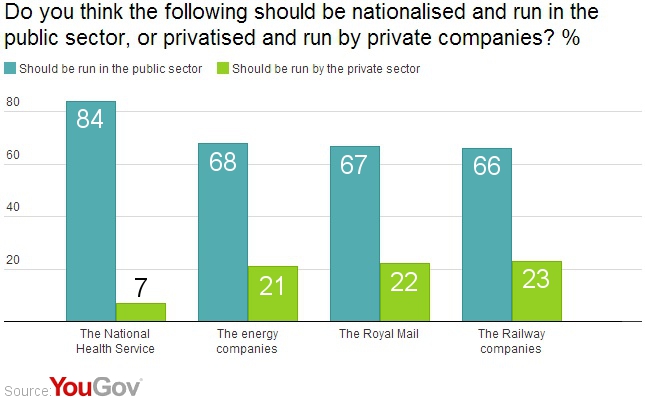
In terms of impacts that still directly affect British people, privatisation is probably her biggest. In polls a majority of people believe certain industries privatised during or following her time in power should not have been (the railway and energy companies in this chart).
While some privatized industries have arguably been very successful, like BP, cable & wireless and British Aerospace, many privatized utilities and services were and continue to be unpopular and by some measures have significantly increased costs to consumers.
In the first 9 years after privatization of water supply, costs to the consumer increased by 46% (adjusted for inflation) [source]
The benefit of privatising rail transport is also heavily debated. See rail fares vs the retail price index since 1987. Privatisation happened between 93 and 97. Rail fares in the UK are some of the most expensive in the world and cost up to ten times as much as fares in other EU countries. That many of the new rail companies are today owned or part owned by state owned railway companies from other EU nations like SNCF and Deutsche Bahn is also seen by some as a negative.
Edit - correction/clarification, Thatcher was out of power during the final round of privatisation in the 90s, though the Major government (also conservative) continued her policies. From a British person's perspective she invented the idea of large scale privatisation of industry when previous governments had generally taken the opposite approach, and most would blame her government for the privatisation that continued after she left office rather than Major or Blair. When Rolls Royce was sold off it had only been 16 years since the Heath government had bailed out and nationalised it.
As many others have pointed out, Thatcher isn't unanimously hated, or else she wouldn't have won three General Elections in a row. Instead, she is despised by one half of the country and revered by the other.
Of all her policies and reforms discussed, I believe one which needs to be stressed the most is the sheer number of people she made unemployed in the UK. This graph shows unemployment throughout her time in office (1979 - 1990) and a couple of years either side. (source). Unemployment jumped within a year of her taking power and did not return to pre-Thatcher levels throughout her tenure.
Her reforms were aimed towards the older industries such as coal and steel, and looked to bring Britain into the future as a country based around the service industry. The issue with this was that the labour-intensive industries were very heavily located in the North, Scotland and Wales. At the same time she looked to diminish the role of the Public Sector, and to bring around privatisation (the arguments for and against this is another debate). This resulted in huge job losses, whole communities were made unemployed. This article quotes from a Cabinet Office note:
“The manpower reductions would bite heavily in particular areas: two-thirds of Welsh miners would become redundant, 35% of miners in Scotland, 48% in the north east, 50% in South Yorkshire and 46% in the South Midlands”.
Because of Thatcher's reforms to cut spending on the public sector, most of these jobless millions were not picked up and put back into work in government-subsidised jobs, but were instead left to find new jobs which, on the whole, weren't there.*^1 Instead, jobs were mostly being created in London. Whilst the many areas outside of London suffered, London (and the close surrounding areas) thrived on her reforms creating a modernised financial sector. Her reforms secured London's place as the international financial powerhouse that it is now.
Many in the communities which suffered from her cuts despise her, and it has created a lot of resentment between the North and the South of the UK. You may also be interested in the "North/South Divide."
|
|
*1. Because mining is dependent on the geographical locations of resources, usually the whole area around the mines were either miners or industries/shops dependent on the miners. When the mines closed down, whole communities were shattered - the unemployment went further than just the miners.
hi! you may be interested in this earlier post; it includes links to several more
How was Margaret Thatchers tenure as Prime Minister? Why is she so hated
In addition to the huge effects on Britain's economy and society that the Thatcher reforms had (which other answers in this thread explain very well), the Thatcher years were marked by a huge shift in the British politics towards the right, a change that is still noticeable today.
Before Thatcher's terms as PM, ultra-liberal right wing ideas (that have come to be referred to as "neo-conservatism") such as the State removing itself from the economy as much as possible (through privatisation, cutting of corporate taxes, etc.) and the cutting of the top bracket of taxes, and the selling off of government infrastructure such as hospitals, council homes, etc. were only really held by a minority of fringe journalists, political scientists and politicians in the UK. Right wing, old school Tory thinking was actually quite anti-liberal, with most Tory MPs being in favour of a more paternalistic (and therefore more present) State.
So many of the reforms that were put in place during the Thatcher years (and the Tory government that followed) had previously been campaigned against by both major parties. Some of the reforms were, in fact, opposed by a majority of Tory MPs and Conservative supporters when they were enacted, but were forced through and have now become an accepted part of British politics: after the Thatcher years, both Labour and Tory governments have continued to push reforms along these lines.
So in the space of 30 years, Thatcherism has gone from being the preserve of a minority of thinkers at the fringe of the Tory establishment to becoming the dominant political consensus in Britain. Even after the Tories had lost a second straight general election to Tony Blair in 2002, Thatcher is quoted as having said "Our greatest achievement is Tony Blair. [...] We forced our opponents to change".
Source: "The Establishment", Owen Jones, Allen Lane 2014
I am going to mention something that has so far been missed which for me defines why she was decisive. One of her landmark policies was 'right to buy' which gave individuals a right to buy their council owned property. This is a Thatcherite policy in every way as it allows individuals to become homeowners for the first time. Lots of people from working class backgrounds did well out of this scheme as you could buy your house at below market rate, paint it, install double glazing and then sell it on at a nice mark up. Culturally defined by 'Loads a Money'.
However on the flip side of this, the mass sell off of council properties meant that the only state housing stock left was that in undesirable areas and led to 'ghetto' effects. It also meant selling off state assets at under market value and thus a bad deal for the tax payer. There were also groups who would offer predatory loans for those looking to take advantage of right to buy.
Its typical of Thatcherism in my eyes given that the economic thought behind the policy (give people access to homeownership) is highly tainted by its implementation which undermined local government, isolated communities and pulled the ladder up behind those lucky enough to be around for one of the UK's biggest ever file sales. There are acute housing problems in the UK today, in part related to the right to buy policy and its heavily politicized implementation. This text gives a pretty good overview.
She entered office as the UK was dipping into a recession, and committed to a monetarist economic policy with the understanding that this would come at the price of high unemployment; this indeed came, along with rioting. With unemployment at its peak she received widespread condemnation from mainstream economists but refused to change course. Although the economy was starting to improve by 1982, she could easily have lost the 1983 election if not for the Falklands and the events of 1979-81 soured many on her permanently.
British politics during the 1970s was largely defined by industrial disputes. Both the Heath and Callaghan governments were brought down largely because they weren't seen to be handling the unions properly, and the Conservative manifesto in the 1979 election centred around bringing the unions into line. For her first term the government's labour reforms were limited to less controversial measures (such as mandatory secret ballots for strike action and abolishing the closed shop), but 1984-1985 saw the miners' strike. Even though pit closures had been increasing since the 1960s, the strike was the definitive showdown between the government and the NUM and had great symbolic importance for the wider labour movement. In mining towns the pits were the main source of work and the miners, most of whom were older men without further education or other training, had little hope of finding permanent employment again. Many people in Wales and the North of England hate her to this day as a result.
As detailed below, she privatized many of the state-owned utilities and allowed the public to buy shares in them. This was an affront to many on the left - and some on the old Tory right, including former PM Harold Macmillan - who saw it as ideologically unacceptable. She shifted the debate on the proper boundaries between public/private ownership to such an extent that the Labour Party was taken over by modernizers who ditched the commitment to nationalization in the aim of making the party electable (she is said, possibly apocryphally, to have declared that her greatest achievement was New Labour). This has continued under Major/Blair/Brown/Cameron but is still mostly attributed to Thatcher, as shown by the most upvoted comment blaming her for the rail privatization that happened after she left office!
She is criticized from the left for the right-to-buy policy that let council house tenants buy their houses at sub-market prices. While the policy proved very popular with those who took it up, it took a large chunk of the housing stock out of the social housing sector and cleaved off a large section of the 'aspirational'/upwardly mobile lower-middle class from the working class, again to the chagrin of the labour movement.
After the crash of 2008 she received a lot of retrospective blame for her reforms of financial services, with critics charging that she allowed the economy to become overly dependent on a poorly regulated City of London. At the time observers saw a culture of greed developing amid increasing inequality.
The UK's complex relationship with Europe became increasingly tense during the Thatcher years. She had been at the forefront of the Yes campaign during the EEC referendum in 1975 but opposed greater political integration and was categorically against a single currency. She was often combative in pursuit of goals such as a budget rebate for the UK and in resisting attempts to rope Britain in to further treaty obligations. For many who otherwise approve of her attitudes and policies, the signing of the Single European Act was one of her greatest mistakes; and when her position was at its weakest in 1990 she bowed to pressure from her Chancellor and Foreign Secretary to join the Exchange Rate Mechanism, which ruined her successor when the UK was forced to leave two years later. Meanwhile, her [rhetoric] (http://www.margaretthatcher.org/document/107332) towards the EU angered many europhiles, including and especially within her Cabinet.
One thing that hasn't been mentioned nearly enough in this thread is the poll tax. The system of local taxation based on property valuation was widely seen as unfair, so the government looked for a way to move towards taxation on the basis of services used. This led to a standard per-capita rate that would vary between local authorities. Its implementation proved disastrous, and destroyed the Tories' fortunes in Scotland where it was debuted.
On a personal level she often found herself in ideological opposition to the 'post-war consensus' agreed by the majority, and would argue her points very forcefully in a way that left colleagues feeling trodden over. She also took a much less collegial view of government than her predecessors, starting a trend of centralizing power within the Prime Minister's office that has continued with Blair/Brown. As the first woman to lead a British political party or occupy any of the major offices of state, who grew up in the lower-middle class, she didn't mesh well with the Tory aristocracy or the 'working man's club' atmosphere of the unions and became the figurehead for contemporary discussions of class and gender. She came across as the 'overbearing schoolteacher/matron' figure and was an easy target for satire.
I've tried to keep my own views out of it as much as I can, but that's an overview of the reasons that people who do dislike her tend to give.