And where can I find any accounts on the Italians' experiences through the occupation?
The situation was quite desperate right after the war and most of the infrastructures such as railways, roads, factories, hospitals, schools and the like were either destroyed, unusable or in a very sorry state.
1) In big cities, housing was scarce. Shantytowns popped up in the big cities' outskirts (particularly Rome's, where they were bulldozed in time for the 1960 Olympics) and even the schools weren't being used for their intended purpose as they housed the sfollati - that is, those who had lost their homes to the bombs.
2) There were many health and social concerns, and Naples itself actually suffered a pretty major typhus epidemic; prostitution there was rampant (as in: mothers selling their own daughters for food) and so were STDs.
3) Food (particularly bread and meat) had been scarce for some five years due to rationing, and people assaulted the bakeries from time to time; many perceived 'luxuries' such as coffee or sugar were unobtainable well before the war due to the League of Nations' sanctions against Italy from 1936. In their stead, Italians drank 'chicory coffee' without any sweetener - a truly nasty concoction.
4) Going from city to city was unfeasible due to the rail and road connections not having being re-established yet. Even moving within the big cities such as Rome, Naples and Milan was problematic at best due to the debris on the road and the fact the bombings also targeted the tram and bus depots - meaning that you'd have had to take a military lorry instead of a now-gutted out tram or trolleybus.
5) Due to the Allies printing the Am-Lira (whose counterfeit variants were just as many as the real thing) in massive amounts, the official currency greatly devalued and inflation was rampant. The black market was also thriving; for example, the flea fair at Rome's Porta Portese was born as a place where to buy stolen engine components.
6) If you were an Italian living in the Julian Marches or Istria (then in the country's far North-East), things would've been getting ugly pretty fast; the region has had a troubled history and this was arguably its worst hour.
To begin with, the area was inhabitated by both Italians and Slovenes/Croats. With the rise of Fascism, a rather aggressive campaign of forced Italianisation was undertaken by the central government, and these people did not obviously take it kindly. Croatian and Slovene partisans were suppressed. In 1940, Italy entered the war; then assisted in the 1941 invasion of Yugoslavia and when it surrendered in 1943, the area (as well as most of Northen/Central Italy) was taken over by the Germans. After they retreated, a social/political/military vacuum had taken place, with the Yugoslav partisans easily taking control of what were now only nominally Italian lands.
These partisans set out to punish those people whom they thought had collaborated with the Fascist government in oppressing the aforementioned minorities, but in doing so they also targeted many innocent civilians; sometimes, even the ethnic Italian members of the partisan formations were purged. All those people were either killed and their bodies thrown in the karst sinkholes (the foibe) or were uncerimoniously dumped in there whilst still alive.
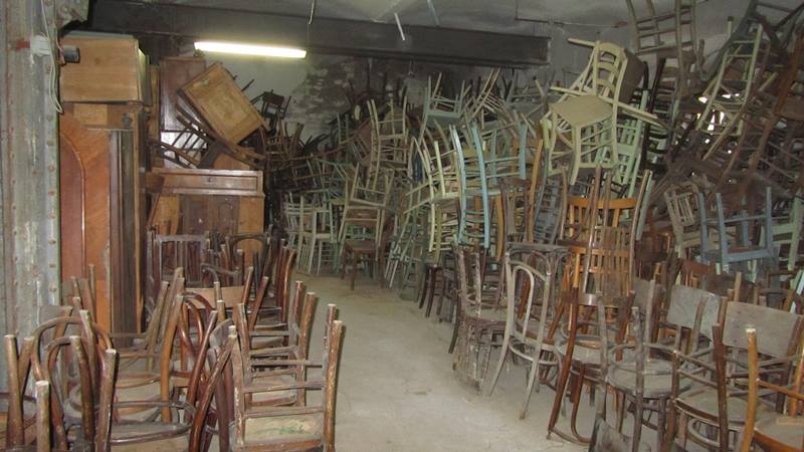
Private retaliations were rampant in that corner of the country due to the strifes among the various ethnic groups - without an army to protect them, many Italians were killed (this was also due to petty feuds between neighbouring families) in the way described above and the rest was forced to flee, bringing what they could carry on their persons. From 1943 to 1949, some 5000 Italians were killed while a further 300,000 was forced to leave and their possessions requisitioned. Here's a pic of Warehouse n. 18, were the goods w/o claimants were stored.
These former Italian lands were then partitioned by the Allies, who put most of them under Yugoslav control. Trieste itself was under YG occupation for 40 days and wouldn't be re-united to Italy until 1954; the rest of the Julian Marches, Istria as well as the city of Zara were officially annexed by that country in 1947. Many of the toponyms were also changed after the war and you can now find these on any guidebook, even though many places (mainly on the coast) are now officially bilingual following the Treaty of Osimo of 1975.
When these Italians escaped to quieter corners of their own country, they were put in rail convoys; one of those stopped in Bologna and the Italian partisans there - who were mostly Communists - believed that the refugees were Fascist collaborators escaping what they thought was the 'Workers' Paradise'. They proceeded to insult and throw rocks at them, who were then put in camps. Many of the refugees settled in a suburb then right outside Rome, which would later become a city district of their own (the Giuliano-Dalmata).
Lastly - due to a good-neighbour policy with Yugoslavia, which also claimed other parts of North-Eastern Italy as war reparations, these killings were only recently (2005) recognised by our own government and the very subject is still virtually taboo in Italy. The Communists claim it never happened, left-wing squatters regard the exiles as Fascists, Neo-Fascists like to use the events for propaganda purposes and according to the ANPI - that is, the Partisan Veterans' Association - even talking about it is a disservice to the Resistance (seeing that it wasn't entirely without fault). You can't speak about it without offending someone.
The only good book on the matter with an English translation I can think of is Arrigo Petacco's essay A Tragedy Revealed: The Story of the Italian Population of Istria, Dalmatia and Venezia Giulia, 1943-1956.
7) If you were an Italian living in the colonies, the situation would have been a bit better. Italian East Africa was under British occupation and the colonists engaged in guerrilla warfare from late 1941 to Autumn 1943; most had left Ethiopia after the end of the war, while a few thousands stayed in Somalia and Eritrea. Libya was partitioned among British, French and Americans but gained independence in 1951; some 30,000 Italians stayed in the country until 1970, when they were forcibly expelled right after Muhammad Gheddafi's rise to power.