First, in this period it can be hard to make generalizations about 'the West' because the Revolutions of the latter 18th century and the ensuing wars really changed social structures in the countries effected, so British society is quite different from that of France or America, while Britain is also different from countries that are less industrialized (like say, Spain). I'm going to restrict myself to America because I know more about this than I do about England (novels aside).
Second, a word of caution about the term 'upper middle class' - people generally didn't use the term 'middle class' in English in this time period, and it has a lot of 20th century connotations (like the idea that the middle class makes up most of the population, or controls most of the wealth) that can introduce a lot of baggage when we talk about history.
1)Who were they? As I mention above the term 'upper middle' is ambiguous, even today. So I'm -assuming- what you mean is people who were wealthier than most of the population, but were not part of the wealthiest, most powerful elite.
Taking that definition, in America this group would include mostly the 'gentlemen' and well as some of the more upwardly mobile of the 'middling sort'. This is not just an economic distinction, but a social one. In America 'gentleman' is already used more broadly than in England -- it means a man who has some liberal education (some college or secondary schooling) in Mathematics, Latin, etc. These people were merchants of various sorts, clergy in the more established churches (Prebyterian, Episcopalian, Congregationalist), Doctors, Lawyers and substantial farmers. They speculated on land and later, invested in early joint-stock companies to build roads and canals. The 'middling sort' was not as formally educated. It's richest members would be master craftsman in well paying trades, like silversmithing, or printers with extensive newspapers circulation, or frontier farmers with large landholdings and profitable operations, or preachers with less established churches like the Baptists and Methodists. As the Early Republic wore on, American society became more 'democratic' the distinction between gentlemen and the 'middling sort' blurred more and more as the political power of gentleman is eroded and the middling sort themselves become better educated and politically involved.
What they wore In cities, and in cooler months men would wear wool coats (with tails), cotton or wool trousers, and silk or cotton waistcoats, with a linen or cotton shirt underneath. In less formal circumstances in the summer men would often wear linen coats due to the warmer American climate. Women wore dresses, generally cotton. In cooler weather they would wear a jacket (spencer) or coat over it. American fashions, particularly for women, could be plainer than in Britain or France -- a lot of the necklines are higher, and the fabric is not as rich. Better fabrics, particularly wool, were also always imported (american produced woolen fabric was...not good), so nice looking clothes were expensive. Linen for shirts and linen coats might be American-made. Coats for wealthier people would be made professionally, by a tailor. Trousers, shirts and dresses were often home-made, either in the wearers own home or a local woman picking up extra work. .
What they could afford Consumer goods depend a lot on where people live. American roads were truly awful (at least before 1820), so people in the countryside, or people away from the coast, could not afford very much at all. However, unlike most Americans, these 'upper middle' people could afford imported goods like imported cutlery and china, rather than just locally made goods. Americans generally did not own carriages (the roads were so bad people would expect a stagecoach to upset at least once a journey...so what's the point of a carriage?), and riding horses (as distinct from draft horses) were mostly owned by the planter elite in the South. Some lesser planters would be the main 'upper middle' people who owned a horse. Houses, similarly, would vary a lot depending on wear you lived - town and country, North or South, East or West. Generally they were wood and at this time they were often painted, unlike the unpainted houses of most Americans. Stoves were rare to say the least, people relied on fireplaces for heat and cooking. Nicer houses would have an upstairs and downstairs, and would have multiple bedrooms, but most family members would sleep several people to a room, and often several to a bed.
Better off people would own enough china and silverwear for everyone to be able to eat out of their own bowl/plate (better than the poorer people got!), and would own chairs and tables and sideboards instead of stools, benches and chests. These 'upper middle' people would own multiple sources of light, and would own oil lamps and beeswax candles for the downstairs and special occasions, in addition to cheap tallow candles. Books were often imported, and were common, but people generally did not own large libraries - people would own a bible, some almanacks, and a few other books. Wealthier Americans (those in our group) would subscribe to a newspaper.
'Upper Middle' Americans could afford art to hang in their walls, mostly prints, and would put down floor cloths on top of their wooden floors.
Finally, you can't talk about America before 1865 before talking about slavery. It was an omnipresent part of life in the South. 'Upper Middle Class' southerners would own slaves. Less wealthy planters might own 12 or 20 people, while southerners in cities like Baltimore or Charleston or New Orleans would own a few household slaves.
At this same time, Slavery was being phased out north of the Mason Dixon Line; most northern Slaves still in bondage in 1815 lived in New York (Sojourner Truth is one famous New York ex-slave). 'Upper Middle' people in the North would have hired men and hired 'girls' to help out with household and farm tasks, who would generally live with the family (at least in the country). Master craftsman's apprentices generally lived in the house as well.
Unlike the wealthiest women, women in our group would work a lot hands on - sewing, cooking etc. But the hardest work (scrubbing floors, carrying firewood, laundry) would be done by servants or slaves, or children in the family.
I am hoping people that know more about France, Britain and other places will chime in.
Sources: The Reshaping of Everyday Life 1790-1840 by Jack Larkin (my current reading project, so I have it on hand)
What Clothes Reveal: The Language of Clothing in Colonial and Federal America
Empire of Liberty by Gordon S Wood (it's a general book with some social stuff thrown in).
Visual Sources:
a French fashion plate showing what an American man at the height of fashion could afford (costume parisien, 1810) - http://3.bp.blogspot.com/-vFDWcayNPrQ/Uzi_WVBTV-I/AAAAAAAABmg/ubXm_66CJgE/s1600/1810az3031a.jpg
The wife of American Painter Charles Wilson Peale, 1798 - https://en.wikipedia.org/wiki/Charles_Willson_Peale#mediaviewer/File:Elizabeth_DePeyster_Peale_%281765_-1804%29,by_Charles_Willson_Peale%281741-_1827%29.jpg
This linen coat is one of the best examples of linen coats in America: http://www.metmuseum.org/collection/the-collection-online/search/79704 - (the linen cloth for this coatay have been American made)
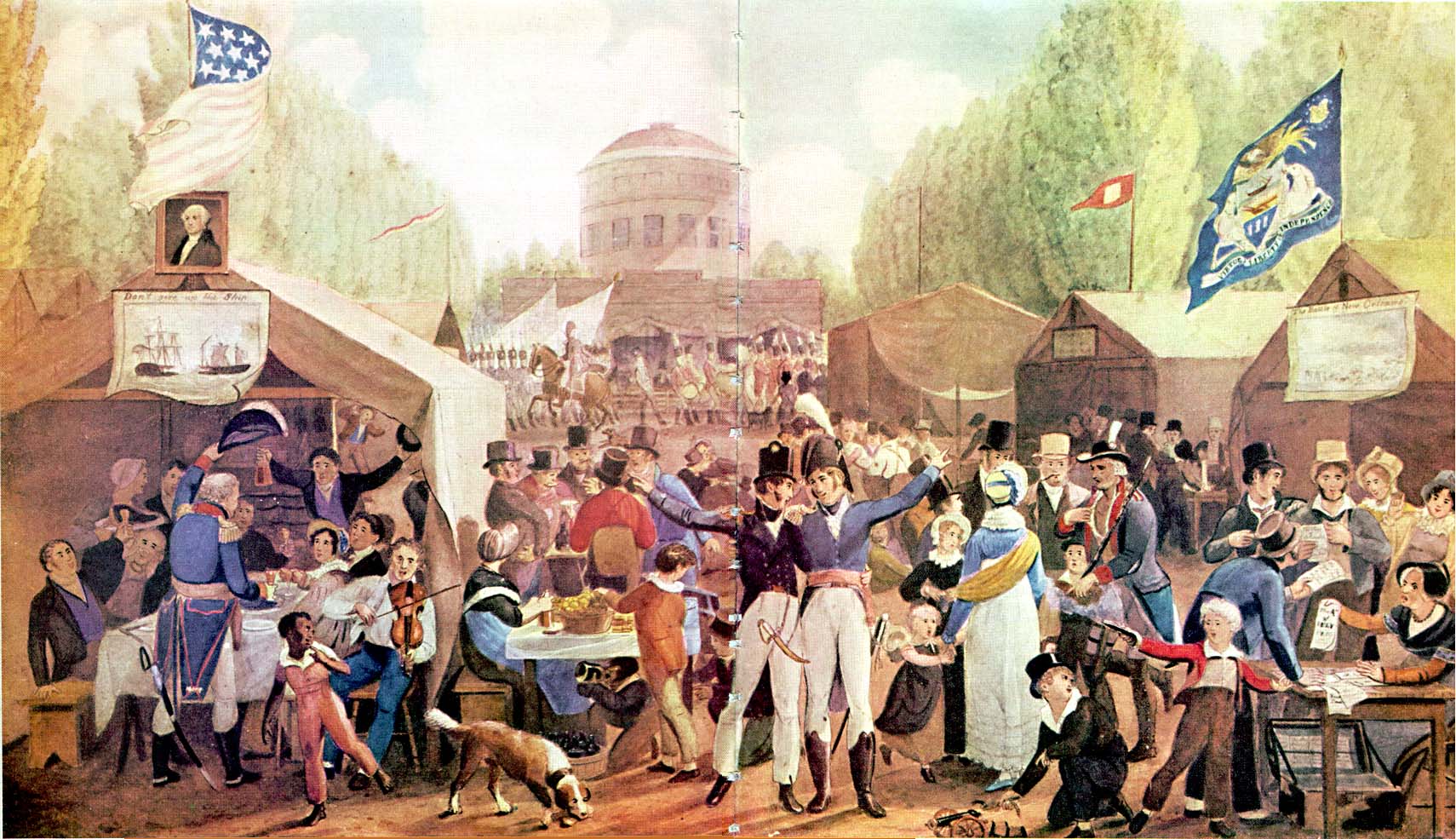
John Lewis Krimmel is an American artist who shows a cross section of society with his paintings. Here's one: http://upload.wikimedia.org/wikipedia/commons/7/7f/4th-of-July-1819-Philadelphia-John-Lewis-Krimmel.JPG
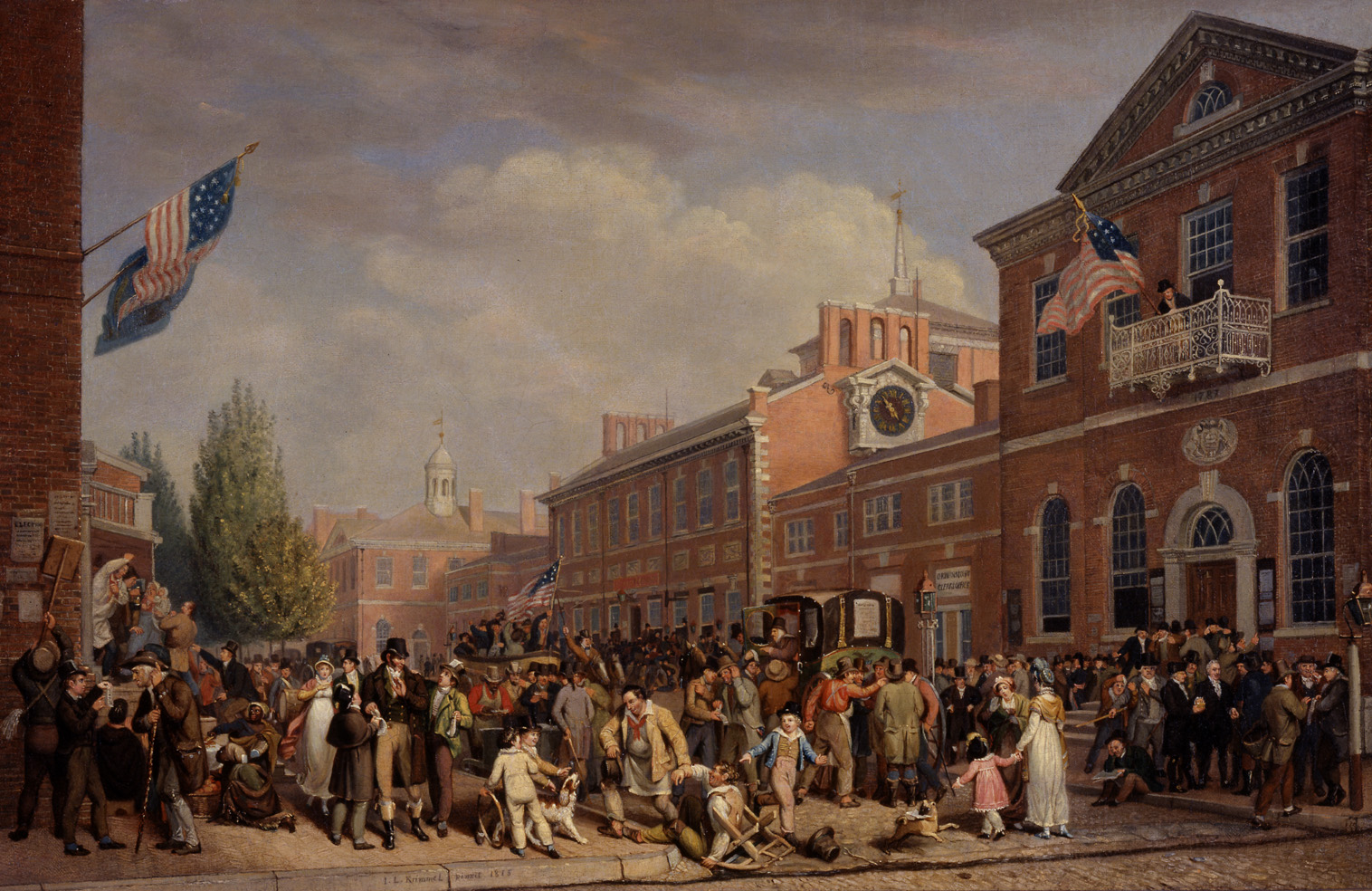
Here's another. I would say that the old men on the far right and the younger man in riding boots, an overcoat and a tailcoat (right above the artist's signature) are good 'upper middle' examples. You can see the contrast between them and the people around them (the dyes are darker, the clothes are in better repair): http://upload.wikimedia.org/wikipedia/commons/a/a4/Election_Day_1815_by_John_Lewis_Krimmel.jpg