[Serious] I've been a history fanatic my whole live but one question is never answered entirely...
Why did some empires expanded out for no logical reason? Was it greed, power, curiosity or all? Napoleon gave his reasons, which was power (and other things).
When the Mongols spread westward, why the need to go SO FAR? Once all local enemies withing thousands of miles were gone and occupied, why the insistent need to expand?
I can see Adolf Hitler's drive to restore the Prussian Empire, and Russia's need to protect itself from invasion, but what about lesser empires of old? It just doesn't seem logical to try and occupy a good part of the globe knowing it can't be governed. It not only seems ridiculous to try, but big question is 'why'? Even the Roman empire would be an example of being too large and spread too thin.
I cannot comment in detail on the Mongols but I can talk about the Aztecs, who share in the fact that the driving force of their expansion was not security, or even really land, but the acquisition of wealth. The "Aztec Empire" itself was actually an alliance between three Nahua groups who made an agreement to not attack each other; to aid each other militarily; and to divide all tribute taken cooperatively.
Rival Round-Up
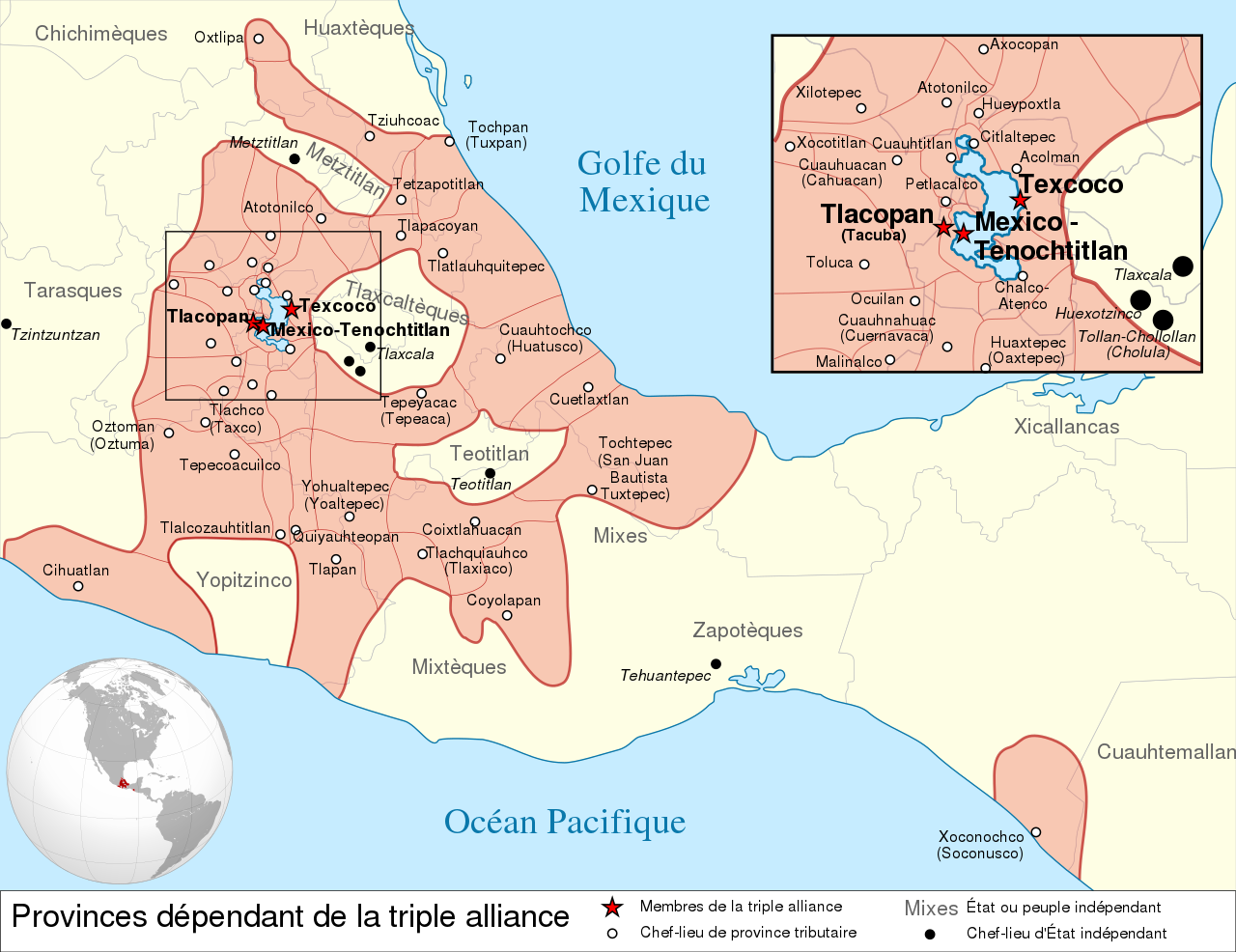
If you take a look at this map of the Aztecs at their largest (based upon the Codex Mendoza, which was itself a tribute list) you can see there are still some states that could be seen as dangerous rivals:
Teotitlan doesn't really count because that area is a bit of an anomaly in that it appears to have never been rich enough or aggressive enough to warrant an official conquest. Other tribute lists, however, do list it as a tributary state and Hassig (1995) notes that that these listings, along with its position near several key trade routes, implies that it was, if not outright conquered, definitely subordinate.
Tarascans were definitely an imposing force, having soundly defeated an Aztec invasion in 1479/80. The Tarascans, however, never really had the numbers to take the offensive against the teeming Aztecs, so the border region settled into a cold war of skirmishes, fortifications, and signal posts. In the reign of Ahuizotl, we also see the expansion northward along the Pacific coast to begin encircling the Tarascan lands.
Tlaxcala, the long-standing rivals of the Aztecs, had its own encirclement firmly completed in the early 1500s. When the Spanish arrived the Tlaxcalans openly complained about not having access to not just rich goods, but staples like cotton and salt. Indeed, the more formal xochiyaoyotl of previous decades were evolving into more hard fought battles of outright conquest.
Mixtec, Yopi, etc. were really independent city-states or small towns, we are not looking at any real threats.
In other words, by the early 1500s, the Aztecs did not have any external threats posing a true existential threat, barring the arrival of a completely new group from over the horizon, which allied with their rivals at the same internal Aztec dissensions led to schism between the two largest groups, flipping one over to their rivals, and then there was a massive plague. But what's the possibility of that happening?
More Blood for the Blood God
Yet, the Aztecs kept expanding. In part this was because of politico-religious reasons. The state religion demanded sacrifices, sacrifices were taken in combat, ergo continuous warfare was required. The famous (well, to Mesoamerican history nerds) example of how this system worked is actually the reign of Tizoc.
Aztec rulers were expected to carry out a "coronation campaign;" a military campaign prior to being formally installed as ruler. Through this, they would gather the sacrifices for their coronation festivities and prove the military prowess thus establishing their mandate for rule. Tizoc failed hard at this, taking only a few dozen prisoners and losing many men in the process. Then he muddled about with some lackluster campaigns for the next five years, whereupon he suddenly passed away. More than one source outright states he was poisoned by the Aztec nobility.
In contrast, his successor, Ahuizotl, led a very successful coronation campaign and, early into his rule, dedicated the Temple of Huitzilopochtli with a purpoted (and certainly exaggerated) 80,400 sacrifices. The role of a tlatoani (ruler, lit. "speaker") was an active one; it required performance, and success in warfare was one way to fulfill the role. Grand campaigns taking captives for bloody public rituals were a way of establishing legitimacy even as you beat down and cowed your opponents.
The Gifts Will Continue Until Moral Declines
Yet, the Aztecs were always happy to accept the peaceful surrender of a town or city. Not only did the Aztecs scrupulously ensure that they always had a justified cause for their military campaigns (no matter how thin), but the capitulation of target generally meant no greater change for the "conquered" then the imposition of tribute burdens. Here we see the underlying political-economy of the Aztecs. As much as war was a way of establishing legitimacy, it was not necessarily always expansionist. There were always rebellions to be put down, and the generations long xochiyaoyotl with Tlaxcala supplied innumerable prisoners and opportunities for military (and thus political) advancement. Acquisition of new tribute, however, necessitated expansion.
Gaining tribute was not simply a means of supporting the official state apparatus or acquiring personal wealth for the rulers, though of course these both happened. Tribute lists do show areas obligated to remit staple goods like maize and unfinished cotton, but mostly the demands were for high-status, finished luxury goods. This has to do with the Mesoamerican custom of gift-giving. Ostentenatious, in-your-face, aggressive gift giving. Bestowing gold armbands and fine cloaks on your subordinates was a way of obligating them to you -- vitally important given that political relationships were not separate from personal relationships. Loading your rivals down with precious stones and quetzal feather headdresses was just as much an intimidation as mass public sacrifice of their people. It was a way of saying, "I am so rich, I command so much land and wealth, that I can literally just give away these precious objects. So go ahead, this is for you, I've got plenty more where that came from."
Returning to the reign of Ahuizotl, we can actually see how military expansion and the securing of luxury goods worked in the conquest of Xoconochco, the furthest Aztec province, tucked in along the modern border of Chiapas and Guatemala. A group of Aztec merchants complained of being attacked while trading in the area. Just cause for war thus established, Ahuizotl marched an army south. Being so far from home, orders were given not to take captives and any that were taken were sacrificed in situ. After smashing resistance, a twice annual tribute was established. The region was to send thousands of handfuls of different tropical bird feathers, hundreds of loads of cacao and drinking bowls, dozens of jaguar skins, strings of jade, and raw and finished pieces of amber. Thus, through means of a justified war unconnected to the more religious aspects of Aztec politics, an important source of extremely valuable tropical goods was acquired.
Little of Column A, Little of Column B
Of course, we can't really point to one campaign or another and say, "this was economic expansion; this was religious obligation." These ideas were not only inextricable comingled into the society and politics of the time, but we also have to take into account all the proximate factors as well. Wars of expansion were religious, political, and economic all at the same time. In addition, even though there were no existential threats, the constant expansion of Aztec power and wealth meant that existing threats became less and less likely to be serious (excepting something crazy like a bunch of aliens showing up off the coast of Cempohuallan).
The lebensraum-y idea that states should expand only enough to assure their safety and protection is a pleasant fiction that nations tell themselves while eyeing the neighbor's house. There will always be the justification to expand in order better secure borders, or because those guys attacked our guys, or because really that was our land to begin with, or any other reason real or trumped up. Moreover, when a state has established itself on conquest (like the Mongols and the Aztecs), it almost becomes more dangerous to let that social machinery stagnate. Conquest begets conquest in order to propagate the established socio-political order, lest the whole thing descend into internal bickering and chaos.