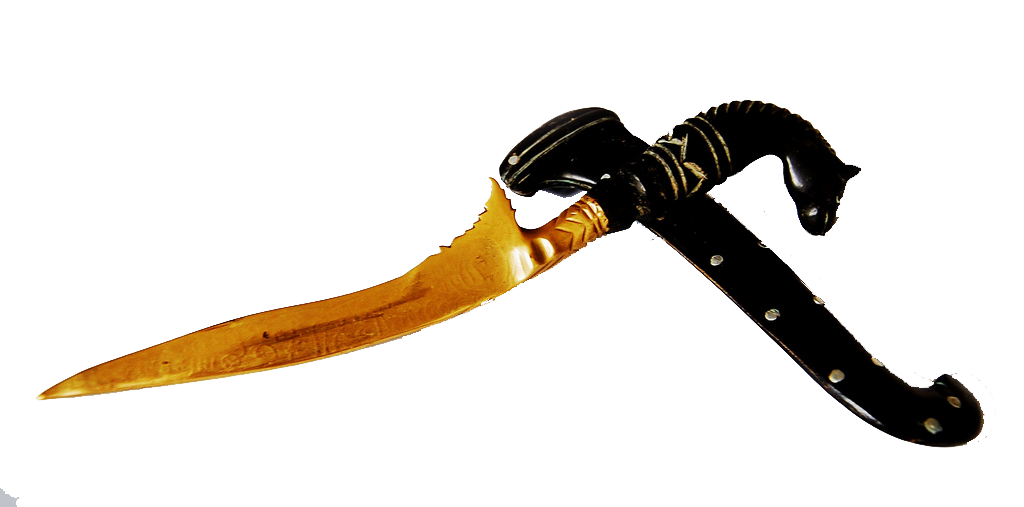
My grandfather passed away a few years ago, but I inherited the sword pictured in the album above. He served in the Dutch army during WWII against the Japanese. He never told anyone about it other than, what I presume to be, tall tales about taking it off a Japanese soldier in a combat situation. The family and I assumed it was a made up story for a young, impressionable, and wide-eyed grandson because my grandfather never saw action in combat, and served as a truck driver in army logistics.
Was wondering if any WWII history/sword buffs could tell me more about it, or point me to another sub-reddit that I could get more information from.
Want to know:
Hi there, Indonesian reporting in. The decoration on the handle resembles an Indonesian mythic creature -- well you could compare with this, it's called baruklinting.
A traditional Aceh weapon called rencong has similar shape with your sword.
This one comes from North Sumatra called Piso Surit.
If your grandfather was serving somewhere around Batavia, then it might also be a variant of a parang, traditional weapon from Jakarta. Here's another shape of parang.
Rencong and piso surit were traditionally carried as part of the attire of Indonesian men, and mostly used for emergency self-defense or a duel. These swords also symbolized the carrier's social status, charisma, or bravery, and indicated the owner's position in community.
Parang, on the other hand, was sort of more common weapon to carry, its usage ranging from cutting grass while farming to killing people on a battlefield. A parang used for battlefield is usually named sundang, and made by special pande besi (blacksmith) who has the magicsmithing ability called mantera sendawe besi specializing on making weapon for murder.
Nowadays this weapon is used for... err... mainly for mowing your lawn / farmland or for hunting. You can buy one for less than four bucks.
Sorry I can't provide definite info. I just thought the shape and the decoration are both very Indonesian.
Edit: Some people said it probably is a kris, but I'm pretty sure it's not. A kris blade will sharpen symmetrically at the tip, not on one side only. The shape should be straight and not curving slightly like the sword in the picture. A kris will have a smaller sort-of base between the blade and the hilt, and usually the blade will get wider on the base like this. The hilt shouldn't be directly connected to the blade. Another thing, a kris without luk (the curves) is usually a very old, antique kris, since it was the original shape of nowadays kris, before blacksmiths found a way to make the curvy form with at least three curves. That type of kris is solely made for killing purpose. As ancient blacksmith said, use the tip to stab, and the side to cut.
Edit again: so far the consensus is that it's a parang, though I don't know about the value, as usual parang shouldn't have an intricately carved hilt like that.
People in /r/swords might help you.
What steps should I take to better preserve the sword? As you can see it's in pretty rough shape
Do not polish it or try to clean it up or restore it in any way. This is a common mistake people make with antiques because they want them to look pretty, but it ruins the historical value and also the monetary value of the item. It looks old because it is old. Keep it out of direct sunlight, away from damp areas, and keep dust off of it and it should be fine.
It's probably Indonesian, as the design is definitely not Japanese or Western, and it looks to be decently old from the stitching along the scabbard and from the wear on the blade.
There are also definite European influences in the blade shape, though, as many traditional Indonesian weapons have squared-off blades or more severe angles in their design, while this is softly curved almost like a 19th century European dirk.
The best place to go with questions about provenance and preservation would be the closest natural history museum. Generally, I wouldn't undertake any sort of preservation or conservation effort without specialized training (I'm a trained archivist, and even I would be reticent to work on that sword without an expert), but the nice thing about the museum is that they should have contacts in the preservation world who they can refer you to. That sword is really cool, though, and I'd love to see what you find out about it!
It's most probably an Indonesian machete aka a Golok, Parang or Bedog.
http://3.bp.blogspot.com/-e2fAqPYhlKY/T7ho7ub_d0I/AAAAAAAAABE/BZ5lGXQA2nM/s1600/GOLOK+CARIBOU.jpg
If you look at the top 1/3rd of the blade you can see evidence of lots of use and grinding, and what looks like the remains of a wicked edge, while the bottom end visible in the picture doesn't look like it had much use (by comparison). That would suggest it's chopped through lots of something (probably vegetation) - you cut with the end of the blade, not the base. The length and blunt tip are also consistent with a Golok / machete as opposed to a sword (swords tend to be at least a little bit pointy to make with the stabby-stabby, and quite a bit longer).
They're not necessarily a primary weapon, and fighting isn't even necessarily their primary purpose, but they do have a hell of an edge and can deliver very very nasty cuts. There are schools of martial arts formed around machete fighting that are very popular in that part of the world, probably because due to the dense vegetation a lot of people carried a machete just for utility, but if a fight kicked off then people would use what's to hand. If you want to see how they are used in combat look up Escrima or Kali on youtube.
Edit: Regarding monetary value, I wouldn't get your hopes up, because as mentioned machetes are extremely common in that region. You never know though.
Edit edit: Some words.
Edit edit edit: Wikipedia has a good description.
I'm intrigued by the possibility of your grandfather serving in WWII in the Dutch East Indies (DEI). As he never saw action in combat I am much more inclined to believe he actually served during the so-called Politionele Acties (the Dutch offensives against the Indonesian National Revolution). Most of the Dutch forces in the DEI were interned during the Japanese occupation. While it's certainly possible that your grandfather survived Japanese captivity and then took this (probably Indonesian) sword from a Japanese soldier during the final stages of the war, I would argue that it is much likely he obtained it during leave sometime during the Politionele Acties.
My grandfather was in the Dutch korpskommandotroppen during the Indonesian rebellion following WWII. He obtained a dagger similar to that and it's called a "kris." I can post a picture of the one he gave me later of anyone is interested.
My instinct is that it is a decorative sword; I have seen many, many such swords in the Middle East that sport an Arab decorative motif, and this looks to be the Indonesian equivalent (I should mention, however, that there were European military sabres with lion-head hilts).
The main reasons I think this are:
The weapon looks too short to be a primary fighting weapon. I would guess a blade length of about 18" based on the pen for scale. That would make it slightly longer than a bayonet from that era; but those bayonets, of course, were meant to be used at the end of a fairly long rifle.
It does look like it could almost be long enough to be a cutlass, but the lack of hand protection means it likely wasn't designed to be one.
The grip looks to be too short for an adult hand to fit beneath the lion's chin. This would make it hard to hold securely during vigorous use.
Is the sword sharp? If not, does it feel like it had been sharp as one time and lost its edge from use? If so, there is a good chance that this was either a machete or indeed a fighting weapon. If not, that's pretty strong evidence that it was decorative.
Does the sword have any markings? If it was the property of any country's military, it would likely have insignia for that country and would almost certainly have a serial number.
Edit: Of course, when I say that it looks decorative, it may have some special ceremonial meaning that I know absolutely nothing about.
The staff at the Queensland Museum in Brisbane have always been really helpful with questions about wildlife, I think they enjoy a bit of a challenge and a break from their normal work. Contact someone in their anthropology department and they'll either gladly help you or point you to someone who can!
In no way do I want to diminish the answers already posted or discourage discussion, but you may want to consider a cross-post to /r/whatisthisthing. They normally specialize in the obscure, but sometimes they are outright wizards at giving people incredible detail on an object.
Hopefully the discussion here will add to the historical nature of most of your questions.
Neat sword, by the way!
That appears to be a relatively recently produced variant of a Kris. The short, heavily carved handle is fairly typical of this style of sword. Depending on the quality of its manufacture, it could have seen use as a machete by a private citizen. I think it's unlikely to ever have been worn in battle, but it's certainly possible that its owner carried it while fighting.
Based on the style of the scabbard and the blade, I would guess at it having been made sometime in the nineteenth or early twentieth century. I don't know enough to say anything else from just those pictures.
I need to dig it out of my pile'o'books, but I'm certain I read a book with a short, but informative section on this sword. I'll edit the title and author in once I get home and find the thing.
My (Dutch) grandfather also brought home a pair of similar swords from Indonesia. I've been told that the blades are poisoned though so you might wanna be careful with them if that's a possibility.