I assume that the Sahara served as a treacherous boundary that prevented the ancients from establishing trade routes between North Africa and sub-Sahara. Did that lack of cultures intermixing result in a very distinct and socially contrasted north vs sub-Sahara?
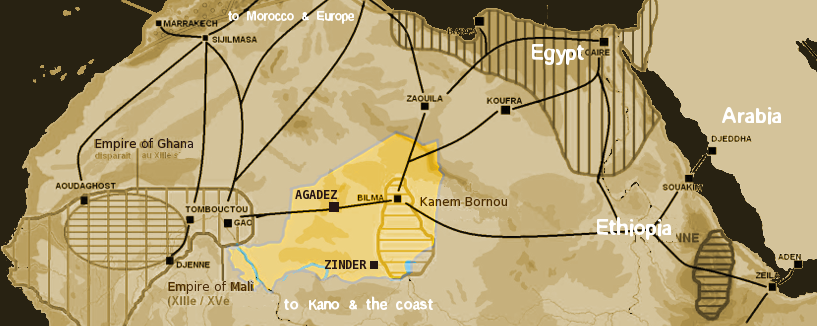
Trans-Sahara trade dates back millenia, but was particularly important during the reign of the Mali empire in the 15th century. At that time the extent of the network crossed from Mali to Morocco, Libya an Egypt (and on to Europe) and to Ethiopia and Somalia (and on to Arabia). Here is a map of the routes at that time and there is lots of good info on the wiki.
The Sahara actually wasn't that solid a boundary. Trans-Saharan trade often took place between North Africa and the Sahel region (Mali, Ghana, Songhai empires), hence the importance of cities like Timbuktu. West African goldfields like Bambuk actually provided a huge amount (I've seen estimates as high as half) of the gold in the entire Old World, prior to the discovery of American gold and silver in places like Potosi and Minas Gerais.
Rather than the Sahara presenting an insurmountable barrier between North Africa and the Sahel/Nubia/Ethiopia I'd say it was the excessively hostile terrain and climates south of the Sahel belt (Guinea, Uganda, the Congo, etc) that posed a real problem for travellers. Trans-Saharan trade routes and pilgrimages (Musa I of the Mali Empire went on a hajj to Mecca in 1324 accompanied by thousands of soldiers, heralds and slaves, bringing with him so much wealth in gold bars that he destabilised the economy of the countries he passed through) were pretty commonplace.
Other areas of Sub-Saharan Africa were also tied into the greater Old World trade network, for example the city-states of Somalia and the East African (Kenya, Tanzania, Mozambique) coast: Mogadishu, Mombasa, Ajuuran, Kilwa, Sofala, et cetera. They were more closely associated with the Indian Ocean trade and connected to China, Arabia and India rather than the Mediterranean.