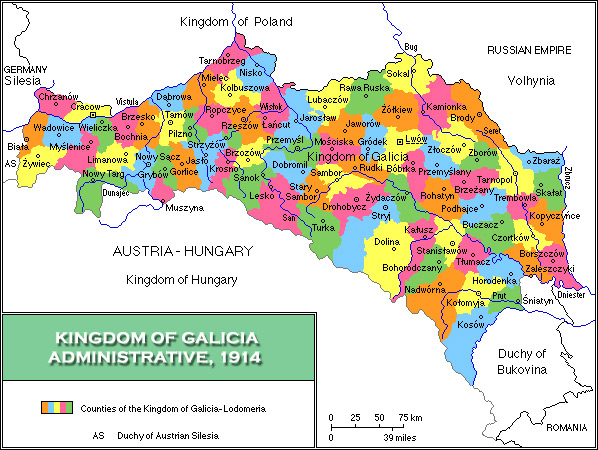
My family claims we are Ukranian, so I took a Russia & USSR history class during undergrad. I got really into it until I became confused after I signed up for Ancestry.com.
My great-grandfather's naturalization papers says he is from "Luzsek, Dolni, Austria-Galicia" and came here in 1903. His first language was Russian, and his second was English. He came to NY from a ship departing Hamburg Germany. He said he left as a "subject of the Republic of Poland" prior to wanting to establish permanent residency in the USA.
I found this wild map but cannot find Luzsek Dolni http://maps.geshergalicia.org/special/east-galicia-ethnographic-1939/
and this source may be useful, but sadly I've hit a roadblock after reading all the pages: http://www.halgal.com/findingvillage.html
Finally I tried Wikipedia http://en.wikipedia.org/wiki/Ignacy_Daszy%C5%84ski where I am now left wondering if I am Ukranian, Austrian, or Polish.
It looks like he fled before World War I judging by the timeframe. My history class described a ton of horrors that were going on there at the time. I would love to know where that village was, what they had run from and what their experiences were prior to coming to America (religion? farmers? etc.)
Thanks in advance for all of your help! Please let me know if I should post elsewhere.
You have linked an ethnic map made by Wołodymyr Kubijowycz. He was involved in the formation of the Ukrainian SS. To say the least he is parisan in questions of the ethnic composition of Galicia in 1939. All the placenames have been Ukrainized as well. Try to find a map of the Kingdom of Galicia Lodomeria printed by the Austrians. They preferred Polish placenames but used their own orthography, avoiding Polish letters. Here is an English language map from that period. Here is a German map. Neither is detailed enough.
Dolina county is in the South of Eastern Galicia. Look for placenames that begin with an L.
According to the 1910 Austrian census of the Kingdom of Galicia and Lodomeria a half of the population was Roman Catholic, a half was Greek Catholic and a tenth was Jewish.
edit: as to what concerns the self-denomination as a "Russian" in 1903 it likely just mean not Roman Catholic (and consequently Polish) and not German. In Austrian Galicia the locals would refer to themselves as Ruthenians ("Rusin") at that time which could be translated to "Russian". Amongst the intellectuals there were the Russophiles (called "Moskalophiles" by their enemies) who preferred to be called Russians and there were Ukrainian nationalists who preferred to be called Ukrainians. The former got massacred or fled to Russia during WW1.
sources:
John-Paul Himka, Galician Villagers and the Ukrainian National Movement in the 19th century, Macmillan in association with Canadian Institute of Ukrainian Studies:1988
Joshua Shanes, Diaspora Nationalism and Jewish Identity in Habsburg Galicia, Cambridge University Press:2012