And if not, why is that so when the hydrogen bomb is much more powerful?
The yield of nuclear weapons has been decreasing since the 1960's as better guidance systems have been introduced. The yield of the smallest H-bombs and boosted fission weapons deployed are much smaller than the largest A-bomb deployed, so yield is not the single criterion to consider. Weight and volume are probably more relevant considerations.
In the case of the UK, it seems that there are no A-bombs currently deployed, and it appears that the last one deployed was [Red Beard](https://en.wikipedia.org/wiki/Red_Beard_(nuclear_weapon)), retired in 1971. Historically, the UK has tended to rationalise its materiel to a small number of types whereas other countries have not, so it would not surprise me if the USA or USSR/Russia had maintained pure A-bombs to a later date.
The first generation of hydrogen bombs were multi-megaton in yield and extremely heavy. They could only be dropped from very heavy bombers. This means that they were not exactly the most nimble weapons and you don't always want megatons worth of power on any given target. So fission weapons were definitely still part of the American nuclear weapon inventory for many decades after that, especially in situations where you wanted flexibility in terms of yield (e.g. lower yields) and size or mass of the warhead (e.g. tactical nuclear weapons, or any situation where you wanted more than a couple bombs carried by a massive bomber).
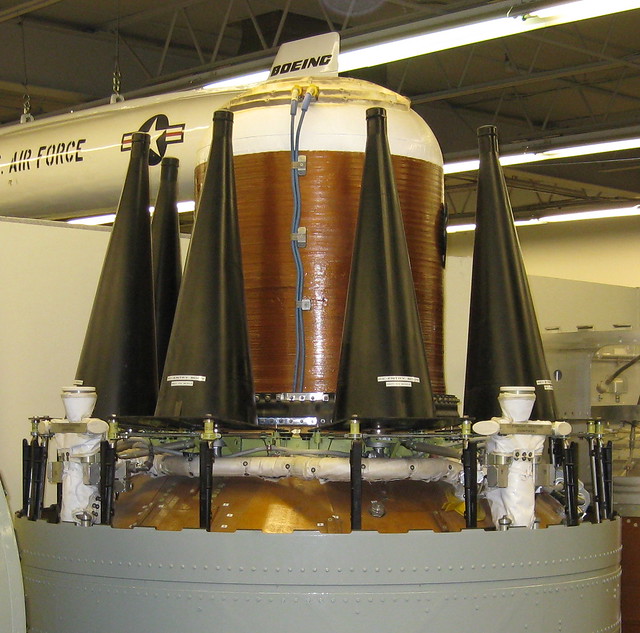
By the 1960s thermonuclear technology had changed enough that such weapons could be successfully miniaturized, and very compact hydrogen bombs were developed that had yields ranging from the hundreds of kilotons to a few megatons. These were used for both gravity bombs and missile warheads. This is why a modern B-61 is not a whole lot bigger than "normal" conventional weapons. (Compare that photo with, say, a first generation hydrogen bomb like the Mk-17.) It is also why they can fit lots of little H-bombs onto modern submarine-launched ballistic missiles.
If you want to get a sense of the variety of weapons that were fielded by the US, check out my warhead yield-to-weight graph. It charts the weapons deployed by their weight (y axis, log scale), yield (x axis, log scale), number produced (size), and date of introduction (color). The toggles at the bottom also let you filter by whether they are fission weapons or thermonuclear weapons. And you can filter by date to see how different periods had different varieties of weapons in play — e.g. the 1960s nuclear arsenal was characterized both by very light tactical weapons as well as very heavy thermonuclear weapons, but not a whole lot in between (because the technology for making fission weapons large had peaked, and the technology for making thermonuclear weapons small had not). The modern US nuclear arsenal is exclusively thermonuclear, and occupies a "sweet spot" in the dead center of the graph, which allows you to get a pretty good bang out of a pretty small package. (I have written more about the importance of the yield-to-weight ratio in understanding the evolution of the nuclear arsenal here.)
The last non-thermonuclear weapon fielded by the US was removed in 1993; the B-57 was a lightweight tactical nuclear weapon that relied primarily on fission for its yield (though it used a little fusion for boosting purposes). It was developed in the early 1960s. The last fission weapon developed by the US was the W79, a very lightweight linear implosion design that was used as a nuclear artillery shell. It was deployed in 1981, and retired in 1991. The discontinuation of stockpiling large number of tactical nuclear weapons led to the removal of all existing fission weapons; now the smaller and flexible version of thermonuclear warheads (like the aforementioned B61) fill that role.
the second half of the question would be at home in /r/askscience.