A little broad and the question might be phrased badly. Basically, in medieval kingdoms what do we know about:
Armor? Were knights dressed in the stereotypical full-suit-lining-a-fancy-hallway, or was it more the chain mail armor? How effective was the armor?
Swords? I've read recently that they're lighter than most people would think. How practical were they against the types of armor?
Any other types of weaponry? Spears, pikes, arrows, etc. and anything that pop culture has missed out on?
Edit: I've been advised to name a time period. I'd say anywhere during the High Middle Ages, so roundabouts 1000-1300.
The first thing to bear in mind about the middle ages is that - especially if we're counting the entire 'dark ages' as the early middle ages, then the era spans about 1,000 years. But I'll try to answer from a context of the 11th to the end of the 15th century.
Armour - As we're covering a period of 500 years, the simple answer is 'It changed.'
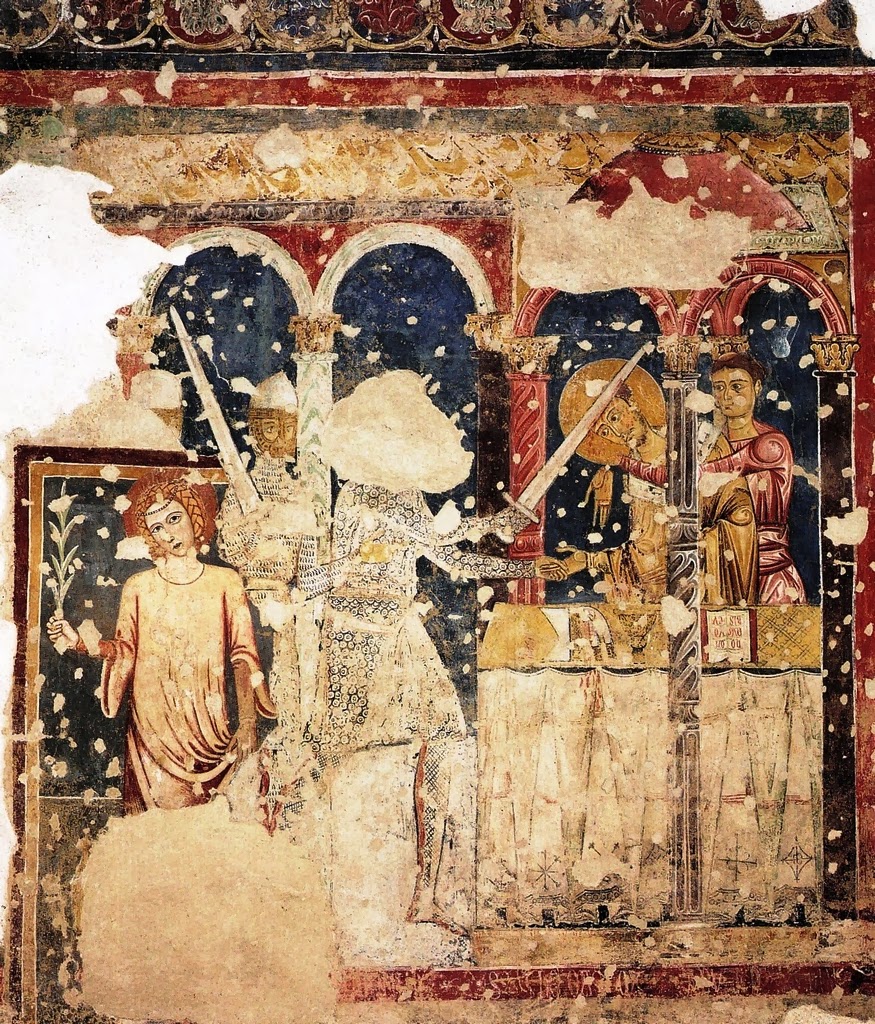
When the Normans conquered England, their early Knights (who rode small horses and used their spears as javelins rather than lances) wore maille hauberks - long, covering the full arm - or haubergeons - - 'little hauberk' shorter and covering half the arm - and the nasal helms that they're universally pictured wearing.
As the Knight becomes a heavier soldier in the 11th and early 12th centuries, his armour starts to cover more, and maille chausses are used to cover his legs, which were particularly vulnerable to infantry when mounted, and these were later extended to cover a knight's feet as well.
Another development in the late 12th century was added protection for a knight's head. First there were masks added to the front of helmets, like this which later evolved into proto-barrel helms.
By the time we're into the 13th century we start seeing knights like this who are pretty much fully encased in maille, the coif is tightly fitted over a 'secret' bowl shaped helm, and on horseback by the mid 13th century, the barrel helm fully encases a knight's head, at the cost of some visibility and ventilation.
Near the end of the 13th and into the 14th century is when we start seeing plate armour developing, initially in the form of the coat of plates, body armour which comprised of multiple plates of metal riveted into a linen coat, and into the early 14th century, plates of metal are used to reinforce armour in the limbs, and by the end of the century, we can see depictions of what can definitely be described as plate armour.
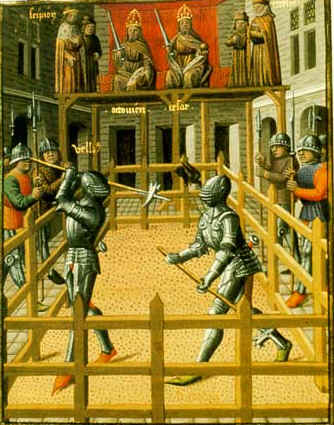
By the time we're into the 15th century, there are more refined plate harnesses, considerably more flexible and fitted to their user, rather than the suits seen decoratively, which - at their oldest - are poorly researched and made Victorian reproductions. Suffice to say, 15th century plate armour was a good thing to own on the battlefield.
The simple thing to remember regarding how effective armour was, is it was used. Maille armour was used for over a millenium, nearing two, and worn with a gambeson consisting of linen padded with layers of wool, a knight or soldier who could afford a hauberk would be nearly impervious to cutting weapons, so the best way of combating an armoured man in the high middle ages would be piercing him with a spear, lance or arrow, though even if the maille links burst open, there's a high chance that the point would fail to penetrate the padded cloth. There are accounts of crusaders resembling pin cushions for all the arrows that had stuck in their armour without actually penetrating their bodies.
When we get to plate armour in the late period, it was basically so protective that people who could afford the full armour eschewed shields (though they were still in use among common foot-soldiers who could only afford partial or mass-produced 'munitions' armour.) and the gaps in the plates were usually covered by voiders, strips of maille worn in certain places - such as the armpits and groin - just to provide more protection. They were slight vulnerabilities, and often targeted by people with piercing weapons, but they'd still provide plenty of protection. The main way of dealing with armour at this stage was to completely batter it with pole weapons like pollaxes and bec-de-corbins
Those two are two other types of weapons that I don't think you see much, but were very widespread in the late 15th century, given how effective they were as primary weapons.
Primary weapons were never swords throughout the medieval era, swords were sidearms, and pole weapons like lances or glaives were the first thing you'd go to in a battle, swords were popular for their versatility (the entire sword is a weapon, not just the blade) and ease of carry when travelling.
They were lighter than a lot of things will have you believe, especially Hollywood, where props like the sword in the Arnie Conan film weighed about 8kg, I'd guesstimate that my sparring arming sword weighs about 1.3kg at most, and that's not really historically accurate either.
Compared to my blunt weapon, a real sword not only tapers along the edge into the cutting blade, but many also had a distal taper which meant the blade was thicker at the base and gradually got thinner at the point, further reducing the weight of the weapon. Most blades in the Wallace Collection in London (which includes arming swords, longswords, rapiers and others) weigh less than 3lbs, therefore under the weight of my blunt modern replica.
One thing you may hear talked about with swords is the balance, which it's worth pointing out is entirely subjective. A balance closer to the hand means that a sword feels lighter and more maneuverable, but more weight near the end of the blade means it hits harder and cuts better.
Hopefully that answers more than a few of your questions, but I feel like I've probably rambled a lot and oversimplified a lot of stuff. If you have any follow up questions or anything you'd like expanded I'll try and answer to the best of my knowledge, but I'm sure there are plenty of people on the sub who'll have better specialist knowledge than I do.
You might wqnt to be more specific with the time period you are asking about. Arms and armor evolved quite a bit throughout the medieval age and it also varied by location.