My great grandfather (Jacob Carberry) was in the Canadian army during WWI. He supposedly served for 7 months in France. According to the documents given to me by my grandmother he was shot in the head during the battle of Ypres. After, he spent his two year recuperation in Clivenden Manor. Here he became very close with a Lady Nancy Astor. From what my grandmother tells me the two may have been seeing each other during this time period. Although we have no proof of an affair my aunt has many of the letters that were exchanged between the two over the course of their lives. Was there a specific battle of Ypres that was primarily fought by Canadian forces? Second, What was the significance of Lady Astor and the Clivenden Manor when it came to the recovery of wounded soldiers.
The two principal battles in Ypres were in 1915 and in 1917, the Second and Third Battles of Ypres respectively but the first of the two was the mostly Canadian one. It would be the first use of Chlorine Gas on the Western Front and it would be directed right at Canadian and Algerian troops. The Algerians would flee leaving a 6-7km gap in the line and the remaining Canadian troops would, quite famously at that, fill the gap and hold off the Germans for half a week until reinforcements could arrive. Here is a decent and cited overview of the battle which goes over the cliff notes. It's a bit of a 'what if' scenario, as the author points out, but without the Canadians efforts the Germans could have cut off over 50,000 Commonwealth soldiers; it was a integral battle posthumously given next to Vimy Ridge as a keynote event which Canadian identity was justified around.
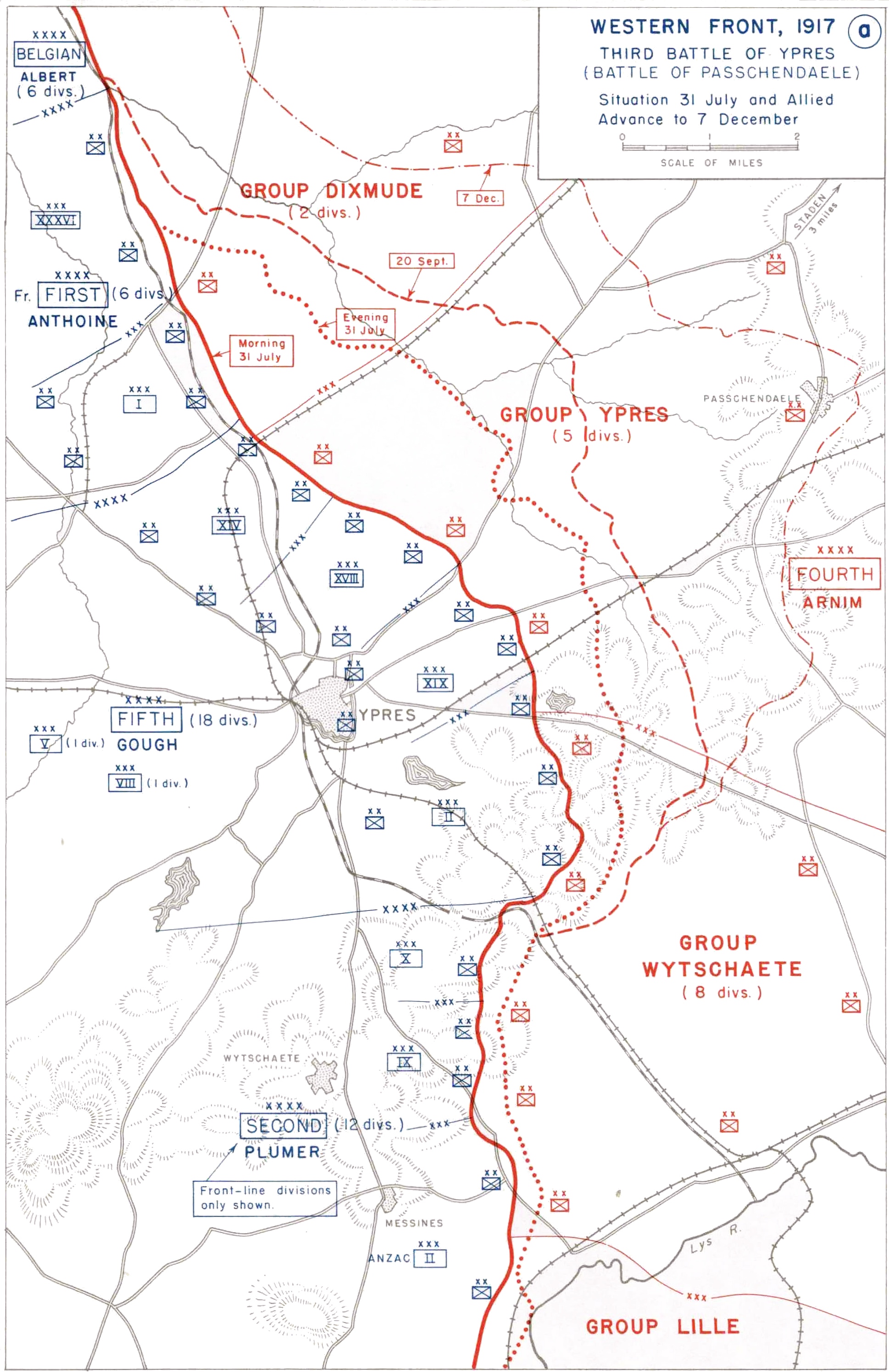
A great book which covers Canada's efforts in the Third Battle of Ypres, which he also very well could have been a participant of is "Shock Troops: Canadians Fighting the Great War, 1917-1918" by Tim Cook. My gut tells me this is actually the one your great grandfather was a participant in. You state he served for 7 months in France but for that to have occurred and for him to have to have been in France in September/October of 1914 which just was not likely whatsoever. The Third Battle was also a distinctly Canadian event: The target was Passchendaele and the Canadians were the ones chosen to take it and after what is called the most pointless operation of the war, almost without any excitement or flair, the Canadians just kind of capture it on the tail end of it all. A map of it shows that it was 'technically' a success but it was still a disaster. They took significant land in the first few days but then it just started to grind in the muddy, wet fields of Flanders.
The book I link above is a great work on it and I'd certainly look there first if you want more information on Canada's astounding performance in the war and their participation in this battle. If you want more on the Second Battle of Ypres I'd suggest Baptism of Fire: The Second Battle of Ypres and the Forging of Canada, April 1915 by Nathan Greenfield.
Second, What was the significance of Lady Astor and the Clivenden Manor when it came to the recovery of wounded soldiers.
Cliveden (pronounced cliv-den) is a rather over the top italianate country house on the borders of Buckinghamshire and Berkshire.
The Astors offered part of the estate to the British Army for use as a hospital at the beginning of the war. They declined, but the Canadian Red Cross accepted and as a result the Duchess of Connaught Red Cross Hospital was opened within the grounds.
Nancy Astor personally took some responsibility for caring for the wounded, so if your great grandad was sent there, its certainly likely that he would have become aquainted with Lady Astor - specially if he was an officer!
The hospital was demolished relatively recently, but a memorial garden still exists in the estate grounds (the house itself is now a hotel, but the National Trust has some degree of control over it and the estate).