How was Baroque art, specifically in Italy, influenced by political, economic, or cultural events leading up to and in the early 17th century?
So there are two major influences of Baroque art in Italy come the 17th century. The first, The Catholic Counter Reformation, and partly as a result of the first, second the legacies of High Renaissance greats, especially Michelangelo.
The Counter Reformation
I get the sense you're probably familiar with the Counter Reformation already, but for the benefit of anyone else reading this post, the Counter Reformation was the Catholic Church's response to the Protestant Reformation, where Northern European dissatisfaction with the Church culminated in a massive schism in the Catholic Church. The start of the Counter-Reformation can be comfortably attributed to the Council of Trent, which was something of a rallying point for the Catholics after being rocked by the Protestant Reformation. Though ostensibly a ecumenical council, any cooperation quickly vanished after what Protestant members attended were rejected any votes, thus making the Council of Trent a very Catholic affair. I'm no historian of religion so I apologize if I botch anything but I feel fairly comfortable in stating that at Trent, the Catholic Church sought to codify and reaffirm basic Catholic tenets, condemn Protestant values, to begin the purging of internal corruptions and most pertinently to the art world, to encourage a revival of religious art in the wake of centuries-long brewing secularization of art throughout the Renaissance, especially in contrast to the protestant reformation's rejection of religious art, considering the art subjects of the previous periods to be idolatrous and religious art itself to be representative of Catholic ideals.
Specifically at Trent, some basic guidelines were laid out for what art the Church should patronize in the future:
The art should be understandable to the common people, rather than being tailored solely to the tastes of the cultural elite. This was seen as essential to winning the support of the masses by delivering essentially was what as visual argument of utmost eloquence to any ordinary person of the Catholic Church's legitimacy.
Artists should focus on distinctive and deliberately contentious areas of Catholic dogma that the Protestants wholly rejected during the Protestant Reformation, such as the glorification of Mary mother of Jesus, or various saints that the Protestants saw as akin to polytheism.
Art should encourage piety and spiritual intensity.
Art should be delivered in a dramatic and compelling nature without illusion or decoration like the previous period of Mannerism.
Thus Italian and Spanish Baroque art can be seen as almost one side of a massive spiritual war where the battlegrounds were the hearts and souls of the masses. You have on the North, the Dutch and Flemish Renaissance with a rapid secularization of art in response to the perceived idolatry of previous art period, and then italio-hispania baroque art immediately afterwards rooted in the South, spurred by a sense of the dramatic and a return to High Renaissance ideals, heavily influenced by Michelangelo's sense of terribilita, to "shock and awe" those who viewed upon it and reaffirm the strength and non-plural nature of the Catholic Church-- as the one true church.
Mannerism
The High Renaissance represented to the artists immediately succeeding the period as the pinnacle of naturalist art. All technical and naturalist ideals had been achieved. There was no more "perfect form" to strive to, no higher truth, for the High Renaissance giants like the likes of Michelangelo, Titian and Leonardo had already plundered what truth in reality as they had already perceived. The "perfect form" could already be seen in real life on the canvases and in the marble flesh of those who came before. This new century of artist sought a new way to express art, and much like the post-impresssionalists, rejected naturalism as a sort of avant-garde movement where unconventional style and unusual presentation of traditional themes surface frequently. Thus, Mannerism, where the most prominent feature of the artwork of the period is the embracing of the "artificial" nature of the art and a something of a liberation from the "constraints" of Renaissance era naturalism. Where Renaissance artists sought to hide that fact and endeavored to reach as close to reality as possible, Mannerism made no attempts to hide its constructed nature. It is important to note here that Mannerism does not really hold as much of a influence over the succeeding Baroque period as much as the High Renaissance did, partly as a result of the Catholic Church's guidelines established at the Council of Trent. However, we can see something like proto-Baroque artists within the ranks of the Mannerists, Tintoretto, for example, who aimed to combine the color of Titian with the style of Michelangelo, can be caught using many elements of the later Baroque period would define itself, such as his dramatic use of perspective and lighting effects, which should be taken as something of a gentle reminder of the porous nature of defining artistic eras.
A Return To The High Renaissance moving forwards
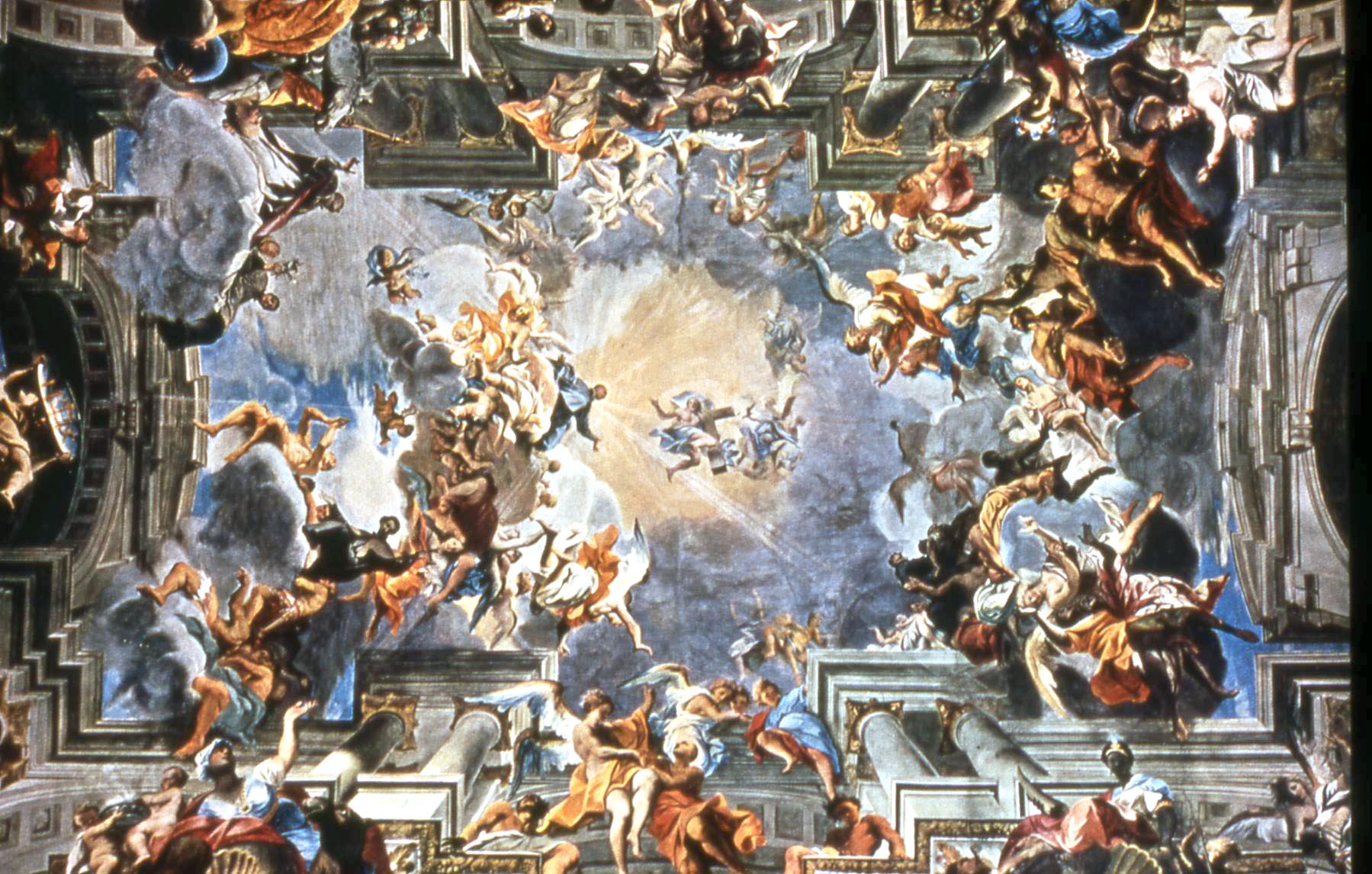
The Baroque period took a different tack from Mannerism, so to speak. Instead of rejecting codified norms in an attempt to embellish and elude reality, the Baroque period took the route of taking naturalism as a base and exaggerated the form of that naturalism, using bold motions and a extreme focus to detail to introduce drama and tension, awe and grandeur when upon viewing. This immediately calls back to mind Michelangelo's so-called terribilita, the ability of his art to strike terrible awe into the viewer, though executed during the Baroque period somewhat in a more heavy-handed manner. That's not to say it took nothing from Mannerism-- notably its asymmetric composition as opposed to the very balanced nature of Renaissance art, as well as a taste for art that did not strive for naturalism in art as the highest ideal, but instead infused emotion and dynamism into that art, shifting art away from reality in order to evoke human emotion. Amusingly enough there was something of a glut of ceiling frescoes during the Baroque period, one of the earliest, Annibale Carracci's Loves of the Gods (1597 - 1601) clearly takes after Michelangelo's Ceiling of the Sistine Chapel the most, visually and thematically, while as the Baroque progresses further and further we see something a bit like an arms race of the dramatic when concerning ceiling frescoes, moving down to Peitro de Cortona's Triumph of the Barberini (1633-1693) the ante is upped again with Giovanni Gaulli's Triumph of the Name of Jesus and then finally culminating in Fra Andrea Pozzo's ridiculous Glorification of Saint Ignatius (1691-1694) which is in my mind about as close as he could have gotten unless he all but tore the roof open and built a skyscraper to heaven himself. Each ceiling fresco after Carracci's seemingly keenly aware of the shadow of the Sistine Chapel looming over them and desperately strikes out a vision of the nearly ludicrously dramatic and undeniably different to the Sistine Chapel so not to be deemed an inferior of Michelangelo.
Sources
Fred S Kleiner, Art Through The Ages High Renaissance and Mannerism in Northern Europe and Spain, Early to Late Paraque Period