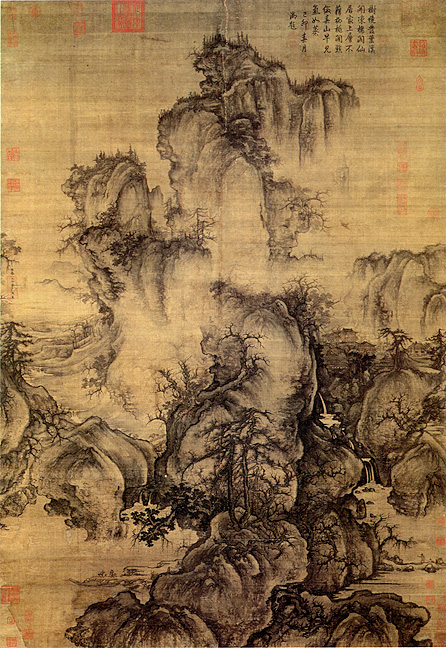
Oh I got this! So to understand Chinese Art from around the time of the Middle Ages (1000-1500, specifically the work of the Song Dynasty), one has to understand the purpose of Chinese Art and the artists who did it. Around this time, the ideas of Confucius and Lao Tzu's (Confucianism and Taoism, respectively) began to affect the Chinese public. We'll look specifically at how they affected the artwork. These stressed harmony and order within oneself and with nature. (Fun fact! Chinese people at the time stressed the 'Confucian on the outside, Taoist on the inside' ideology). This harmony with nature came out in their work in their ink wash style and became the subject of the pieces of that time.
I am getting ahead of myself. We need to know who the artists were. In China, the 'literati' as they were called were the highest class of society, sort of a reverse pyramid as we know in the European societal ranking system. They were the scholars and literates of society, and thus they could write calligraphy well. Calligraphy was seen as the highest form of art in Chinese society, later transferring to their 'shan-shui' pieces. (Shan-shui means earth-water, or nature scenes) They saw it as a type of meditation, reflecting the Confucian and Taoist ideology of inner peace and order. The two most famous literati of this time were Guo Xi and Ma Yuan.
So we now know that calligraphy was the highest form of art/work in Chinese society and that philosophical ideas came out in Chinese calligraphy. However, just looking at characters would be pretty boring. So they added pictures! Their skill in calligraphy transferred to their ability to draw nature because of the skill they acquired with their hands from the calligraphy. To further reflect Taoist ideology, they began to draw imaginative scenes of nature to achieve inner peace. The best example of this is Guo Xi's Early Spring. Now you may notice the calligraphy at the top right. This is called a 'callophone.' It's a poem based on beautiful sounds in Chinese rather than the words themselves. This was important because Chinese artists are recognized by their handwriting. (They never signed their works, but were recognized by their brushstrokes! Pretty cool! The exception is Guo Xi, who did sign his works with his name.)
I sort of just went off here! My ideas probably were all over the place. I am just excited there was finally an Art History question! I can go much more in depth if you want, but I am pressed for time right now.
tldr; Chinese works of the Song Dynasty stressed the ideology of Confucius and Lao Tzu, specifically the harmony with nature. The literati were the artists (former calligraphists) and were able to transfer their skills of writing to their skills of drawing using black ink and white scroll, the whitewash style.
EDIT: I have a couple things to add. I guess I was under a few assumptions. The typical medium for calligraphy was ink on black scroll before the time period talked about so it just carried over. I should also state that a major emphasis of the literati in their work was the hyperbolization of nature and the minimilzation of human influence. This point can be said especially about Ma Yuan's Dancing and Singing. You can see the massive landscape artwork (waterfalls, bamboo, trees, etc.) in the foreground and at the very better you can see minuscule peasants returning from work overjoyed. It all ties back to the ideas they had regarding nature and the nobility of man.