Assuming that she was, was her influence limited mostly to the upper classes, or would the middle class and peasantry also attempt to imitate her?
Did her influence mostly stay contained to France, or was it international?
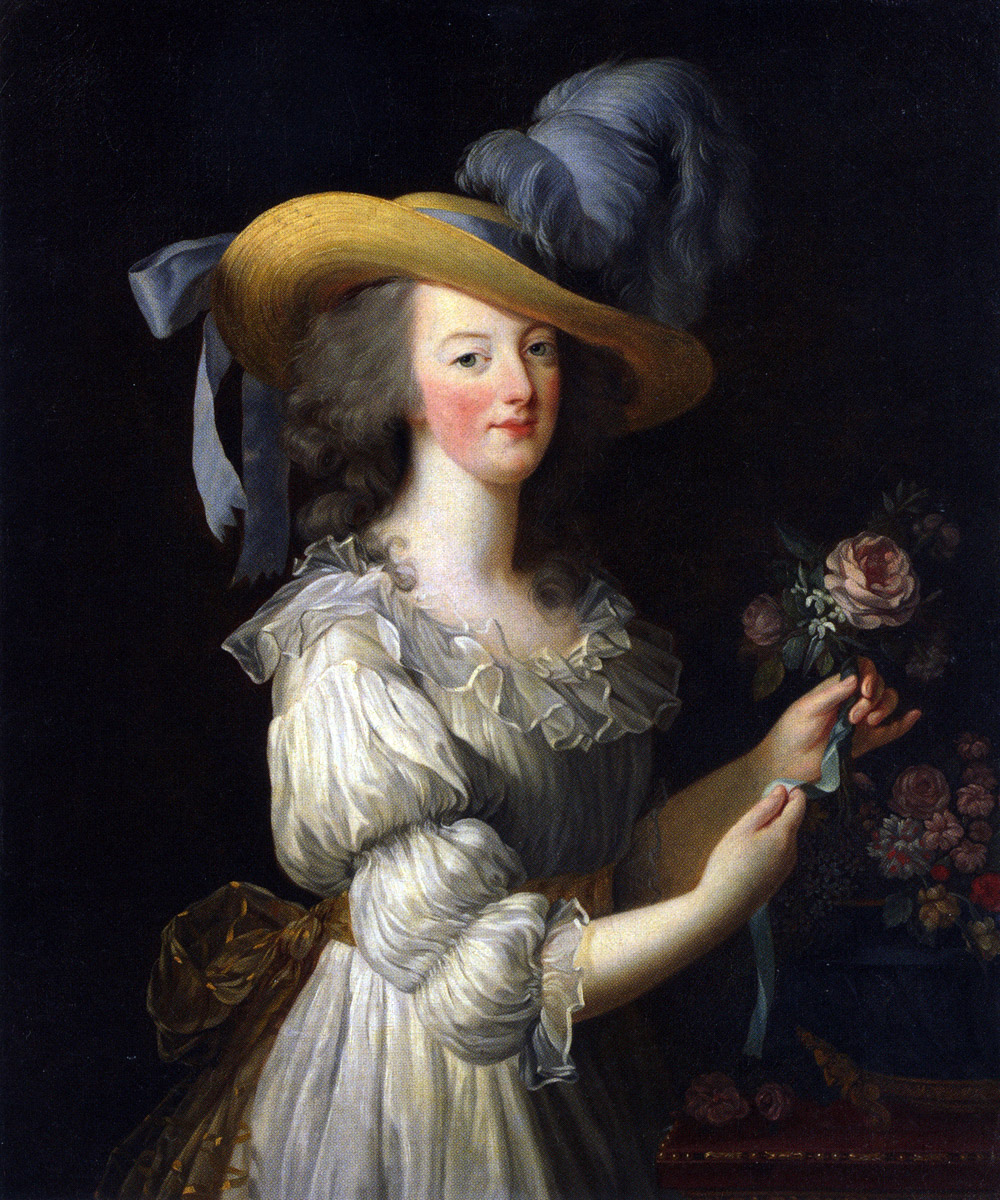
Here's a tidbit I researched recently: Sometime around 1780's, Marie Antoinette started wearing very simple white muslin dresses in Petit Trianon made by her dressmaker Rose Bertin (you should read more about her if you want to understand more about Marie Antoinette's influence on fashion). It was inspired by dresses worn by women living in the West Indies. She then posed for this portrait in 1783 and caused a scandal because people thought she is posing in her underwear as it was so simple and different from what she usually wore. This kind of dress is called Gaulle or chemise de la reine (some historians say there is a distinction between the two, namely gaulle has tight sleeves while chemise de la reine has loose sleeves; while other historians say there isn't a distinction). In addition since muslin were imported back then she was accused of being unpatriotic for not supporting the French textile industry.
In England, Georgiana, Duchess of Devonshire received one sent by Marie Antoinette (in this painting she is wearing a tight sleeve version) (English painter George Romney painted a lot of women wearing this style). Newspapers and magazines were fascinated by the steady adoption of the style and in November 1784, the Morning Herald wrote the following:
'Ladies of the first style adopt it, and gentlemen patronize it. The Chemise de la Reine, in which Mrs (Mary) Robinson appeared at the Opera, is expected to become a favourite undress among the fashionable women, who are either by necessity or inclination put to their shifts, the ensuing winter!'
By 1790 both English and French women started adapting the white muslin dress en mass and the fabric continue to be the top choice for clothes for the next few decades.
Hi /u/Georgy_K_Zhukov, thanks for the question! This question is far more complex than many realize, so I'm going to use only one example of how far reaching Marie-Antoinette's influence was on a particular style of clothing.
Marie-Antoinette was indeed a huge influence on fashion during her reign, and in that sense, yes, she set the trends for fashionable women from the wealthy middle classes up to her personal sphere. By Antonia Fraser's account, she was known for having a creative eye for fashion but typically paid heed to her advisors and friends as to what the next big fashion trend was. As she was so visible, arguably the woman who set the standards for all of Western Europe, she gets credit for "originating" styles of clothing such as the chemise à la reine (as /u/cecikierk mentions below), but if you scratch the surface there, you realize that Marie-Antoinette was not the originator of the style in the least. She made it famous by dint of being Queen of France (some would argue that she made it infamous, as I'll describe below).
Clearing aside all other fashion that Marie-Antoinette made popular during her life at Versailles, it's really the chemise gown that is essentially the uniform of the Trianon crowd (the elite women and female artists who surrounded Marie-Antoinette) and subsequently becomes a rallying cry for her detractors. It all hinges on this 1783 portrait of Marie-Antoinette by Elisabeth Vigée-Brun. After about 1784, this style of dress becomes known as the chemise à la reine, however it had been going by a number of different names prior, usually known only as a gaulle, chemise, or a chemise à la [insert famous person's name]. It is the dress that becomes so firmly associated with Marie-Antoinette that, leading up to the events that would become known as the Affair of the Necklace, the conwoman Jeanne de la Motte dresses a prostitute in a chemise gown to masquerade as the queen in order to swindle the Cardinal Rohan out of an embarassingly substantial amount of money.
(It's also the center piece of my thesis, so I'm slightly partial).
The story of Marie-Antoinette and the chemise à la reine begins with Madame du Barry, former mâitress en titre to the previous king, Louis XV, who came from a very common background and was the first inhabitant of the Petit Trianon. She was an early patroness of Vigée-Lebrun, and appears in one of the earliest Vigée-Lebrun portraits of the chemise gown, dated to 1781. This is critical to note because du Barry's reputation had always been heavily sexualized, so depicting her in a uncorseted, gauzy white dress with her hair unstyled wasn't that shocking for someone who had once been the focus of the King's incredible sexual appetite.
One of the key arguments I make in my thesis (sorry for the self-referencing here) is that Marie-Antoinette came to be associated with the chemise gown only after the gown itself had come to be associated with women like du Barry. This was problematic in the eyes of the French people (aristocracy and commoner alike) who seemed to be ticking off associations between Marie-Antoinette and the previous royal mistresses until they could no longer abide by their queen following so obviously in the footsteps of women like du Barry. These transgressions were many. To name but a few that occurred in the last quarter of her reign: The Petit Trianon, Marie-Antoinette's haven away from Versailles, was built for Madame Pompadour but was first inhabited by du Barry after her predecessor died before it was complete. The Porcelain Trianon, the larger pink palace on the same grounds, had been built for an earlier mistress, the Marquise de Montespan. Both Trianons were firmly associated with licentiousness and sexual over-indulgence from the start, and when the Petit Trianon was passed to Marie-Antoinette, it was seen as the King confusing his queen with the role of a mistress. Then you factor in the chemise gown, a style of dress that had been floating around for a few years by the late 1770s, that was similar in style to the types of cotton frocks worn by Creole women in the French Caribbean, and had come to fashionable French society by likes of du Barry, the ballerina Guimard, and others of their station, and it's now being publicly endorsed by the Queen of France in one of her official portraits at a juried show by the Academie...? It was not a good PR move, to put it mildly. When the portrait en chemise was revealed at the Paris Salon in 1783, the outcry forced the king to have it removed. Vigée-Lebrun replaced it shortly thereafter with a more formal portrait of the queen in a similar pose.
It’s all downhill from there for the queen, however. While the chemise gown implied a desire on the Marie-Antoinette’s part to “downsize” and simplify her clothing expenditures, as well as the growing influence of Rousseau’s ideal natural woman, she appears damned if she did and damned if she didn’t. Leaving aside the uproar caused by the silk weavers in Lyon who demanded reparations for destroying their trade by making imported cotton muslin all the rage, there were other, graver issues that came about in the wake of the 1783 salon. The backlash against the portrait en chemise apparently caused Marie-Antoinette to abandon it entirely, and thus marks the beginning of the end of the Trianon era. The queen makes a conscious effort to dress and appear more queenly from 1784-onwards, but the damage appeared to be irreparable in the wake of the Diamond Necklace Affair, in which her enemy Rohan was cleared of all wrongdoing, and the con artists at the center of the plot either escaped entirely or received light punishments. Indeed, Marie-Antoinette had expected the trial to clear her good name, but instead, it did the opposite in the court of public opinion. The image of a conniving foreigner queen, seducing an upstanding blue-blooded French aristocrat to satisfy her lust for jewels, and then trying to pass the blame to a couple of petty criminals was wholly inaccurate, but it’s the story the public latched on to, much like her association with “let them eat cake.”
To be continued...
I'm not sure "trendsetter" is a word that can be applied to Marie Antoinette. While, as /u/cecikierk relates, she was instrumental in the dissemination of the chemise gown out from the inner circle of aristocratic ladies, her relationship to fashion was more about supporting the French luxury industry and her position. Fashion magazines of the time referred much more habitually to actresses and the clothing they wore when describing the most up-to-date ensembles.
Very very broadly, prior to Marie becoming queen, women of all classes wore the same cut of gown with small variations, made out of fabric that suited their pocketbooks and stations, and being fashionable was more a matter of looking your best than adapting to quickly-moving trends. In the 1770s and 1780s, quite a few totally new styles arose that didn't require more fabric but were nevertheless marked as Gowns For The Wealthy: turques, circassiennes, polonaises, levites, etc. As far as I know, there is no research that supports Marie as having anything to do with promoting them, but she did wear them. According to Mme Campan, one of her ladies, every day she wore one formal court gown, one of these "undress" fashiony gowns, and one slightly less formal court gown. So what she wore only had the potential to influence the dress of those who were wearing high-status gowns in the first place. (The same goes for hairstyle, where you actually would see a lot more quickly-changing trends, since a hairstyle cost a lot less than a gown!) There was a lot of satire and criticism aimed at women of the working or middle classes dressing above their station, but they were only aiming upwards generally, not specifically mimicking her.
The chemise gown certainly went international, due in part to her gift to Georgiana Cavendish. Marie Antoinette is also thought to have had much to do with stereotypical tall hairstyles with accessories in them (here are some great examples), again through Georgiana, but only the general idea of higher and more decorated hair left the highest French circles.
There's a fantastic book on Marie Antoinette and her clothing: Queen of Fashion: What Marie Antoinette Wore to the Revolution, by Caroline Weber.