I should probably begin by stressing how the colonisation of Ethiopia was a relatively short-lived affair lasting a little less than five years, from 9 May 1936 to 5 May 1941. Therefore, Ethiopia did not quite receive the same influx of colonists and public investments than the other - and arguably more developed - parts of the Empire (Eritrea and Libya come to mind) despite Mussolini's ambitious plans.
1) Let's spend some words on the colony's organisation first. After its conquest Ethiopia became part of the Africa Orientale Italiana, or A.O.I. (Italian East Africa, which also comprised Eritrea and Somalia), and was put under the authority of a Viceroy - who was also in charge of the A.O.I. as a whole. King Victor Emmanuel III became the self-styled (and internationally unrecognised) Emperor of Ethiopia - having usurped that title from Hailé Selassié, who never renounced to it - and two years later, Benito Mussolini was reluctantly appointed First Marshal of the Empire...
...a title he had to share with the King himself due to a legal quibble.^1
2) The newly-created colony was soon divided into four Governi, or governorates:
Addis Abeba: the most central, least populated (300,000 inhabitants, most of whom locals) and arguably the most secure governorate of the whole lot, being under the direct rule of the Viceroy.
Amara: NW of the colony, bordering both Eritrea and the British possessions (Sudan).
Galla e Sidamo: Arguably the biggest, it was located in the west, between the capital and British Kenya.
Harar: located in the colony's NE, it bordered both French and British Somaliland plus Somalia proper.
The governorates were ruled by governors appointed by the viceroy himself; these were further divided into commissariati, residenze and (sometimes), vice residenze - which were just about the smallest administrative units around. Due to the lack of an official census in the colony (something the Fascist authorities bothered to apply to Italians only) the numbers of the Ethiopian population can only be guessed by estimate; the native population ranged anywhere from at least 6 to 10/12 million individuals, two thirds of whom were ethnic Ethiopians (Attilio Mori describes them as "Abyssinian") and the rest belonged to others as well as the Azebo Galla, whose warriors sided with the Italians during the conquest. These figures - the only, accurate figures we have covering the interwar period - are largely due to Mori's work on the Enciclopedia Italiana, but are unreliable. ^2
3) Whom did the Fascist government send to Ethiopia, and where?
Of course, Mussolini had grand plans for Ethiopia - and the depression of the Italian South, coupled with the economic sanctions levied against Italy by the League of Nations, made the situation even worse. Many people were therefore even more willing to get out of the country, and the Fascist government saw fit to re-route the migrational exodus towards its own colonies - mainly Libya and Ethiopia. It would take at least a decade (1932-1940) for the influx of immigrants, Southerners above all, to reach consistent numbers.
Angelo del Boca argues that early attempts at colonisation were unsuccessful because the prospective colonists saw too many dangers on their path, and thought that investing the few money available wouldn't have been profitable enough ^3 - but it is also worth noting that while the government offered free plots of land, the colonists had to pay for their expenses. However I think that the relative instability of other possessions such as Libya, whose brutal 'pacification' lasted until 1931, had a decisive role in discouraging people from immigrating in the colonies.
The Fascist State then embarked in an ambitious construction programme, which focused on the building of roads connecting the new colony with the rest of the A.O.I.; the railways were modernised (but only to a certain degree, and mainly between Ethiopia and what whas then known as the French Somaliland); hospitals and other public buildings were built as well. Many Italians were hired to to do the work, and even more joined them - this way, population skyrocketed from less than 5000 in 1936 to 40,000 in 1941.
4) What was the life of the colonists like? What about their relationship with the Ethiopians?
Many - if not most - of the resident colonists chose to live in the urban areas (especially Addis Abeba's), where they set up thriving activities of their own and only a fraction chose to get into the countryside^4 , mainly in order to work in the cotton plantations. There was a precise reason behind such a choice: the Ethiopian guerrilla was still alive and well, save for the territories held by the Galla - allies, as we said, of the Italians - as well as a few other parts of the country. The Ethiopians controlled most of the surrounding plateaus, thus making settlement there undesirable: colonial authorities would have needed some more years in order to 'efficiently' quell the rebellion (as they did in Libya), but the war prevented any such plans from coming into full effect.
On a more personal note - and I'm talking about the personal experiences of a close friend's grandmother, who followed her husband in Ethiopia - during the early years (until at least 1939) interracial relationships were not that uncommon, and she seemed to recall that cinemas weren't segregated yet. The Racial Laws, which forbade any such sexual relations, were enacted in 1938 but their application in the colonies was tardive and proved to be quite problematic to enforce.
Law enforcement was provided by the Polizia dell'Africa Italiana (P.A.I.), which had been created for the purpose.
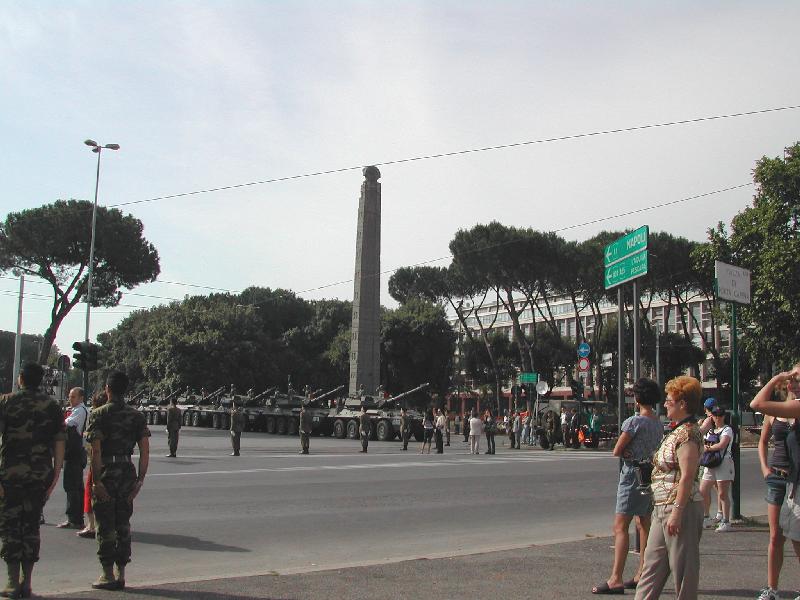
There were also many Italian-speaking schools, which the Ethiopians too had to attend, but these were short-lived and almost non-existent outside the major urban centres: however, many Italians ended up learning Amharic to some degree. Life in the plantations was hard - even moreso than in the urban centres - the work was exhausting and diseases such as malaria were rampant; mortality was a concern. On the other hand, the pay was good as the government actively encouraged people to immigrate. As far as culture is concerned, the Obelisk at Axum was cut to pieces and rebuilt in Rome - where it stood near the building of the former Ministry of Italian Africa (now the FAO headquarters) until 2005. Addis Abeba too was modernised with a few churches, avenues and other public buildings but not to the same degree as Asmara or Mogadiscio were.
5) What happened to the colonists afterwards?
Italy declared war on the Allies on June 10, 1940; British Somaliland was easily seized and our troops managed to hold out for the time being. However, by early 1941 the tide had changed and Prince Amedeo di Savoia-Aosta - the King's relative, as well as the last viceroy of Ethiopia and Commander-in-Chief of the Italian troops - fought a last stand at the Amba Alagi peak. 7,000 Italians (3,000 of whom were ascari, indigenous soldiers that is) held out for a whole month against 39,000 Commonwealth troops from April 17th to May 14th, 1941; after having run out of water and ammo, Amedeo sought the Duce's permission to surrender, which was granted on the 17th. The British conceded the Italians the honour of the arms, and Amedeo himself died as a POW in early 1942.
Addis Abeba had fallen a few days earlier.
Meanwhile, the colonists - led by Amedeo Guillet - aka "Commander Devil", a man with military experience - had started a guerrilla war against both the British and the Ethiopians, which lasted until October 1943: as a result, many Italians were put into concentration camps.
After the war, there were some 4000 of them left and were allowed to stay; however, after Hailé Selassié's 1974 deposition at the hands of Menghistu Hailé Mariàm and the USSR-backed Derg (junta), they were expelled and their property seized. Some sought refuge in Eritrea (federated with Ethiopia in 1952), others left and got back to Italy. Nowadays there are none and their histories are being forgotten, if they haven't been already.
All we've been left with are sad memories and a few Ethiopian restaurants in Rome.
^1 Gazzetta Ufficiale del Regno d'Italia n. 77 del 4 aprile 1938 - p. 1282, Legge n. 240 del 2 aprile 1938-XVI, art. 2.
^2 Attilio Mori et al., "Etiopia", in Enciclopedia Italiana I ed. (Roma 1932), vol. 14, p. 465.
^3 Angelo del Boca, Gli Italiani in Africa Orientale: La conquista dell'Impero, III ed. (Arnoldo Mondadori, 1999), p. 15.
^4 ibid.