Roman soldiers are always depicted in pictures and drawings as armored. How close is this to reality?
What do you mean by 'armored'? You mean in Lorica Segmentata(the iron banded, the classical representation of Roman Legionnaires)? As AceOfSpades70 said Roman Legions were very different across the time period of the Roman state (for the lack of better term).
For instance for what we can considered the "Polybian" system where we had the Legionary Infantry consist of Velites (skirmishers with only a shield to protect them, the poorest), Hastati (wore a metal heart-guarder, the youngest), Principes (armor covering the whole upper body except the arms and usually maille, the prime of their life) and the Triarii (the best armor which infantry could usually carry, mail/similar level of upper body coverage, greaves and still had their spears from the Camillian days). So aside from the Velites Polybian Infantry had varying level of protection depending on status as it was a Militia based system of 'bring whatever arms and armor you can afford' in comparison to the Marian reforms and onwards (though do not mistake this in terms of experience and capability, though that's another argument entirely).
With the Romans you are probably thinking of are the Cohorts during the Principate, I'd say Roman Legionnaires always had armor for certain (though not a historian so an actual historian can correct me on this) but not all of them had Lorica Segmentata (which arrived after the Marian reforms which had Legionnaires in maille) which is the classic pop culture view of the Roman Legionnary, some of them wore Lorica Hamata (maille) and some of them had Lorica Squamata (scale). I think the reason why Mail isn't represented is due to budget (actual maille, especially the real stuff) is expense to make and Lorica Segmentata can be represented cheaply without much cost. This probable choice has also resulted in anachronistic dates in some movies representing the Romans.
I hope this is accurate and useful enough, I probably got something entirely wrong and a Historian will shout at me :P.
Could you expand on your question? The western portion of the Roman Empire existed for over 1000 years with multiple Army reforms depending on the time period and a Roman soldier from the 300s BC would look drastically different from a Roman Soldier during the reign of Hadrian.
It depends, as has been mentioned. equipment varied throughout the period.
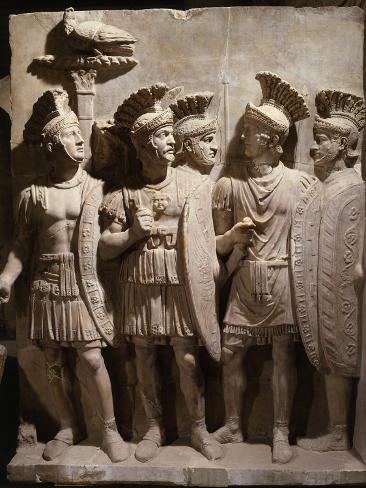
Roman soldiers are actually quite frequently depicted wearing no armour. This sculpture of the Praetorian guard in Rome shows them only wearing helmets for example. Legionaries performed functions in society as well, such as construction, and it would've been very unlikely for them to be armoured when building!
In the late Roman army there is some evidence that armour was less common but it isn't possible to say for certain whether soldiers were less armoured from the 3rd century. Vegetius mentioned the scarcity of armour worn by legionaries from Gratianus' reign in the 360s AD. This though is believed to reference only the eastern armies after the battle of Adrianople in 378. In this battle practically the entire Eastern Roman field army was destroyed and the loss of equipment must have taken a while to replace. This can not be applied to the army across the whole empire though. In reliefs or mosaics, such as the one at Piazza Armerina in Sicily, soldiers are shown unarmoured. This mosaic shows soldiers hunting and it wouldn't be unusual for them to do that unarmoured.
It really depends on the period and what they were doing. Bishop and Coulston's book 'Roman Military Equipment from the Punic Wars to the Fall of Rome' is a very good summary of arms and armour throughout the periods and Southern and Dixon's 'The Late Roman Army' is worth a read for the later army.
Vegetius wrote that at his time many of the soldiers did not wear armor. However some scholars dispute this statement and say he was most likely exaggerating.