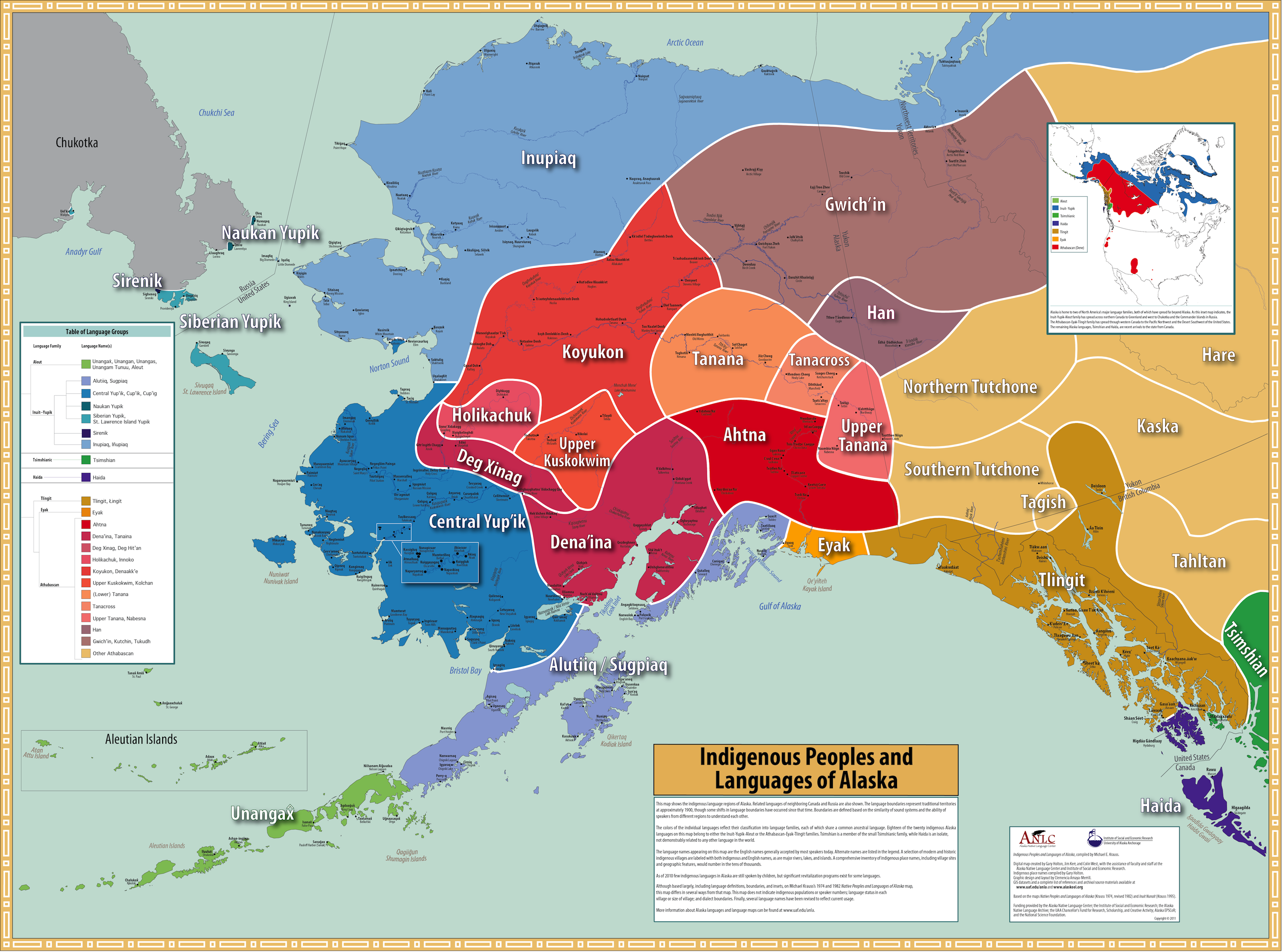
As you can see on this map, the Yup'ik live on both sides of the Bering Strait and made regular voyages between Siberia and Alaska until both the USA and the USSR banned such travel during the Cold War. The ban was temporarily lifted after the Cold War, but was quickly reinstated by Russia until last year.
In the mid to late 1600s, a Yazoo man named Moncacht-Apé criss-crossed North America; I wrote about his explorations here. While he was making his way up through the Pacific Northwest, he was told that if he continued onward, the land coast would take him northwest, then west, then he'd arrive at a narrow sea that cut the land in two. While not much was made about the land on the other side, that this waterway was described as dividing the land does imply knowledge of land beyond it. While Moncacht-Apé's explorations took place post-1492, it's certainly possible, if not likely, that the geographic knowledge he received while in the Pacific Northwest long predates his journey. Perhaps others who specialize in the region might know some more direct information concerning this.
At the time of Columbus' arrival the people of the Caribbean were certainly aware of North and South America and had at least intermittent trade contact with both. In fact, the peoples of the Caribbean trace their origins back to South America. When Columbus asked the Lucayans, the first people he encountered in the Bahamas (eight of whom he abducted to serve as interpreters), where the mainland was, what little they were able to communicate to the Spanish at the time indicated that they were pointing him in direction of South America, rather than North America. Considering that the Taino in Cuba regarded Florida as another island, albeit a large one, this probably isn't surprising. Among the scattered objects indicating continental trade and contact with the Caribbean are jade axes from Guatemala found in Antigua, a Taino axe found in Florida, a Taino spatula found in the Yucatan, and Warao canoes found on Dominica. See Curet's Islands at the Crossroads Migration, Seafaring, and Interaction in the Caribbean for more information on that front.
For more direct contact between North and South America, we can look to Central America. Chibchan peoples live in both Central America and Colombia, and from one of those - the Guna or Kuna - we get the term Abya Yala, the Fully Grown Land, as the name for the American continents (which they regard as a single landmass rather than two separate continents). At the time of Spanish contact, the Guna lived in Colombia, but have since settled in coastal Panama.
In ancient times, when Teotihuacan ruled central Mexico, there appears to have been trade between Mesoamerica and the northern South America, via maritime traders shipping out from Ecuador who brought spondylus shells north and, by 800 CE, also introduced Andean metallurgy to Mesoamerica.
Aware of other continents might be a stretch but awareness of other landmasses is most likely a yes.
There is evidence of contact across the Bering Strait at times. How extensive this contact was and whether it was simply a few hunters visiting another landmass or an actual trade route is unclear. However, I emphasize that this was probably not knowledge of continents so much as knowledge that there is land on the other side of the Bering Strait. A recently discovered bronze buckle shows a link between Alaska and China or Korea about a thousand years ago. The cast bronze buckle was likely made in China or Korea and then somehow traveled to Alaska before Columbus.
A previous thread has some good answers
There is also evidence of contact between the Thule people of Canada and the Viking settlements in Greenland. Again evidence of knowledge of a landmass but not necessarily knowledge of continents. It is possible that the Thule knew the Vikings had come from somewhere else but there is no evidence of this.
Interestingly, the accounts of Bernal Diaz, making his journey (along with Cortes in his company of Spanish soldiers) into the Aztec capital, speaks of the monumental riches possessed by Montezuma. In an attempt to explain the vast wealth possessed by Montezuma, Diaz recalled a great collection of exotic animals, including many different mammals, birds, reptiles, and fish. The majority of the animals mentioned were from North and South America, but a few on the list were not. The most important example I can think of was the Tiger, which is not native to North or South America.
Although, it is possible they were incorrectly referring to a predatory cat native to the Americas, such as a jaguar or a mountain lion, as a tiger.
Just finished reading "Cod". Basque fishermen were drying cod on the beaches of the East Coast long before Columbus. West Coast tribes had trade trinkets from the Orient. If they were not specifically aware of the other continents, they knew there were peoples from other cultures.